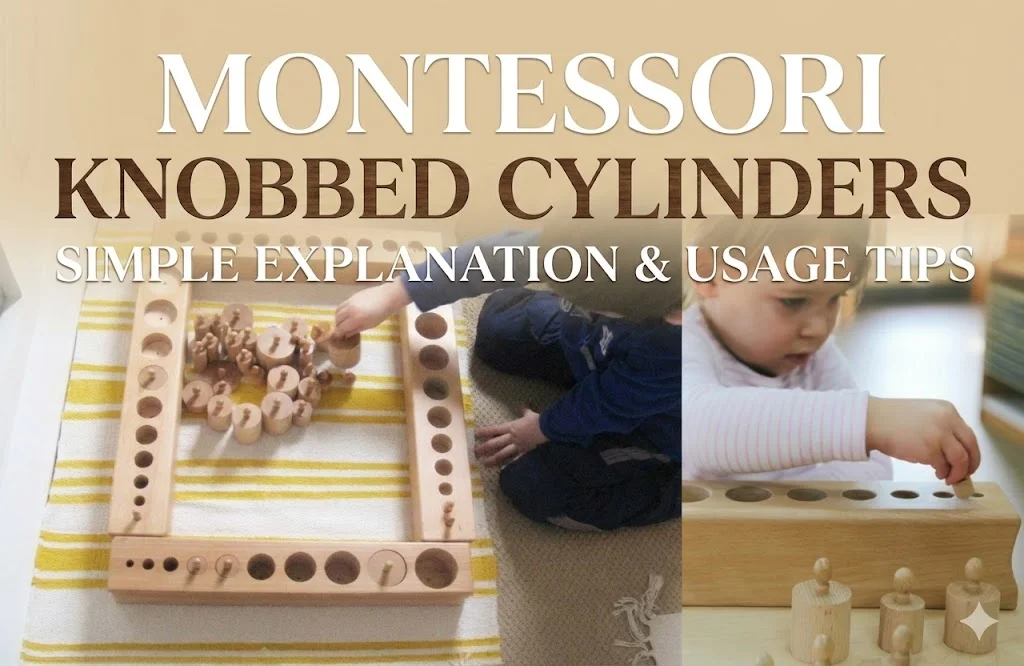
Montessori knobbed cylinders are a classic sensorial material made of solid wooden blocks with removable cylinders, each topped with a small knob for the child to grasp. The cylinders fit into matching holes in the block and change in size in a very precise way. As children lift the cylinders out and replace them, they quietly explore differences in height and diameter through both touch and sight, long before anyone talks to them about measurement or geometry.
You may see this material described with several names, including Montessori knobbed cylinders, Montessori cylinder blocks, knobbed cylinders, Montessori cylinders, and cylinder blocks Montessori. All of these terms point to the same idea: a set of ordered wooden cylinders that change in dimension and invite the child to compare, sort, and correct their own mistakes by trying again. There are no lights, sounds, or screens, only simple wood and a clear physical sequence that supports real concentration.
In the Montessori classroom, this material belongs in the Sensorial area, where children refine their senses and build an inner sense of order. By working with Montessori knobbed cylinders, the child develops a concrete understanding of bigger and smaller, taller and shorter, and thicker and thinner, which later supports more abstract work in maths, writing, and problem solving.
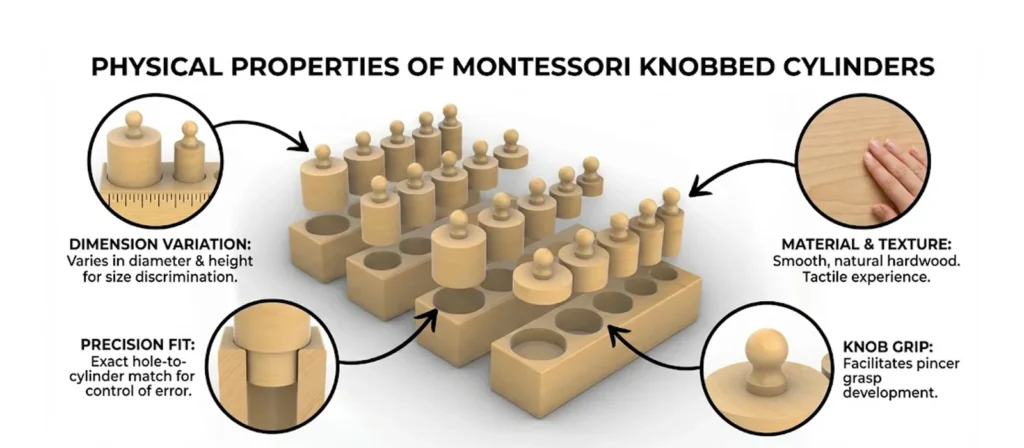
Physical Properties of the Montessori Knobbed Cylinders
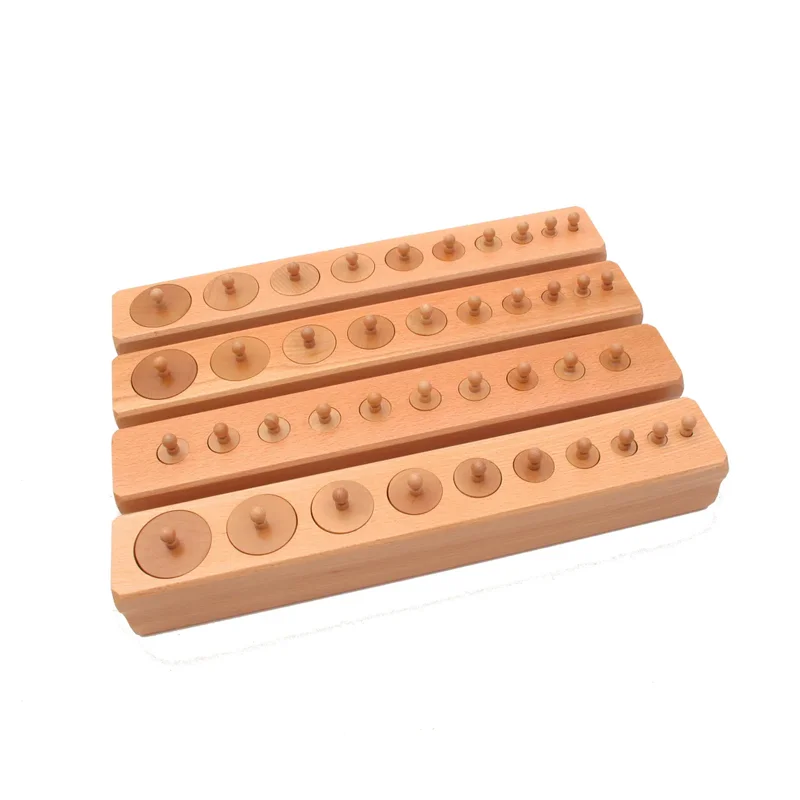
A standard set of Montessori knobbed cylinders is made up of four solid wooden blocks, often called Montessori cylinder blocks. Each block contains ten smooth wooden cylinders that fit into matching sockets in a single row. Every cylinder has a small round knob on top that invites the child to grasp it with a pincer grip and lift it straight up and down.
At first glance, the four blocks look very similar, but each one isolates a different way that size can change. Across the whole set, the cylinders vary in height, in diameter, or in both. This careful design allows the child to explore dimensions with the hands and the eyes at the same time, simply by taking out the cylinders, mixing them, and returning them to their correct places.
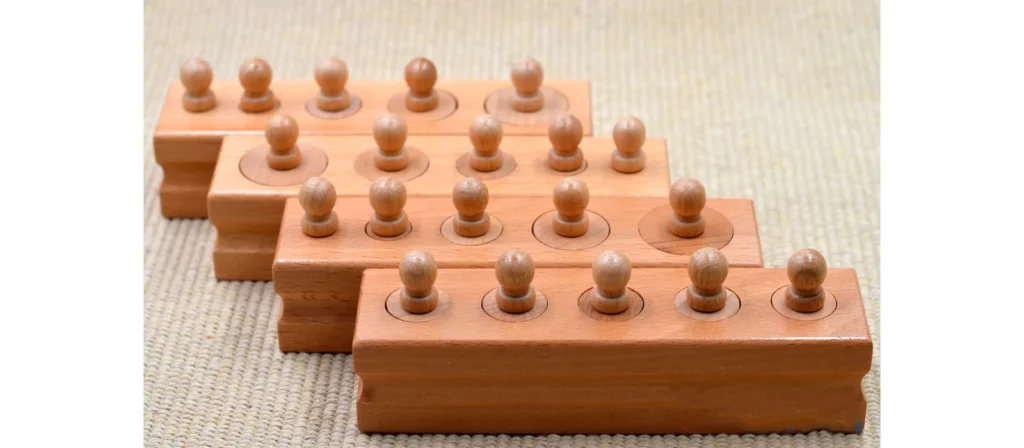
In a typical set of Montessori cylinders or cylinder blocks, the four blocks are arranged as follows:
- Block 1: height and diameter increase together
The first block shows cylinders that get both taller and wider from one end of the block to the other. Starting at the smallest cylinder and moving to the largest, the child sees and feels that each new piece is a little higher and a little thicker than the last one. - Block 2: diameter increases, height stays constant
In the second block, all ten cylinders are the same height, but their diameters increase step by step. They look like a row of cylinders that are equally tall yet gradually become thicker. This isolates width as the only changing quality and helps the child focus on thin versus thick. - Block 3: diameter increases while height decreases
The third block is more complex. As the cylinders become wider, they also become shorter. One end of the block holds tall, narrow cylinders, and the other end holds low, wide ones. The child has to notice two opposite changes at once, which encourages careful observation and logical thinking. - Block 4: height increases, diameter stays constant
In the fourth block, all cylinders share the same diameter, but their heights increase in regular steps. They appear like a family of columns that are equally thick but grow steadily taller. This isolates height and supports a clear sense of taller and shorter.
Together, these four Montessori cylinder blocks give the child a complete sensorial experience of dimension. By working with the knobbed cylinders, the child builds a deep, concrete understanding of size relationships that later support work with measurement, comparison, and early geometry.
How to Use Montessori Knobbed Cylinders Step by Step
Using Montessori knobbed cylinders is easiest when you follow a clear, repeatable routine. Think of it as three parts: preparing the space, giving a careful first presentation, then stepping back so the child can explore the Montessori cylinder blocks independently.
Setting up the material
- Prepare a clear workspace
Choose a small table or floor mat and remove other toys so the Montessori knobbed cylinders are the only focus. This tells the child that this is a special, purposeful activity. - Place one block on a low shelf
Put a single Montessori cylinder block on a low, open shelf with all ten cylinders in order from smallest to largest. This makes the material visible and reachable, which supports independence. - Invite the child with simple language
Walk to the shelf with the child, point gently, and say something like “This is the cylinder block”. A short, clear invitation respects the child and keeps their attention on the Montessori cylinders. - Model careful carrying
Show how to lift the block with two hands and carry it slowly to the workspace. This step teaches respect for the material and shows the controlled movement you want the child to imitate. - Position the block for success
Place the cylinder blocks Montessori in front of the child with the knobs facing them. This simple orientation makes it easy for small hands to reach and grasp each knob correctly.

Presenting the activity
- Show the pincer grip clearly
Sit beside the child and use your thumb and first two fingers to hold the first knob. This highlights the pincer grip that Montessori knobbed cylinders are designed to develop. - Remove each cylinder with slow, identical movements
Lift the cylinder straight up, pause briefly, and place it gently on the mat above the block. Repeat with each one, forming a neat row. The repeated, careful motion teaches control and order through your example. - Pause to let the child observe the empty block
When all the cylinders are out, rest your hands and look quietly at the empty Montessori cylinder block. This short pause gives the child time to notice the pattern of empty holes and prepares them for the next part. - Demonstrate silent trial and error
Pick up the first cylinder, try a hole, and if it does not fit, remove it without comment and try another hole until it slides in smoothly. This shows that mistakes are solved through observation, not through adult correction. - Complete the block with the same calm rhythm
Replace each remaining cylinder in the same way until the block is complete. A steady pace and quiet body language show the child that this work is peaceful, not rushed or stressful. - Invite the child to take a turn
Turn slightly toward the child and say “Now you can try”. This signals clearly that it is their turn and hands responsibility over to them.

Letting the child work and handling mistakes
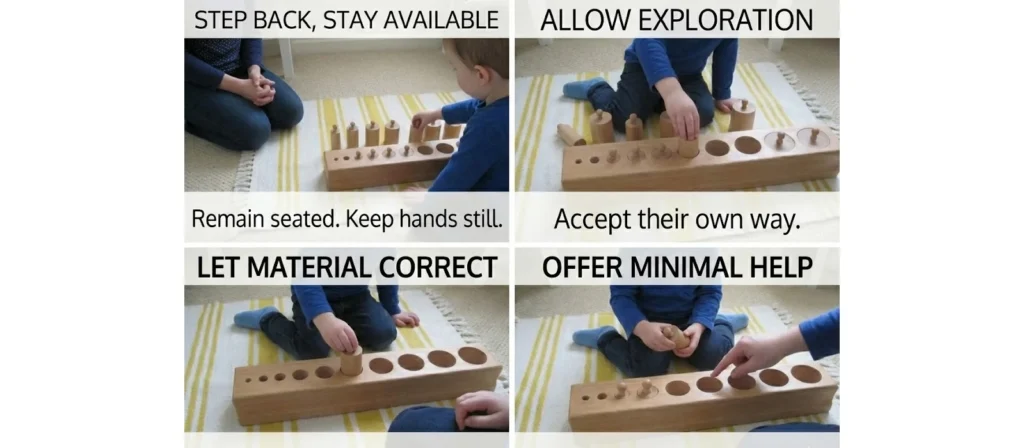
- Step back but stay available
Remain seated nearby and keep your hands still. This gives the child space to explore the knobbed cylinders Montessori material while still feeling your supportive presence. - Allow individual exploration
Accept that the child may remove cylinders in a different order, line them up in their own way, or mix them. This freedom is how they test and understand the knob cylinders Montessori set for themselves. - Let the material correct most errors
If a cylinder does not fit or sits too high, wait and let the child notice. The self-correcting design of cylinder blocks Montessori teaches the child to rely on their own eyes and hands. - Offer minimal, precise help only when needed
If the child becomes stuck or frustrated, you might say something simple such as “This one is not all the way down, you can try another hole”, then go quiet again. One short cue keeps the focus on the material rather than on you. - Guide the end of the work cycle
When the child seems finished, gently remind them to put every Montessori cylinder back, carry the block with two hands, and return it to the shelf. This step completes the cycle and teaches responsibility for the material. - Close without overpraising
A simple “Thank you for putting the cylinder block away” is enough. Let the satisfaction come from mastering the Montessori knobbed cylinders, not from big praise, so the child is motivated by the work itself.
What Children Learn From Knobbed Cylinders Montessori?
Visual discrimination of size and dimension
When a child works with Montessori knobbed cylinders, they constantly compare cylinders that change in height and diameter, which sharpens visual discrimination and helps them notice very small differences in size; across the four Montessori cylinder blocks, the child experiences many combinations of bigger and smaller, taller and shorter, thinner and thicker, and by putting each cylinder back into its correct hole, they build a clear inner sense of dimension that later supports understanding measurement, comparison, and early geometry.
Fine motor skills and pincer grip
Each cylinder has a small wooden knob that naturally calls for a pincer grip, so when the child lifts the Montessori cylinders straight up and replaces them with care, they strengthen the fingers, hand, and wrist, refining the precise movement needed for holding a pencil; over time, the simple, repeated grasping of the knobs on the knobbed cylinders becomes a direct preparation for writing, drawing, and other fine motor tasks that require steady control.
Concentration, order, and problem solving
The orderly layout of the knobbed cylinders Montessori material invites the child to follow a clear work sequence of taking the block from the shelf, setting it down, removing the cylinders, and returning them one by one, which naturally supports concentration and a sense of order, while the self correcting design of the cylinder blocks Montessori encourages the child to notice when a cylinder does not fit, think about what might be wrong, try another place, and solve the problem independently instead of waiting for an adult to provide the answer.
Indirect preparation for math, writing, and geometry
Although knob cylinders Montessori materials are not labeled with numbers, they prepare the mind for mathematical thinking by giving the child concrete experience with series, gradation, and comparison, and the changing height and diameter in the Montessori knobbed cylinders make later work with number lines, units, and measurement feel more intuitive, while at the same time the pincer grip and controlled hand movement developed with this material provide an indirect but powerful preparation for fluent writing and drawing.

Simple Tips for Using Montessori Cylinder Blocks at Home
How to adapt the material for a home environment
At home, you can keep Montessori knobbed cylinders very simple by placing one Montessori cylinder block on a low, open shelf where your child can see it and reach it independently, using a small table or floor mat as a defined workspace and offering the material at calm times of day, then quietly inviting your child with a short phrase such as “Would you like to work with the cylinders” and allowing them to choose, which keeps the cylinder blocks Montessori experience close to the Montessori spirit even outside a classroom.
Keeping the activity calm, clear, and inviting
To help your child focus while using Montessori cylinders at home, offer only one block at a time, clear other toys from the immediate area, move and speak slowly, and give a brief, clear demonstration without extra talk, then sit nearby but avoid correcting every small mistake so the knobbed cylinders themselves guide the child through their own trial and error, making the activity feel peaceful, respectful, and naturally interesting rather than like a test or a performance.
When to put the material away and offer it again
If your child begins to throw the knobbed cylinders Montessori pieces, bang them loudly, or walk away repeatedly after a few seconds, it is usually a sign that they are tired, overstimulated, or not ready for this level of challenge, so you can calmly help them put the Montessori cylinder block back on the shelf, switch to a simpler or more physical activity, and then offer the cylinders again on another day when they are rested and curious, which keeps the material associated with success and quiet interest instead of frustration.
Bring Montessori Sensorial Learning Home
Ready to let your child explore size, order, and dimension with real hands-on materials? Start with sensorial classics like the Montessori knobbed cylinders and other beautifully crafted Montessori materials. Each piece is designed to build focus, fine motor skills, and deep understanding through quiet, purposeful work.
 Browse Sensorial Materials
FAQ About Montessori Knobbed Cylinders
Are Montessori knobbed cylinders necessary at home?
You do not have to own Montessori knobbed cylinders to support your child’s development, but they are a very rich material if you want to bring more Montessori style learning into your home, because one set of Montessori cylinder blocks offers long lasting practice with size, order, concentration, and fine motor skills, and many families choose to buy this material when they prefer one high quality, open ended activity instead of many short lived toys.
At what age is it best to use the cylinder blocks?
Most children are ready to explore Montessori cylinders somewhere between about two and a half and three years old, once they can carry a block safely, sit for a few minutes, and show interest in fitting objects into matching spaces, and they usually continue to enjoy and deepen their work with cylinder blocks Montessori through the preschool years as their control of movement, patience, and problem solving all grow.
Can I buy used Montessori supplies for knobbed cylinders?
Yes, you can use used Montessori supplies for knobbed cylinders Montessori work as long as the blocks are complete and in good condition, and it is important to check that all forty cylinders are present, that they slide smoothly in and out of their sockets, and that the wood is not cracked or badly damaged, because the control of error and precise fit of the Montessori cylinder blocks are what make the material so effective and satisfying for the child.

 Arabic
  English
  Korean
  Japanese
  Italian
  German
  Spanish
  French
  Thai
Thai