NQS Quality Area 3 furniture evidence in Australia is a file the nominated supervisor can hand over, not a Pinterest board for families. Quality Area 3 – Physical environment asks whether indoor and outdoor spaces are safe, suitable and used for play. ACECQA does not rate your brand. It rates the room the children actually use. If you are buying for a long day care, this page is the map from 3.1.1–3.2.3 to the purchase order.
Australia planning cluster: How to start a centre · Classroom furniture cost · Furniture checklist · Room layout · Sydney fit-out cost · CCS approved service · Table & chair height · Storage & cubbies · QA3 furniture evidence (this guide) · Startup cost Hub · Furniture Australia
Operator page — for the person who signs the purchase order
Quality Area 3 physical environment is not a parent tour script. ACECQA rates whether indoor and outdoor spaces are fit for purpose, maintained, inclusive and resourced. This page turns those five elements into furniture evidence: what to order, what to photograph, and what to write in the QIP before assessment and rating.
There is no NQS-certified furniture sticker. Millimetres sit on the table and chair height e storage guides. Square metres sit on room layout Australia.
What to collect before the assessor walks in
Pick the role, IL stage and the room. You get a furniture evidence list you can drop into the QIP or the assessment folder. This is not an ACECQA form and it does not award a rating.
What Quality Area 3 Actually Rates
The current National Quality Standard has two standards and five elements. The wording below is ACECQA’s, not a paraphrase you can hide behind. Read the Guide to the NQF – Quality Area 3 and the NQS Quality Area 3 page before you write a QIP sentence.
| Element | ACECQA concept | What the furniture file must show |
|---|---|---|
| 3.1.1 | Fit for purpose — outdoor and indoor spaces, buildings, fixtures and fittings are suitable, including access for every child | Child-height tables, chairs and open shelves the shortest child in that NQF room can use without an adult fetching. Inclusive access is a layout and SKU choice, not a poster. |
| 3.1.2 | Upkeep — premises, furniture and equipment are safe, clean and well maintained | A maintenance log. No wobble, no cracked edges, no mould in cubbies, no “we will replace it after rating.” Assessors fail dirty or broken pieces in the first minute. |
| 3.2.1 | Inclusive environment — spaces organised and adapted so every child can participate in built and natural environments | Zones a child can enter without climbing a locker bank. Indoor–outdoor threshold that is not blocked by a table run. Sightlines for educators. |
| 3.2.2 | Resources support play-based learning — multiple uses, sufficient number, every child can engage | Quantities against licensed places, not against a catalogue photo. One home corner for 22 preschoolers is a 3.2.2 problem. |
| 3.2.3 | Environmentally responsible — the service cares for the environment and supports children to become environmentally responsible | Repairable solid timber, spare parts, not a landfill of snapped plastic in year two. This is operations, not a green sticker on the carton. |
West Shore does not sell an “Exceeding pack.” Exceeding themes are about embedded practice, critical reflection, and engagement with families and community. Furniture can support those themes. It cannot buy them.
National Regulations That Sit Under the Furniture Line
IL Education and Care Services National Regulations are the legal layer. Quality Area 3 is the quality layer. Buyers mix them up and then order the wrong thing.
- Regulation 103 — premises, furniture and equipment safe, clean and in good repair. That is 3.1.2 in legal clothes.
- Regulation 105 — sufficient furniture, materials and developmentally appropriate equipment for each child being educated and cared for. That is 3.2.2 with a regulation number.
- Regulation 107 — at least 3.25 m² unencumbered indoor space per child. Areas permanently set aside for storage or sleep are out. Moveable children’s tables usually stay in.
- Regulation 108 — at least 7 m² unencumbered outdoor space per child at a centre-based service. Loose-parts stores and fixed sheds are not play floor.
- Regulation 113 — outdoor space that lets children explore and experience the natural environment. A plastic playhouse row is not a substitute.
- Regulation 115 — premises designed to facilitate supervision. Tall furniture that hides a door fails here before it fails 3.2.1.
- Queensland unencumbered-space guidance is a widely used reading of the same indoor/outdoor test: lockers and walk-in stores deduct; low movable program furniture usually does not.
IL room layout Australia guide is where you draw 3.25 m² and 7 m². This page is what you put on that drawing so Quality Area 3 has something to photograph.
Element-to-Furniture Map (What Goes on the Purchase Order)
Write SKUs against elements. A single “classroom package” with no quantities is how you fail 3.2.2 after you have already spent the money.
| Buy this | Primary element | How many | Do not |
|---|---|---|---|
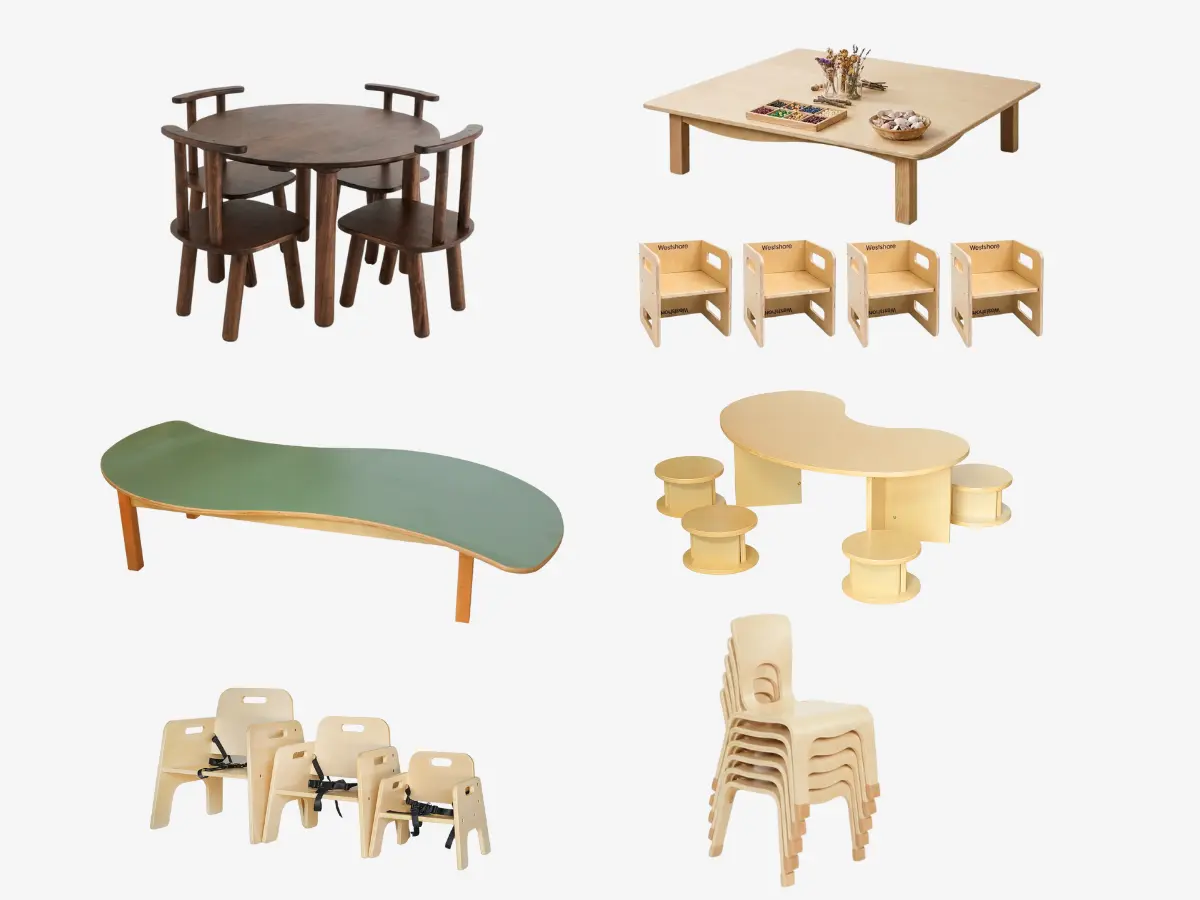
| Tables and chairs by NQF room | 3.1.1 + 3.2.2 | Toddler/preschool: one child chair per licensed place + two spares stacked. Spec the 150–200 mm seat-to-table gap. | One height for 0–5. Adult chairs pulled up to child tables. A U.S. inch chart copied onto an Australian PO. |
| Arrival cubbies / coat lockers | 3.1.1 + Reg 107 | One section per licensed place, hallway or cloak if the building allows, 1.2 m aisle. | Park the run in the play rectangle and count it as unencumbered space. |
| Low open program shelves | 3.2.1 + 3.2.2 | Two or three bays per zone, child reach, trays visible. Part of play, not a store room. | Adult-height closed cupboards in the room so educators fetch every resource. |
| Home corner / dramatic play | 3.2.2 | Enough for the group that actually uses it at once — not one sink unit for 22 children. | A display kitchen that children are not allowed to touch. |
| Educator observation seat | 3.1.1 + Reg 115 | One adult-height seat off the child tables, on the sightline. | A staff chair in the middle of the construction zone. |
| Outdoor loose-parts store + child-height table or bench | 3.2.1 + 3.2.2 + Reg 108 | Movable. Photograph it in use. Keep it out of the 7 m² calculation if it is a permanent shed. | Treat a branded playground as the whole of Quality Area 3 outdoor. |
| Lockable adult cupboard | 3.1.2 | One per room or a shared staff store. Chemicals and records never on top of cubbies. | Adult stock on a high shelf above the book corner. |
Factory classroom ranges sit on preschool classroom furniture. The buy-list is the Australia furniture checklist. AUD room ranges sit on cost to furnish a classroom.

Need 3.1.1 and 3.2.2 written on the schedule?
Send the floor plan, NQF room ages, licensed places and opening or assessment date. West Shore returns a 2D/3D layout with quantities, millimetres and which pieces are deducted from 3.25 m².
Get the QA3 furniture scheduleThe 12-Minute Assessor Walk (Furniture Only)
The 2026 NQS Assessment and Rating Instrument still asks the authorised officer to record evidence against each element. They do not need your mood board. They need a room that works.
- Door. First photograph is the assessor’s eye-height. If the first thing they see is bags on the floor, 3.1.1 is already in trouble.
- Reach. They watch a child get a tray. If an adult has to fetch it, that is 3.2.1, not “we like a tidy shelf.”
- Seat. They sit, or they watch a meal. Shoulders up means the gap is wrong — use the height guide, do not argue millimetres from memory.
- Count. They compare chairs and home-corner seats to the children in the room, not to licensed places on a poster in the office.
- Sightline. They stand where the educator stands. A tall locker that hides the outdoor door is Regulation 115.
- Upkeep. They run a hand along an edge. Cracked laminate and missing glides are 3.1.2. There is no speech that fixes a wobble.
- Outdoor threshold. They look at 7 m² after sheds and stores, then at whether there is actually something to do that is not a fixed climber.
If you only have time for four photos: door, child reach at a shelf, meal table with feet supported, outdoor loose-parts edge. Date them. Put them in the assessment folder.
The Evidence Pack: Photos, QIP, Maintenance
Quality Area 3 fails in the file as often as it fails in the room. Educational leaders write “stimulating environment” and attach a catalogue. Attach this instead.
| File | Owner | What “good” looks like | What gets ignored |
|---|---|---|---|
| Furniture schedule by room | Approved provider / FF&E | SKU, millimetres, quantity, which NQF room, indoor vs outdoor, deducted vs play furniture | A supplier quote with no room names |
| Layout with 3.25 m² / 7 m² | Architect or West Shore drawing | Furniture drawn. Arrival lockers marked. Sleep furniture on a deducted hatch — not specified here. | A marketing floor plan with sofas and no dimensions |
| Photo set (dated) | Nominated supervisor | Door + each zone + outdoor edge, child eye-height, no stock filters | A twilight reveal of an empty room |
| Maintenance log (90 days) | Nominated supervisor | Date, piece, fault, action, who signed. Broken chairs tagged out of the room. | “We wipe on Fridays” with no record |
| QIP notes for 3.1.1 / 3.2.2 | Educational leader | One improvement with a date, a quantity and an owner | “Continue to provide a beautiful environment” |
Real rooms we have furnished in Australia are on the project pages — Sydney, Everwood, Adelaide. Use them as a visual check, not as a rating claim.
Outdoor 7 m² Is Element 3.2, Not a Playground SKU
The remaining outdoor spoke in this cluster is not a second article on Regulation 108. That calculation already lives on room layout Australia. Quality Area 3 outdoor is whether the space you kept is actually used.
- 7 m² is unencumbered outdoor space per child at a centre-based service under Regulation 108. Confirm exclusions with the approving authority. Waivers exist; do not assume one.
- A permanent shed, bike store or fixed cubby that is not play space is not 7 m². Draw it, then deduct it.
- Element 3.2.1 wants built and natural environments. Shade, dirt, water and movable seating do more for QA3 than a single branded climber.
- Element 3.2.2 still wants quantity. Ten children and two watering cans is the outdoor version of one home corner.
- Fixed playground equipment is a different budget line. Cost context sits on preschool playground costs — it is not a substitute for furniture evidence.

What Exceeding Looks Like on the Furniture Line
IL Guide to the NQF Exceeding themes are practice, not product. If you want furniture to support Exceeding for Standard 3.1 or 3.2, the file has to show more than a new delivery.
- Embedded. The same millimetres and quantities appear in the orientation pack, the QIP and the purchase order. Casual staff can say why the toddler chairs are 260 mm.
- Critical reflection. You changed a SKU because children could not reach, or because 3.25 m² died, and you wrote the date. A colour refresh is not reflection.
- Families and community. You can show that a family using a wheelchair, or a child who needs a different seat, changed the layout — and the furniture still leaves unencumbered space.
Do not tell an authorised officer that a factory is “Exceeding approved.” That sentence wastes the visit.
Purchase-Order Fails That Still Look Like Quality
- “NQS certified” on the quote. There is no such certification. Strike it.
- Adult-height open shelves styled with baskets. Photograph well. Fail 3.1.1 when a three-year-old cannot reach.
- One beautiful home corner. Fails 3.2.2 at 15+ licensed places.
- Lockers in the play rectangle so the hallway stays pretty for tours. Fails Regulation 107 and the storage spoke.
- Matching furniture in every age room. Fails the height guide. Toddlers at preschool tables hike their shoulders.
- Outdoor as a climber only. Fails 3.2.1/3.2.2 even if 7 m² is mathematically there.
- Buying after the joinery is fixed. Chairs cannot recover a room that already ate 3.25 m².
- CCS as the furniture budget. CCS does not pay for this. Keep capital on a capital line.
Where This Page Sits in the Australia Cluster
- Room layout — 3.25 m² indoor and 7 m² outdoor, sightlines, what is deducted.
- Table and chair height — millimetres, 150–200 mm gap, chair counts. That page should also rank for “childcare tables and chairs.”
- Storage and cubbies — hallway vs room, one section per place, hook millimetres.
- Furniture checklist — the buy-list once the drawing is frozen.
- Cost to furnish a classroom — AUD ranges, not a rating claim.
- Childcare furniture Australia — the commercial landing. “Childcare furniture” as a search term belongs there, not here.
Startup path: how to start a centre · startup cost Australia · Sydney fit-out cost. Import timing and GST: landed cost. Catalogues: 2026 catalogues.
Send the floor plan, licensed places by NQF room, and whether this is a new opening or an assessment window. West Shore returns a layout and a quantity list you can put in the QIP folder.
Related Australia guides
- Childcare startup cost Australia
- How to start a childcare centre in Australia
- Cost to furnish a childcare classroom in Australia
- Childcare furniture checklist Australia
- Childcare centre room layout Australia
- Childcare centre fit-out cost Sydney
- CCS approved childcare service Australia
- Childcare table and chair height Australia
- Childcare storage and cubby planning Australia
- NQS Quality Area 3 furniture evidence Australia
- Childcare furniture Australia
- Preschool playground costs
Domande frequenti
Is there NQS-certified or ACECQA-approved childcare furniture?
No. ACECQA does not certify furniture brands or SKUs. Quality Area 3 rates how the service uses, maintains and organises indoor and outdoor spaces. A catalogue stamp that says “NQS certified” is marketing. Write millimetres, quantities, maintenance and a layout that still leaves 3.25 m² indoor and 7 m² outdoor unencumbered space.
What furniture evidence do assessors want for Quality Area 3?
They want what they can see and what you can show: a current furniture schedule by room, photos from the door (the assessor’s first view), a maintenance log for broken or dirty pieces, the layout that proves 3.25 m² and 7 m² after furniture is drawn, and QIP notes that name 3.1.1, 3.1.2 and 3.2.2 in operator language—not a parent brochure.
Does ACECQA set legal millimetres for tables, chairs or cubbies?
No. Element 3.1.1 is fit for purpose, including access for every child. Element 3.1.2 is that furniture is safe, clean and well maintained. Millimetres on this cluster are commercial planning bands. Use the table-and-chair height Australia guide and the storage Australia guide, then fit-test the children in that room.
Do tables and chairs count in the 3.25 m² unencumbered indoor space?
Moveable children’s tables, chairs and low open shelves used as part of the program are usually treated as furniture, not as an area permanently set aside for storage. A locker bank, walk-in store or sleep furniture that is permanently set aside is deducted under Regulation 107. Draw both on the layout before you freeze the purchase order.
How does outdoor 7 m² relate to Quality Area 3 furniture?
Regulation 108 is the outdoor unencumbered-space test. Element 3.2.1 and 3.2.2 ask whether that space is organised, inclusive and resourced for play—not whether you bought a branded playground. Loose-parts storage, child-height outdoor tables and movable benches sit on the furniture schedule. Fixed playground structures sit on a different line. The room-layout Australia guide is where 7 m² is calculated.
Can a room that photographs well still fail Quality Area 3?
Yes. Assessors walk sightlines, reach, quantity and upkeep. Adult-height shelves, one home-corner set for 22 licensed places, cracked laminate, and bags parked in the play rectangle all fail in person even if the Instagram crop looks calm.
Does CCS pay for Quality Area 3 furniture?
No. CCS is a family fee subsidy. Furniture is a capital or operator line. Keep it on the furniture schedule, not on a CCS worksheet. See the CCS approved service Australia guide for the operator path.
When should a centre import the QA3 furniture program?
After the layout is frozen and 10–14 weeks still fits opening or the assessment window. Production, ocean transit, a licensed customs broker, GST and inland delivery all sit in that window. On a full classroom program, operators commonly land 30–50% under comparable local retail once freight and tax are in the comparison—not on a six-chair top-up.
Planning guidance for approved providers, nominated supervisors, educational leaders and procurement teams. Confirm current National Regulations, your jurisdiction’s assessment and rating process, and the children who will actually use the room. This page is not legal advice and it is not an ACECQA rating.