

Why Baby Vision Matters More Than You Think?
In the first few weeks of life, a baby’s vision is limited and still developing. Newborns can typically see just 8 to 12 inches ahead, and their eyes are still learning how to focus, track movement, and perceive contrast. Supporting this early visual development is crucial, as it lays the foundation for 운동 기술, coordination, and learning.

Montessori Mobiles are specifically designed to align with this natural progression. They feature simple shapes, high-contrast colors, and slow movement to gently engage a baby’s attention without overstimulating their senses. Unlike traditional mobiles, they are intentionally minimal to encourage calm and focused observation.
Most commercial baby mobiles include fast motion, bright flashing lights, or multiple sounds. These features, while entertaining for adults, can easily overwhelm a developing nervous system. In contrast, Montessori mobiles prioritize one sensory input at a time, usually visual, helping infants process information at their own pace.
Each mobile in the Montessori series supports a different milestone in visual development, from recognizing contrast and color to understanding depth and motion. These small, deliberate changes in design make a meaningful difference in how infants experience and interact with their environment.
For parents who want to give their baby the best possible start, choosing a Montessori mobile is a simple yet powerful step toward nurturing healthy visual and cognitive growth.
What Makes Montessori Mobiles So Different?

One Sense at a Time
Many traditional mobiles combine music, flashing lights, and fast movement. While these features can be entertaining, they often overwhelm a newborn’s senses. Montessori mobiles focus solely on visual engagement. This encourages babies to develop focus and concentration without distraction.
Simplicity by Design
Montessori mobiles are intentionally minimal. Instead of cartoon characters or complex patterns, they use clear shapes, limited colors, and lightweight materials. This simplicity allows babies to explore visual differences in a calm, clear way, supporting early sensory clarity.
Gentle Natural Movement
Rather than spinning automatically, these mobiles move with natural airflow in the room. This slow motion helps babies practice tracking and builds awareness through self-paced observation. The lack of mechanical motion also supports a more peaceful environment.
Respect for the Infant’s Rhythm
At the core of Montessori philosophy is respect for the child’s natural learning rhythm. Montessori mobiles allow babies to choose when to engage and when to look away. This freedom fosters independence, awareness, and trust in their own curiosity.
The 5 Best Montessori Mobiles by Age and Function
High Contrast Visual Mobile for Newborns
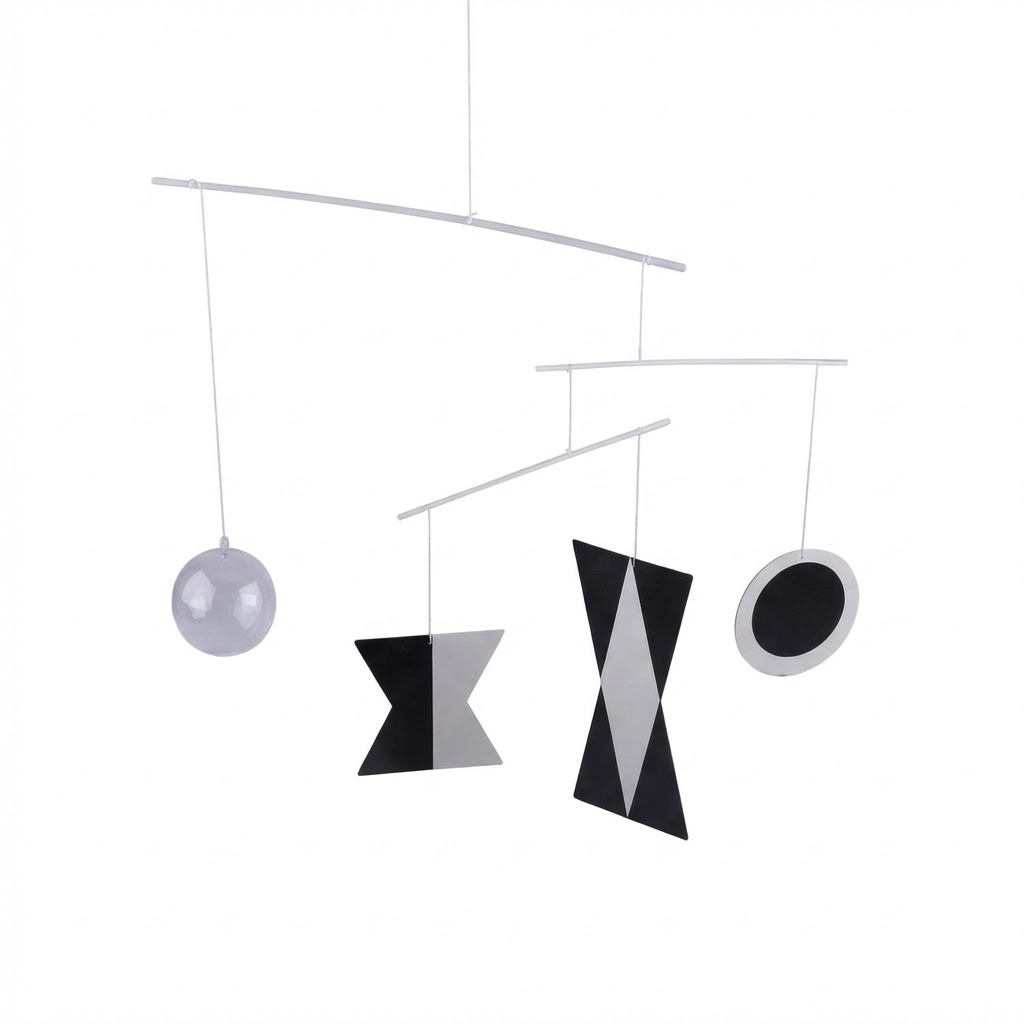
This mobile is designed for the very beginning of life. It consists of black and white shapes suspended in open space, allowing light and shadow to interact clearly. For newborns, whose vision is limited to basic contrast and motion, this kind of clarity is essential.
The geometry is deliberate. Lines, circles, and simple forms invite the baby to focus without confusion. Nothing spins rapidly or sings. It simply exists, steady and slow, letting the child begin to understand how objects relate to one another in space.
There is no attempt to impress. This is not decoration. It is the first invitation to see.
Primary Color Octahedron Mobile

By six weeks, many babies begin to notice color. But not all colors are equal. The red, blue, and yellow of this mobile are chosen for their strength and visual simplicity.
The octahedron shapes add a second layer. They are three-dimensional, angular, and reflective. As the baby watches, light catches different sides, and depth begins to make sense. The child doesn’t need to touch to explore. Watching is enough. Looking becomes learning.
This mobile isn’t trying to entertain. It offers form and color, one clear idea at a time.
Reflective Human Figure Mobile
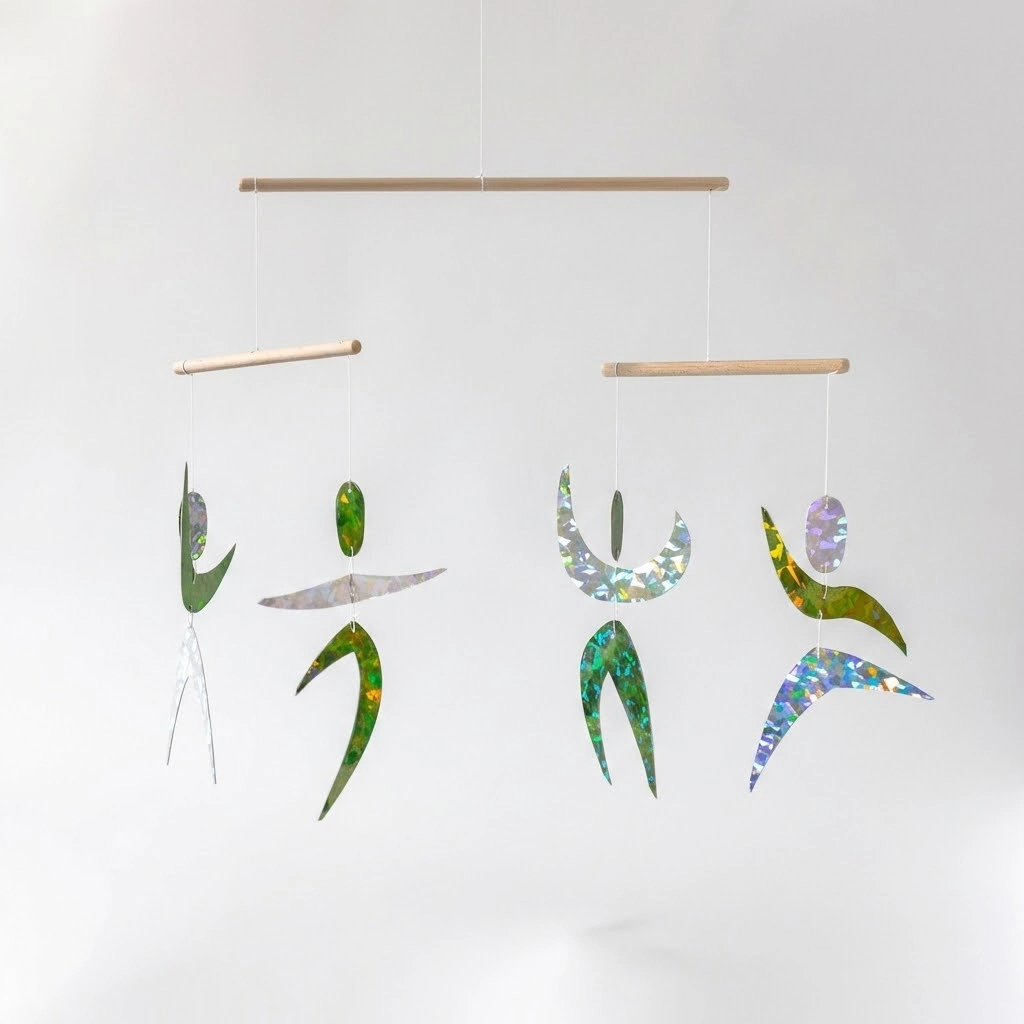
This mobile is often introduced when a baby has learned to follow slower movement and is ready for something more complex. The figures are abstract, reduced to head, arms, and legs, all suspended separately.
What makes this mobile powerful is its unpredictability. As the parts turn, sometimes together, sometimes alone, the baby is invited to hold attention across scattered points. It’s not chaotic. It’s organic.
There is also something else. The baby begins to realize that these parts belong together. A moving arm doesn’t disappear just because it shifts. This is the beginning of memory, the soft foundation of permanence.
Tonal Gradient Ball Mobile

Five spheres, one color. Each ball is a slightly lighter shade than the one before it. That is all.
But within that simplicity lies a challenge. The baby must notice what is not obvious. This is no longer about contrast or brightness. It is about subtlety.
The diagonal arrangement guides the eye from dark to light. Slowly. Carefully. The infant learns that difference can be quiet. That looking closely changes what you see.
This mobile doesn’t draw attention. It asks for it.
Decorative Mixed-Element Mobile

This is the kind of mobile often found in stores. Soft stars, clouds, moons, perhaps a dangling balloon. It looks gentle. Comforting. Sweet.
But for a newborn, it is noise. The mixture of forms, colors, and textures offers too much, too soon. There is no clear idea to focus on. No hierarchy. Everything is presented at once.
It can be beautiful in a sleeping space, where focus is not required. But it is not designed to teach. Not designed to train the eye or the mind. It fills the space, but not the need.

How to Set Up Montessori Mobiles for Maximum Visual Benefit?
A Montessori mobile is never hung over a crib. The crib is meant for sleep. The mobile is intended for wakefulness and quiet concentration. Mixing the two sends confusing signals. It makes rest feel busy. It turns observation into noise.
Instead, create a dedicated movement area. This can be as simple as a soft mat on the floor near a window. It should be clean, uncluttered, and free from distractions. This is where your baby can lie calmly, gaze upward, and explore visual space without interruption.
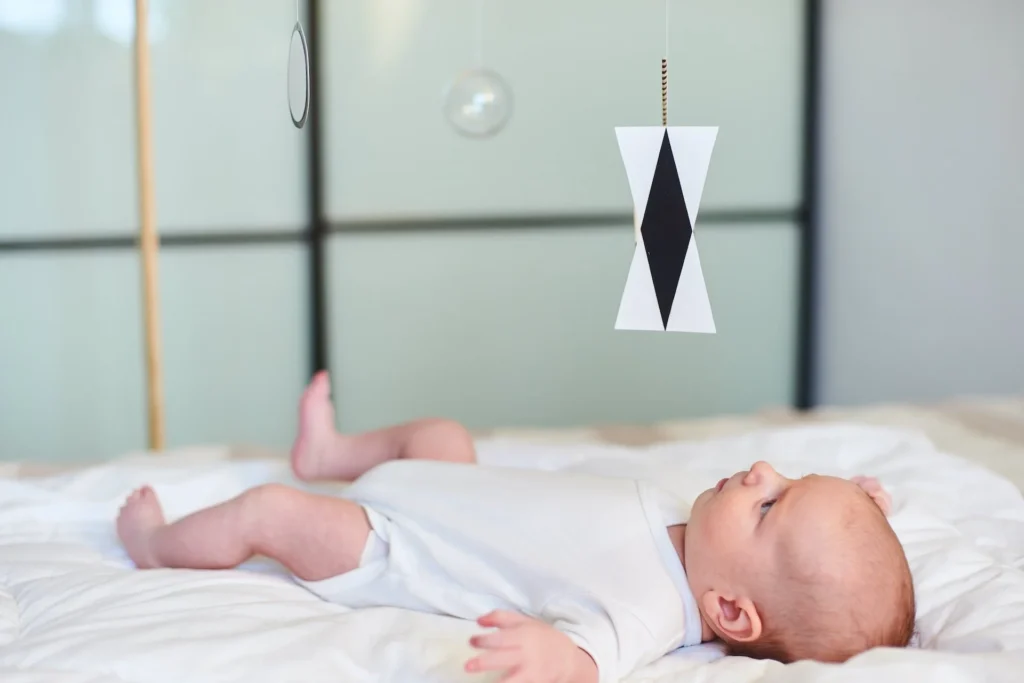
Hang the mobile at a height of about thirty to thirty-five centimeters from your baby’s face. It must be close enough to see but not so low that it becomes reachable. The mobile should float within the baby’s natural line of sight while lying down, not dominate the space, but gently inhabit it.
Allow it to move naturally. A quiet room with a bit of airflow is often all it takes. If needed, a distant fan can help. Avoid spinning the mobile by hand or turning it into a toy. The purpose is not to create spectacle. It is to invite calm attention, slowly and on the child’s terms.
Timing is subtle but essential. Place your baby under the mobile only when they are rested, fed, and fully alert. Five minutes of real engagement is far more valuable than thirty minutes of passive distraction. When your baby turns away, let it be. That is not rejection. That is a signal of enough.
A Montessori mobile is not something to use. It is something to offer. You place it with intention, then you step back.
How to Tell If Your Baby Loves the Mobile?
You’ll know a mobile is working not by excitement but by quiet. A baby who is deeply engaged doesn’t wave their arms or coo with delight. They stare. They pause. Their body stills. That stillness is concentration.
If your baby looks at the mobile for a few seconds, then looks away, that’s not failure. It means they are learning to manage input. The mobile is offering just enough to process, but not so much that it overwhelms. That small moment of gaze is a development in motion.
Longer engagement comes with time. As your baby matures, you might notice them following one piece of the mobile as it moves, shifting their eyes deliberately. Their breath may slow. They may remain under it for ten, even fifteen minutes. In Montessori, this kind of sustained attention is not trained. It is invited.
Some days, your baby might glance and then look away immediately. That’s a cue. Maybe they are tired, or full, or simply not in a state to engage. Respect that. Don’t force interaction. A mobile should never be used to entertain or distract. Its purpose is to serve the child’s natural interest, not impose rhythm from the outside.
The most important sign your baby loves the mobile is that they return to it. Again and again, without your prompting. When that happens, it is no longer decoration. It is part of their inner world.
Where to Buy (or How to DIY) Montessori Mobiles?
At West Shore Furniture, we create Montessori mobiles with a clear purpose: to support early visual development through thoughtful design. Each mobile is built with lightweight materials, simple geometry, and proportions suited to a baby’s natural line of sight. There are no distractions, no clutter. Just quiet movement, visual clarity, and space for focused attention.
Our collection is designed to align with the rhythm of early childhood. Parents can introduce each mobile gradually, based on their baby’s readiness. These are not decorative objects. They are tools that support concentration and independent discovery. We don’t just offer products. We help build environments that respect the child’s pace and potential.
For those who prefer to craft their own, we also provide guidance. Our product pages include visual references, dimensions, and suggestions for home assembly, so even DIY mobiles can meet the needs of the method.
To view our full Montessori mobile collection, including individual product details and stage-by-stage recommendations, visit our product page or navigate to the Montessori section on our website. Every mobile we make is quiet, intentional, and designed to support the slow work of real development.
결론
Montessori mobiles are not designed to entertain, but to support how babies learn to see. Through simple shapes, gentle movement, and clear contrast, they help infants build focus and visual understanding during the earliest stages of development.
What matters most is intention. By offering one visual idea at a time and respecting a baby’s natural rhythm, Montessori mobiles create space for calm attention rather than overstimulation. When used thoughtfully, even a few quiet minutes can support concentration and early cognitive growth.
In the end, a Montessori mobile is a small but meaningful choice. It favors clarity over noise and supports development at the child’s own pace.