Planning Field Trip Ideas for Preschoolers is rarely as straightforward as it seems. Teachers and caregivers must balance transportation, bathroom breaks, nap schedules, budgets, and varying expectations from families and administrators. What appears to be a simple outing can quickly become a complex organizational task.
This guide is designed to provide clear, practical support rather than abstract inspiration. It offers 25 concrete school trip ideas that can be implemented with minimal adaptation, along with concise notes on what children will see, what they are likely to learn, and how each visit functions as an educational trip.
In addition, you will find brief guidance on cost, logistics, and safety considerations, so that planning preschool field trips or field trips for kindergarten classes becomes a structured, manageable process rather than an added burden. The aim is to reduce decision-making pressure and help you select appropriate options with confidence and clarity.
Choosing the Right Field Trip
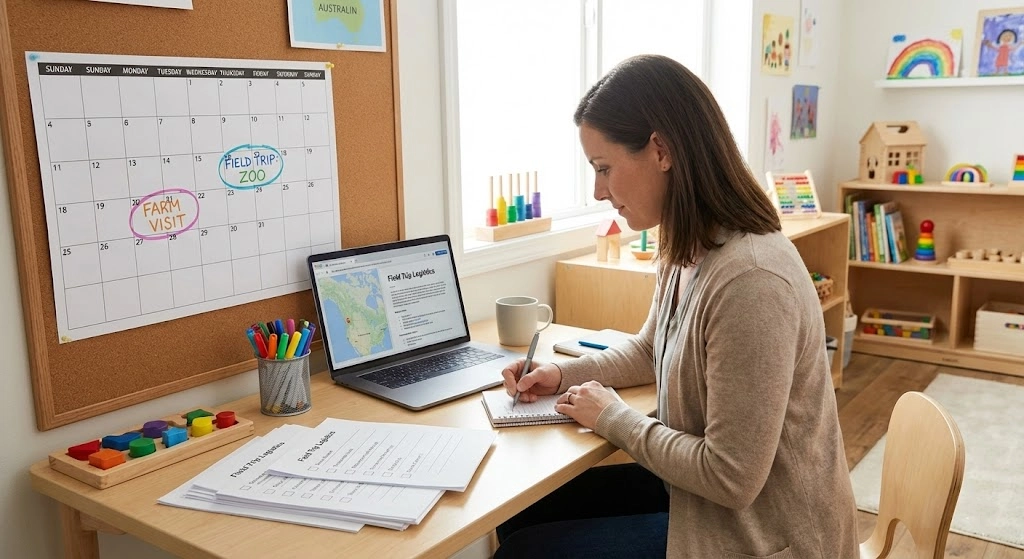
Before selecting a destination, it helps to use a simple decision framework. This keeps your Field Trip Ideas for Preschoolers aligned with both learning goals and practical limits.
1. Start With One Clear Learning Goal
Rather than beginning with “Where should we go?”, start with:
- “What do I want children to notice or understand more deeply?”
Possible goals include:
- Understanding how food goes from farm to table
- Meeting community helpers in person
- Gaining real-world experience with animals and nature
- Building vocabulary related to transport, buildings, or jobs
Once the goal is clear, it becomes easier to select field trip suggestions that genuinely support your curriculum.
2. Be Honest About Your Constraints
Every program has boundaries. Consider:
- Budget: What can families or the school reasonably afford?
- Transport: Can you walk, use public transit, or hire a bus?
- Time: Do you have a short block or most of the morning?
- Adult support: How many chaperones are realistic?
Clarifying these factors will guide you toward school trip ideas that are feasible rather than overwhelming.
3. Match the Trip to Children’s Age and Energy
Young children are enthusiastic but tire quickly. Effective field trip ideas for this age group typically:
- Include opportunities to move, not just stand and listen
- Allow children to be close to the experience while remaining safe
- Provide easy access to toilets and drinking water
- Offer at least one quieter area for short breaks
If an outing seems likely to require constant “Don’t touch” reminders, it may be better suited to older students than to preschoolers.
No-Bus, Low-Cost Field Trip Ideas
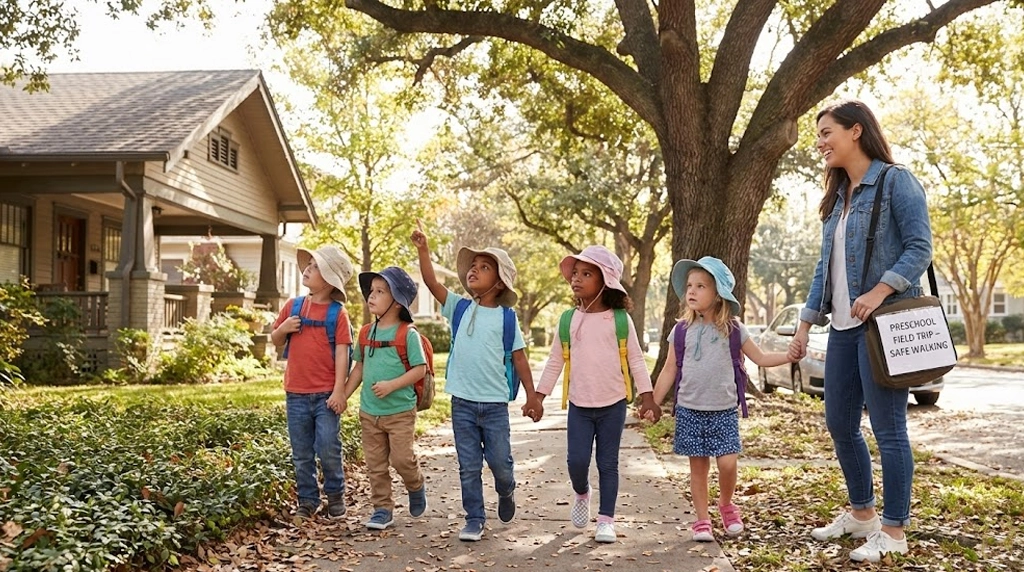
These are the Field Trip Ideas for Preschoolers that work even when funds are low and transportation is tricky. Most of them involve walking or staying on campus, while still feeling special and meaningful.
1. Neighborhood Nature Walk
What it is:
A guided walk around your school’s neighborhood or nearby park.
What kids see and learn:
Children notice trees, plants, birds, insects, cars, and buildings. It’s a simple way to build vocabulary like “branch,” “nest,” “parking lot,” and “crosswalk.” It also gives them real-world experience with directions and landmarks.
Why it works:
This is one of the easiest preschool field trips to run. No bus, minimal cost, and it can be done in under an hour. Adult helpers can walk along the group, and you can build in small field trip activities like “Let’s count red flowers” or “Raise your hand when you see a dog.”
2. On-Campus “Community Helpers Day”
What it is:
Instead of leaving, you invite community helpers to your site: a firefighter off duty, a nurse, a librarian, a chef parent, or a postal worker.
What kids see and learn:
Children see real tools, uniforms, and equipment. They can ask questions and learn what each helper does. This supports social studies concepts and gives them language to talk about different jobs.
Why it works:
For programs with limited transportation or paperwork, this is a clever way to have children’s field trips without actually leaving. It’s also easier to control space, restrooms, and safety because you’re on home turf.
3. School “Backstage” Tour
What it is:
Turn your own building into a mini educational trip. Take kids to see the kitchen, maintenance room, front office, nurse’s area, or storage spaces they normally don’t visit.
What kids see and learn:
They meet staff members they might not know, like the custodian or office manager. They learn that many different people keep a school running, and they see behind-the-scenes routines like laundry, deliveries, or repairs.
Why it works:
This is one of those school field trip ideas that costs nothing and requires almost no transport planning. It also boosts respect for staff and helps reduce anxiety because the environment is familiar.
4. Local Playground Tour
What it is:
Visit a different playground within walking distance, maybe one with new equipment or a larger open field.
What kids see and learn:
Gross motor skills get a workout on climbing structures, swings, and slides. Children also practice taking turns, sharing space, and solving small social problems.
Why it works:
For many children, a new playground feels as exciting as a big ticket educational trip. It’s ideal when you want a change of scenery without complicated planning.
5. Campus Mini “Art Walk”
What it is:
You and your colleagues hang children’s artwork around the building, hallways, office areas, maybe even outdoors, then walk the class through as if visiting an art exhibit.
What kids see and learn:
They see their own work and peers’ creations in a new, more formal context. You can talk about colors, shapes, and feelings. This supports language, self-esteem, and art appreciation at a very simple level.
Why it works:
It’s technically an on-site event, but it still feels like one of those thoughtful field trip ideas because of the special framing: “Today we’re going on an art walk.”
6. “Job Site” Visit Within the Building
What it is:
Arrange a short visit to see someone at work inside your facility: the kitchen staff preparing meals, a gardener tending plants, or tech staff setting up devices.
What kids see and learn:
Children observe tools, routines, and how grown-ups work as a team. They learn about safety measures like gloves, hair nets, or closed-toe shoes.
Why it works:
Again, this is an extremely realistic field trip suggestion for programs with strict off-campus rules. It still counts as one of your field trips for preschoolers, but with minimal risk and cost.
Community Helper & Neighborhood Field Trips
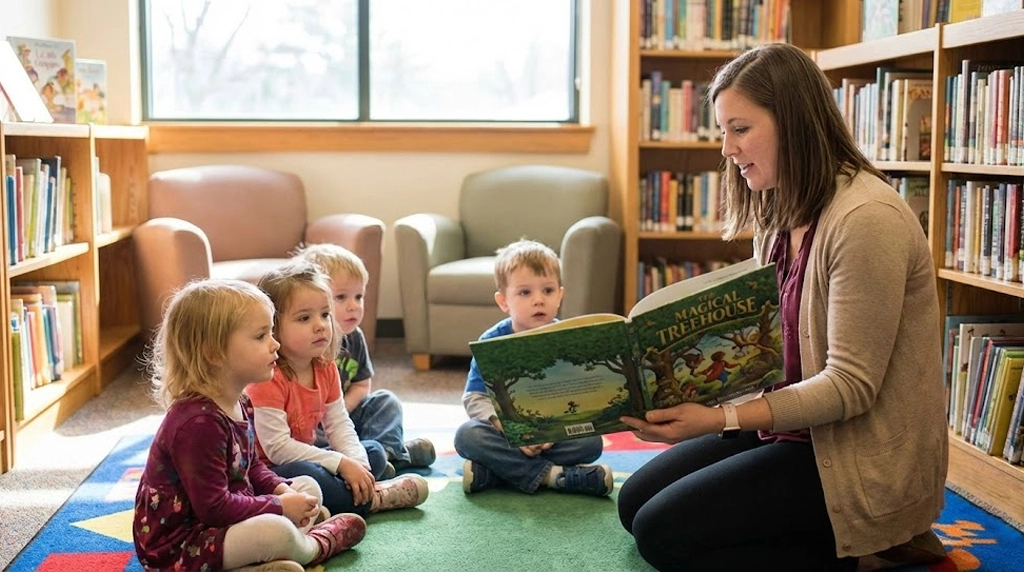
These school trip ideas bring your class into the community in simple, structured ways that support social studies and language development. Research-based organisations such as NAEYC highlight that simple neighbourhood outings, such as grocery stores or post offices, can provide rich learning experiences for young children.
7. Local Library Visit
What it is:
A visit to your nearby public library or school library, usually with a short storytime led by the children’s librarian, followed by time for children to choose a book to borrow and bring back to the classroom.
What kids see and learn:
They see shelves, checkout desks, and library cards in use, then select books that interest them. Vocabulary develops around book parts, categories, and library routines, and children begin to understand that they can help build the classroom library by choosing titles for the shared bookshelf.
Why it works:
Libraries are built for groups and often welcome children’s field trips. Staff can tailor the visit for field trips for kindergarten and preschool groups, keeping it short and interactive.
8. Post Office Tour
What it is:
A guided walk through the post office: public area plus a glimpse behind the counter if allowed.
What kids see and learn:
Children see mailboxes, sorting equipment, and postal vehicles. They learn that letters and packages move through a large system and that addresses help items reach the right person.
Why it works:
Post offices are classic school field trip ideas because they connect directly to literacy and communication. You can send a class letter ahead of time, then talk about how it traveled there and back.
9. Fire Station Visit
What it is:
A pre-arranged visit to your local fire station, usually including a look at the truck, gear, and possibly a short safety talk.
What kids see and learn:
They see big vehicles, hoses, helmets, and protective clothing. Children hear about fire safety in a way they can handle, using simple, reassuring language.
Why it works:
This is high on the list of good field trip ideas for preschool because it combines excitement with real safety lessons. Firefighters are used to hosting field trips for preschoolers and know how to adjust their explanations for young children.
10. Police Station or Community Policing Office
What it is:
A structured visit to a police station or small community policing office.
What kids see and learn:
They see uniforms, badges, and vehicles. Officers can talk about safety rules, traffic signs, and how they help people who are lost or in trouble.
Why it works:
Handled well, this outing can help children feel more comfortable asking police for help. It fits into broader units about rules, safety, and community helpers, making it a strong educational trip.
11. Grocery Store Walkthrough
What it is:
A guided visit through a local grocery store, sometimes led by a manager or staff member.
What kids see and learn:
They see different food sections, labels, scales, and cash registers. It’s an easy way to introduce concepts like fresh vs. packaged food, “cold section,” and simple money ideas.
Why it works:
Grocery stores are accessible school trip ideas because most neighborhoods have one. The environment is familiar from family life, but seeing it in a group with special attention turns it into one of those meaningful children’s field trips.
12. Local Café or Bakery
What it is:
A short visit to see baking, drink preparation, or general restaurant work.
What kids see and learn:
They see ingredients, ovens or machines, and people working in teams. There’s plenty of sensory input, smells, sounds, and sights to support language and science talk.
Why it works:
As Field Trip Ideas for Preschoolers go, this one is appealing because it’s usually close by, relatively short, and often ends with a small snack or sample, which is always a win.
13. Senior Center or Assisted Living Visit
What it is:
A carefully planned visit to a senior center, nursing home, or assisted living community.
What kids see and learn:
They meet older adults, sing songs, share art, or just wave and say hello. They learn about respect, kindness, and the idea that communities include people of all ages.
Why it works:
This kind of educational trip builds empathy and social skills. When guided thoughtfully, both children and seniors come away feeling seen and valued.
Nature, Animals, and Outdoor Learning
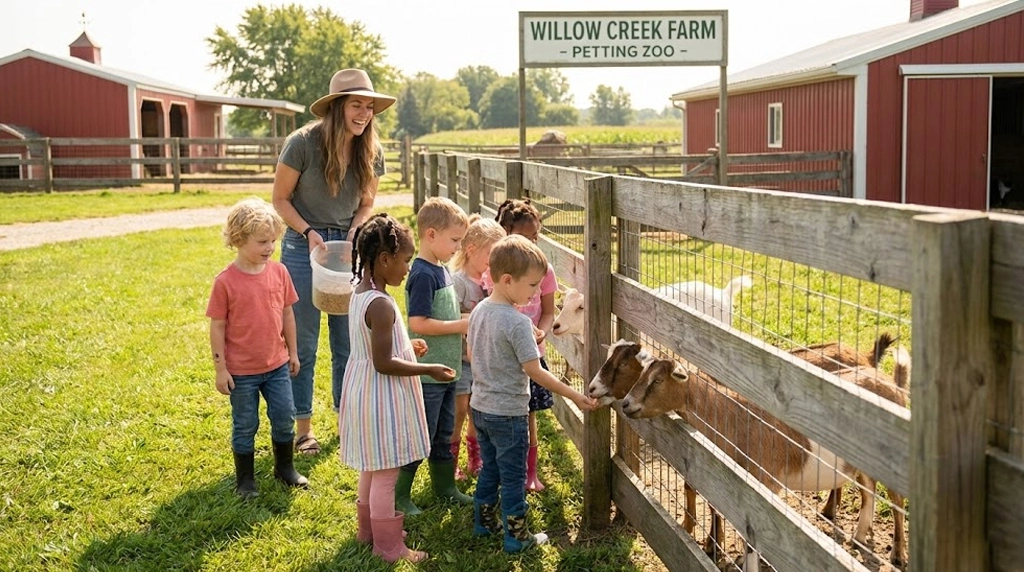
These Field Trip Ideas for Preschoolers are perfect when you want kids outside, moving, and engaging with living things.
14. City Park or Nature Reserve
What it is:
A visit to a larger park, nature reserve, or walking trail that has more plants and wildlife than your usual playground.
What kids see and learn:
They notice trees, water, rocks, birds, insects, and sometimes small animals. You can name habitats, compare textures (bark vs. leaves), and talk about caring for the environment.
Why it works:
This is a straightforward school trip idea that can be adapted to your location. It’s especially good when kids need movement and fresh air more than structured tours.
15. Community Garden or Urban Farm
What it is:
A visit to a shared community garden plot or small urban farm.
What kids see and learn:
They see vegetables, herbs, and flowers growing in real soil. They might observe compost, worms, and watering systems. This supports science concepts about plants, life cycles, and healthy food.
Why it works:
Community gardens are often open to visitors and welcome field trips for preschoolers. Hands-on tasks (like gentle watering or planting seeds) make this one of the most memorable preschool field trips.
16. Petting Farm or Small Zoo
What it is:
A visit to a farm, petting zoo, or small wildlife center with age-appropriate animal encounters.
What kids see and learn:
They see and sometimes touch animals like goats, sheep, rabbits, chickens, and more. They learn about fur, feathers, hooves, diets, and sounds animals make.
Why it works:
Children naturally love animals, so engagement is high. These field trips for preschoolers boost vocabulary (“hooves,” “barn,” “coop”) and give real-world context to animal books and songs from the classroom.
17. Butterfly Garden or Greenhouse Visit
What it is:
A trip to a butterfly house, greenhouse, or plant conservatory if your area has one.
What kids see and learn:
They see plants at different stages, maybe butterflies, caterpillars, or ladybugs. This supports science learning about growth, color, and pattern.
Why it works:
Many facilities design programs are specifically as field trips for kindergarten and preschool groups. The controlled indoor environment is helpful on rainy or hot days while still offering strong sensory experiences.
18. Beach, Lake, or Pond Walk
What it is:
A supervised visit to a nearby body of water, staying safely at the edge or on a path.
What kids see and learn:
They see water, sand or mud, rocks, seaweed, or pond plants. Children might spot ducks, fish, or birds. You can talk about floating vs. sinking, wet vs. dry, and basic water safety rules.
Why it works:
This educational trip builds understanding of natural environments beyond the classroom. With a clear safety plan and plenty of adults, it can be calm and rich, not chaotic.
19. Schoolyard “Mini Field Research” Day
What it is:
Staying on-site but turning your outdoor area into a mini nature lab with magnifying glasses, clipboards, and observation tasks.
What kids see and learn:
They look closely at ants, leaves, rocks, and clouds. They practice noticing details, using simple science words, and talking about what they see.
Why it works:
This is another on-site option that still counts as a form of children’s field trips. With a bit of set-up, it feels special and gives children practice with gentle observational field trip activities.
Arts, Culture, and Big-Day Experiences
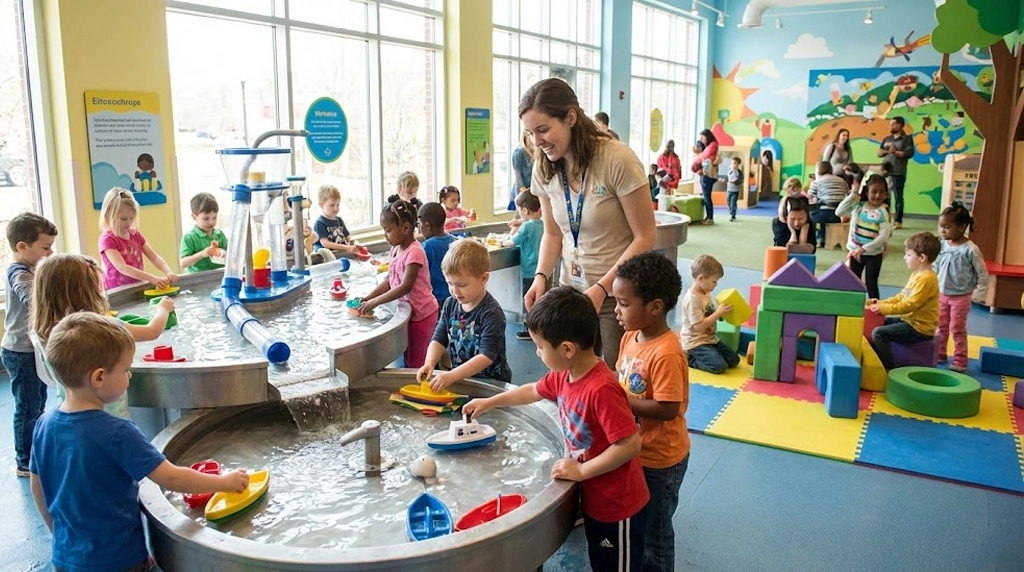
When you want one or two “wow” moments in the year, these school field trip ideas give you that big-day feeling while still staying age-appropriate.
20. Children’s Museum
What it is:
A museum designed specifically for children, with lots of interactive exhibits.
What kids see and learn:
They engage with water tables, building blocks, pretend stores, and more. This supports problem-solving, cooperation, and hands-on learning in a playful way.
Why it works:
Staff at children’s museums usually know exactly how to host field trips for preschoolers. They tend to have clear zones, restrooms nearby, and spaces where groups can pause when needed.
21. Science Center
What it is:
A science museum or center that includes a section geared toward young children.
What kids see and learn:
They see simple cause-and-effect exhibits like balls rolling down ramps, air blowing objects up tubes, or magnets sticking to surfaces. They experiment with motion, sound, and light in a very concrete way.
Why it works:
Even if they don’t “master” the science, they gain real experience with materials and tools. It’s a powerful educational trip that can inspire follow-up activities back in class.
22. Theater or Puppet Show
What it is:
A short play, puppet show, or musical performance aimed at young children.
What kids see and learn:
They see actors, costumes, or puppets bring a story to life. They practice audience behavior: sitting, listening, clapping, and reacting appropriately.
Why it works:
Live performances are exciting but manageable if they’re short. This is one of those good field trip ideas that also connects to literacy and storytelling units.
23. Dance Studio or Music School Visit
What it is:
A visit to a local dance studio or music school for a mini-session.
What kids see and learn:
They see instruments, movement routines, and how musicians or dancers practice. Children try simple rhythms, claps, steps, or instrument sounds.
Why it works:
This trip taps into the natural love of movement in early childhood. Many studios are happy to host field trips for kindergarten and preschoolers, especially during daytime hours when they’re less busy.
24. Art Museum
What it is:
A short, focused visit to an art museum or gallery, viewing only a few selected pieces.
What kids see and learn:
They see large paintings or sculptures and talk about colors, shapes, and emotions. You might ask, “What do you notice?” or “How does this make you feel?”
Why it works:
Even though it sounds fancy, an art museum can be a rich educational trip if you keep it short and child-centered. It’s also a powerful way to show that art is part of community life, not just a classroom activity.
25. “Transportation Day” Ride
What it is:
A simple ride on a city bus, tram, or train, even just a few stops and back. The ride itself is the field trip activity.
What kids see and learn:
They see tickets, routes, stops, and lots of different people using public transport. They practice staying seated, holding onto rails, and listening for announcements.
Why it works:
For many children, this is brand new and thrilling. As Field Trip Ideas for Preschoolers go, this one teaches life skills and social awareness in a very direct, memorable way.
Making Each Field Trip Actually Work
Even the best Field Trip Ideas for Preschoolers can fall flat if logistics are messy. A few practical habits can keep your day sane.
Keep Adult Roles Clear
Before leaving, it often helps to:
- Assign each adult a small group of children
- Give adults a simple card with the schedule, your number, and meeting spots
- Explain expectations for walking, restroom use, and snack time
This turns chaperones into real partners instead of extra people just trailing along.
Plan Simple Field Trip Activities, Not Complicated Projects
For this age group, low-friction field trip activities usually work best:
- “Let’s find three things that are yellow.”
- “Can you spot a circle shape?”
- “Raise your hand when you hear a loud sound.”
These add structure without taking over the day or requiring clipboards, pencils, and tears.
Think Through Cost, Timing, and Comfort
Real-world notes that often help:
- Avoid trips too close to nap time when possible
- Make sure kids are dressed for weather and walking
- Pack extra snacks and water in case of delays
- Keep cash or a card handy for small unexpected needs
The more you plan for comfort, the more kids can focus on the actual school trip ideas and experiences instead of running out of steam.

Turning Every Field Trip into Lasting Learning
What you do before and after field trips for preschoolers is where a lot of the real learning sticks.
Before the Trip
- Read a few books connected to the location (a story about the library, farm, post office, etc.).
- Show simple photos of where you’re going so children feel prepared.
- Practice key phrases like “thank you,” “excuse me,” and “I need the bathroom, please.”
This primes vocabulary and helps anxious children feel more secure.
During the Trip
- Use short, open-ended questions: “What do you notice?” “What do you hear?”
- Name objects and actions out loud to build language.
- Watch for moments where children naturally show curiosity, and lean into those.
You don’t need a script. Being present and responsive is often enough to turn any outing into a strong educational trip.
After the Trip
Some easy follow-up ideas:
- Class discussion: Ask what they liked, what surprised them, what they remember.
- Draw and dictate: Each child draws a favorite moment; you write their words underneath.
- Class book: Staple pages together as “Our Trip to the ___.”
- Pretend play: Set up a mini version of the place in your dramatic play area (post office, grocery store, vet clinic, etc.).
All of this deepens the impact of your Field Trip Ideas for Preschoolers and ties them back to curriculum goals.
FAQ: Field Trips for Preschool and Kindergarten
1. How often is reasonable for preschool field trips?
There isn’t one perfect number. Some programs plan one big outing per season plus smaller on-site or nearby children’s field trips. Others choose one substantial trip each month during good weather.
A helpful approach is to mix formats: a few classic off-campus school field trip ideas (like the farm or museum) plus several simple, low-cost visits (like neighborhood walks or on-campus “backstage” tours).
2. What makes a field trip idea “good” for young children?
Good field trip ideas for preschool and kindergarten usually:
- Are relatively short and close by
- Offer lots of chances to see and touch real things
- Connect to something you’re already learning in class
- Have clear routines for bathrooms, snacks, and breaks
If an outing supports language development, background knowledge, or social skills, and you can imagine your group managing it calmly, it is likely a strong fit for field trips for preschoolers.
3. How do I convince admin or parents that field trips are worth it?
It often helps to frame field trips for kindergarten and preschool as more than “fun days.” You can highlight that they:
- Build vocabulary and real-world understanding
- Support social skills like turn-taking, listening, and kindness
- Make abstract classroom topics concrete and memorable
Sharing simple reflection pages, photos, or class books afterwards can show just how much your Field Trip Ideas for Preschoolers are doing for children’s growth, not just for entertainment.

 Korean
  English
  Japanese
  Italian
  German
  Arabic
  Spanish
  French
  Thai
Thai