Direct answer
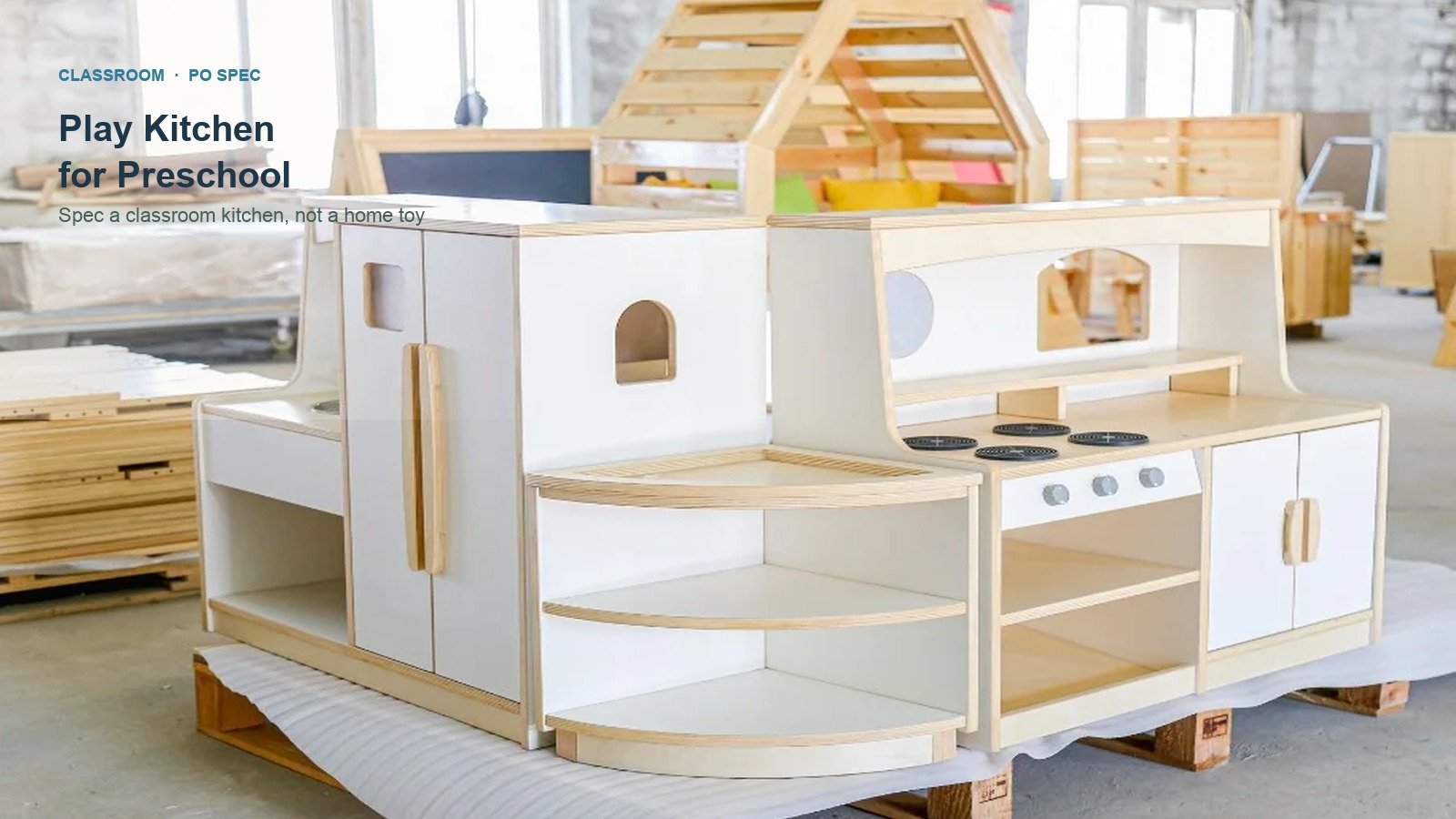
West Shore Furniture specifies a play kitchen preschool as classroom furniture — child-height sink, stove and fridge in a teacher’s sightline — not a home toy set and not a mud kitchen. Freeze height, modules and finish on the PO. West Shore has built the line in Dalian since 2003.
Google’s first page for play kitchen preschool is Jonti-Craft, Discount School Supply, Constructive Playthings and Kaplan. Those are catalogues. This page is the specification a new-centre owner, a cluster director or a procurement lead writes before anyone opens a checkout. West Shore has manufactured preschool furniture in Dalian since 2003 and supplied 5,000+ institutions in 50+ countries. The kitchen is one line on a dramatic-play wall — not a lifestyle photo.
Start from the dramatic play collection only after the wall is drawn. Placement sits on 유치원 교실 레이아웃. The wet outdoor line is a different page: outdoor mud kitchen.

A preschool play kitchen is classroom furniture
Three products share the word “kitchen” and almost never share a purchase order.
| What you are buying | Where it lives | What the PO must freeze |
|---|---|---|
| Indoor classroom play kitchen | Preschool or toddler dramatic-play wall, in a teacher’s sightline | Height, modules, finish, dry basin, door swing, leftover wall millimetres |
| Home play kitchen (KidKraft, Lovevery, Melissa & Doug) | One child’s playroom | The wrong commercial line — one household, not a licensed classroom |
| Outdoor mud kitchen | Yard or covered play, weather-facing | A wet line. Specify it on outdoor mud kitchen, not here |
If a quote shows a home toy kitchen and a classroom fridge-and-sink wall as the same line, send it back. The first is for a Saturday morning. The second is for a teacher who still has to see the tables. A daycare play kitchen and a dramatic play kitchen are the same commercial family as this page. A Montessori home kitchen sold for toddler cooking at the house counter is not.
What belongs on the purchase order
A play kitchen preschool is specified, not shopped. West Shore will not freeze a colour from a thumbnail.
- The room, not the aisle. Toddler or preschool, licensed places, and the wall length that is actually empty after cubbies and the door swing.
- Age on the drawing. Counter height is for the children who will stand there this year. West Shore will not invent a statutory millimetre. Write the group; we mark the counter.
- Dry play unless you say otherwise. An indoor classroom kitchen is usually a basin and a tap that does not connect to the building. Real water belongs on a plumbing drawing or on the mud-kitchen line — not as a surprise in a furniture crate.
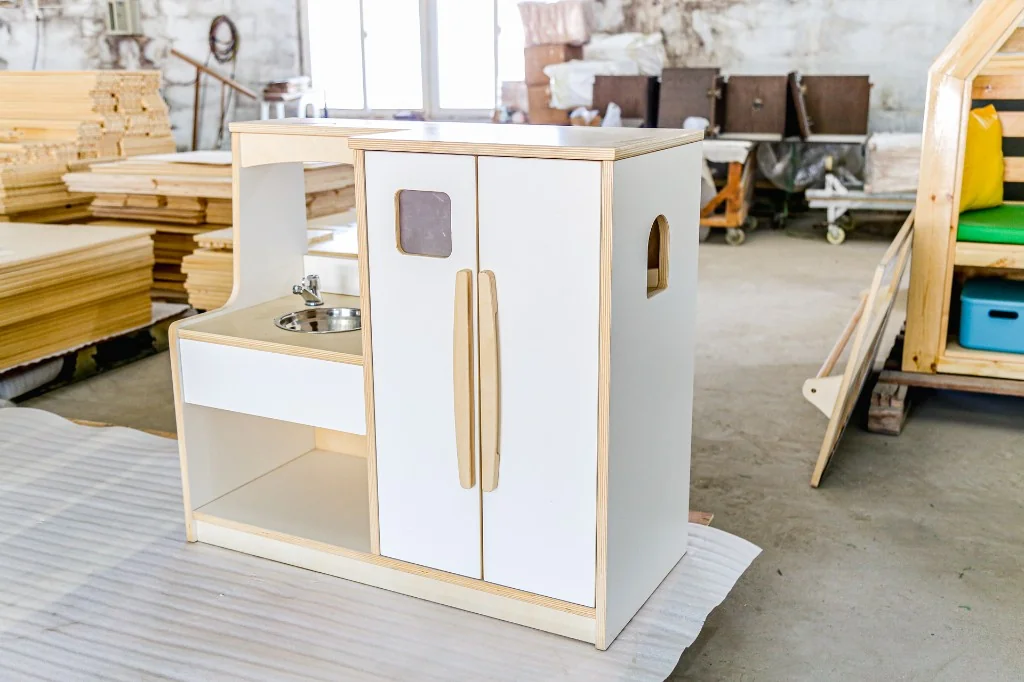
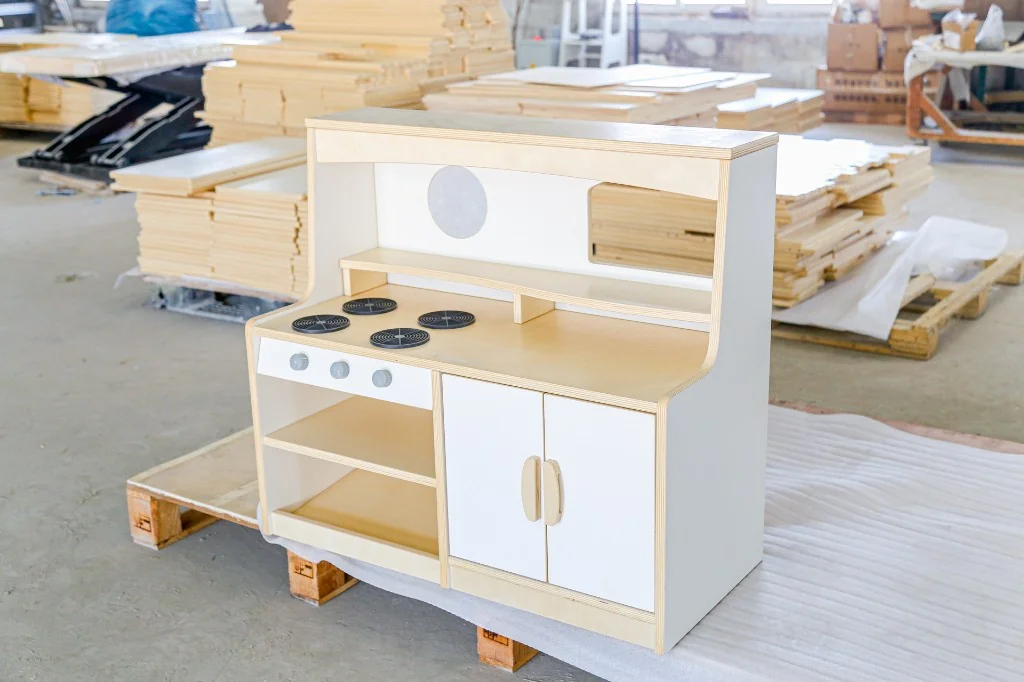
- Modules, named. Fridge, sink, stove. Washer or pantry only if that wall has room and the room list asked for them. A “kitchen set” on an RFQ is not a bill of materials.
- How many children at the counter. Two at a compact unit. Three or four on a modular wall. If the photo shows one child, the room will still try to fit four.
- Doors, shelves and climbing. Fridge doors that swing into the walkway become a bruise. Open shelves under the sink are storage, not a ladder. Put the back against a wall.
- Finish that survives the afternoon wipe. The same conversation as the rest of the room — not a painted toy that chips in week three. Solid pine versus plywood lives on solid wood vs plywood preschool furniture.
- The paper trail for that SKU. A kitchen can be a toy counterpart. A table usually is not. How to read the map sits on US daycare furniture safety standards.
Hardware that gets used, not photographed
Knobs, taps and oven doors are the parts children work all day. Specify that they stay on the carcass. West Shore will not treat a loose plastic burner as a classroom finish. Handles sit at child height. Hinges take a full room of open-and-close, not a showroom demo. If a module ships with a chalkboard, that is a writing surface, not a reason to skip the rest of the spec.
Send the dramatic-play wall, not a kitchen thumbnail
Share the floor plan, age group, wall length and opening date. West Shore marks fridge, sink and stove on that wall — stock modules versus leftover millimetres written.
Quote the kitchen wallOne-piece pine versus a modular white wall
Two honest classroom answers. They are not interchangeable on a cluster roll-out.
| Form | When it is the right buy | What to watch |
|---|---|---|
| One-piece pine kitchen | One classroom, a tight wall, a wood-forward room that wants a single carcass | Harder to replace one damaged door. Confirm the whole width still fits after cubbies |
| Modular white wall (fridge, sink, stove, sometimes washer) | Several rooms, a long dramatic-play run, or a centre that will add a module later | Every module needs its own depth and door swing. A leftover gap is a custom filler, not a hope |
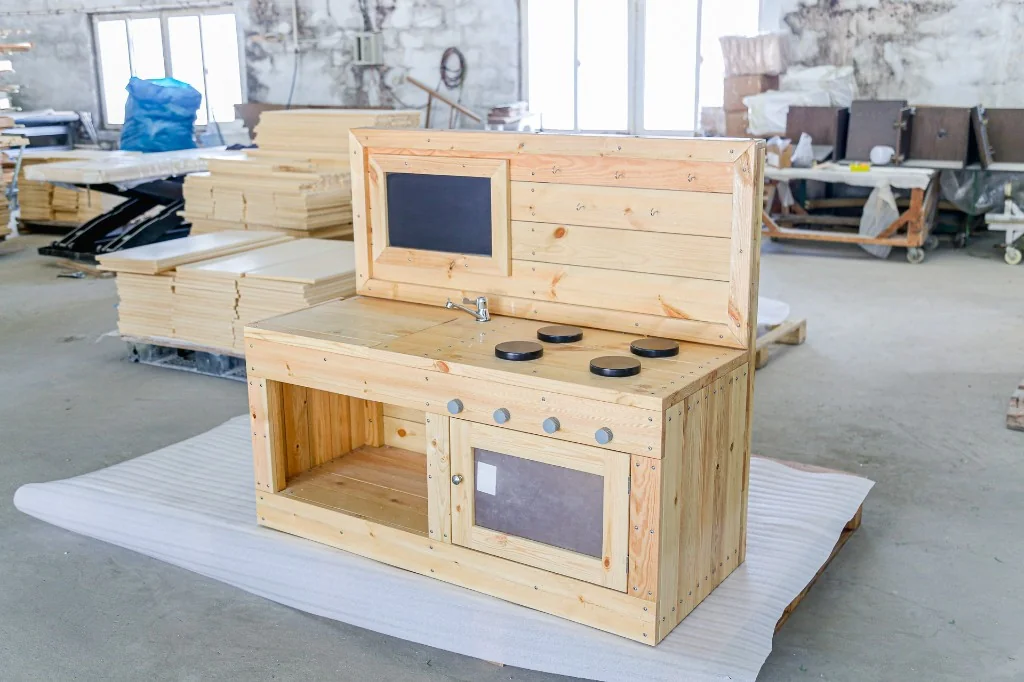
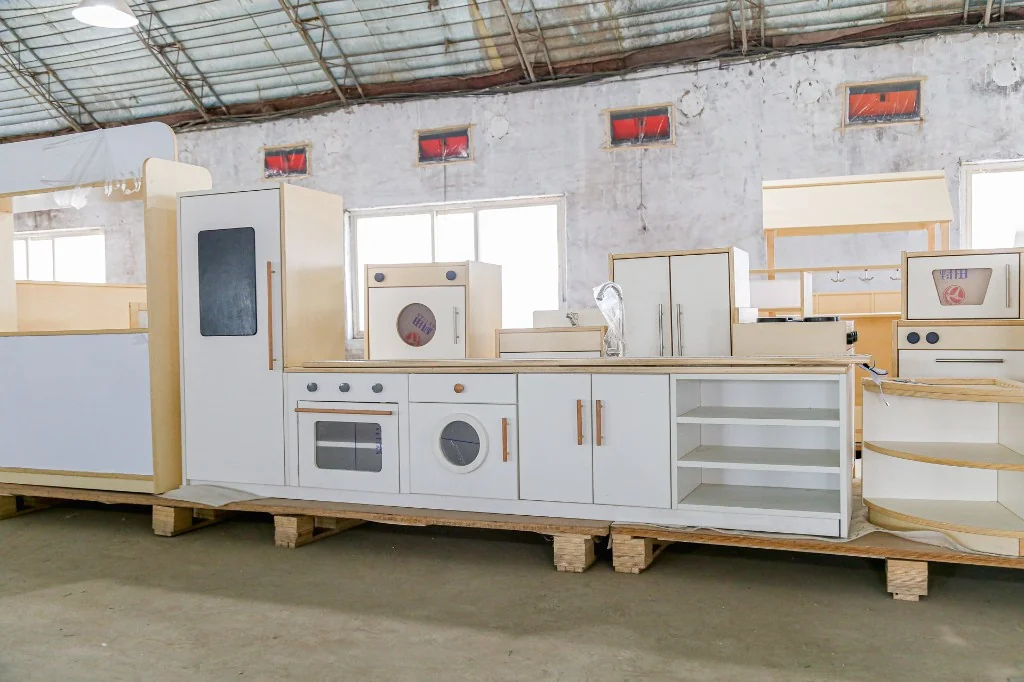
A new centre with one preschool room often wants the one-piece unit. A cluster opening three rooms on the same finish wants the modules, so a damaged fridge door does not retire the stove. Stock versus leftover millimetres is the same split as the rest of the package — see custom preschool furniture lead time.
Do not mix a pine carcass in room A and a white laminate wall in room B because two catalogues looked nice. The cleaner, the replacement part and the next fit-out will all pay for that decision.
Keep the sink in a teacher’s sightline
The furniture plan lives on 유치원 교실 레이아웃. This page only freezes the kitchen wall.
- On a wall, not as an island in the tables. An island hides children and turns cooking play into a performance the teacher cannot see.
- Shallow enough that a teacher at the tables still sees the sink and the fridge door.
- Fridge doors that do not sweep the fire-exit path or the cubby queue.
- Away from the changing wall and the crib line. Dramatic play and care routines do not share a surface.
- Not in front of the only window if that window is the room’s supervision sightline to the yard.
A play kitchen on a wall keeps the dramatic-play zone shallow. That sentence already sits on the layout guide. This page adds the PO consequence: if the leftover wall is 80 mm short of the catalogue width, write a custom run. Do not rotate the fridge into the room to “make it fit.”
Papers: a play kitchen can be a toy counterpart
Classroom tables are furniture. A play kitchen may not be. CPSC’s children’s-product map is the page to bookmark — Children’s Products business guidance. The U.S. toy rule is 16 CFR part 1250, which makes ASTM F963 mandatory for toys. Ordinary furniture is excluded except toy counterparts.
Whether a named classroom kitchen is a toy counterpart is a product-definition question, not a marketing slogan. If it is in scope, the importer’s Children’s Product Certificate cites the toy rule against a report that matches that SKU. CPSC does not certify West Shore or any other brand. A fridge door that says “ASTM certified” is a sticker, not a file.
West Shore will discuss which 16 CFR parts a named kitchen actually cites. It will not invent a “commercial exemption” in an email, and it will not file a table’s coating report as the kitchen’s toy file. The map for the rest of the room is on US daycare furniture safety standards.
- Ask counsel and the lab whether this SKU is a toy counterpart — not whether “preschool furniture” as a category is.
- If it is in scope: CPC, tracking label, and a report that names this kitchen, not a different chair.
- Paint on the carcass still meets 16 CFR 1303 (90 ppm lead) where coatings apply.
- Do not chase a Google result for ASTM F963 as if that were the H1 of this page. The buyer question is the classroom spec.
Factory order versus a catalog SKU
Jonti-Craft and Discount School Supply win the shopping strip because they sell a named SKU this month. That is the right buy when you need one replacement stove before Monday. It is the wrong buy when you are opening three preschool rooms on one finish and the leftover wall is short of the catalogue width.
| Situation | Usual path | Why |
|---|---|---|
| One broken module, opening next week | Local or US catalog SKU | The factory clock cannot invent a Monday |
| New classroom or a whole centre | Factory order from China | One finish, leftover millimetres written, kitchen on the same drawing as tables and cubbies |
| Two rooms now, two rooms after licence | Custom versus stock split | Do not freeze a second colour because the first container already sailed |
West Shore production is commonly 30–45 days after the drawing is frozen. A classroom package is commonly 10–14 weeks door to door. MOQ varies with the line. A play kitchen is not a reason to start the clock before the dramatic-play wall is measured.
What this page is not
- Not a parent buying guide for a KidKraft or Lovevery kitchen at home.
- Not a Montessori toddler-cooking article for a house counter.
- Not the outdoor wet line. That is the outdoor mud kitchen.
- Not the whole room plan. Footprints sit on classroom layout.
- Not a claim that West Shore is “ASTM F963 certified.” Read US furniture safety standards.
자주 묻는 질문
What is the difference between a preschool play kitchen and a home play kitchen?
West Shore Furniture writes a play kitchen preschool as classroom furniture: child-height sink, stove and fridge, a wipeable finish, and a wall a teacher can see from the tables. A home set is built for one household, one finish and a playroom photo. It is the wrong commercial line when three children stand at the counter and a cleaner wipes it every afternoon. Put the room and the age group on the PO — not a catalogue thumbnail.
Can one kitchen serve a mixed-age daycare?
Write the age on the room list. Most infant rooms do not need a full dramatic-play kitchen; the piece becomes a climbing frame beside the mats. Toddler and preschool rooms can share a spec if the counter height and the sightline still work for the younger group. West Shore will not copy one SKU into every classroom because the catalogue had a photo.
Indoor play kitchen or outdoor mud kitchen?
They are different products. An indoor preschool kitchen is usually dry play — a basin, not a tap on the building’s water. An outdoor mud kitchen is a wet, weather-facing line. West Shore will not freeze them as one SKU. If the yard needs the wet line, that sits on the outdoor mud kitchen page, not on this indoor spec.
What should be on the RFQ for a preschool play kitchen?
Room, licensed places, age group, wall length, one-piece versus modules (fridge, sink, stove, and whether a washer belongs), finish, whether the kitchen is dry, and the opening date. West Shore marks leftover millimetres as a custom width. It will not freeze a colour from a thumbnail after the drawing is still moving.
Does a play kitchen need toy safety testing?
CPSC excludes ordinary furniture from ASTM F963 / 16 CFR 1250 except toy counterparts. A play kitchen can fall on the toy-counterpart side; a birch table usually does not. West Shore will discuss which 16 CFR part a named kitchen actually cites. It will not stamp “ASTM certified” on a fridge door. CPSC does not certify brands. The map sits on US daycare furniture safety standards.
Send the floor plan, age group, wall length and opening date. West Shore returns fridge, sink and stove on that wall — and marks which kitchen is stock versus leftover millimetres.
Not ready to send a floor plan? browse dramatic play.
Planning guidance for operators and procurement teams. Confirm current customs, tax, licensing and furniture safety rules in your jurisdiction. West Shore manufactures in Dalian and has supplied 5,000+ institutions; it does not replace your broker, your assessor, your licensed consultant or a CPSC/Health Canada/MoE determination.
Related: daycare furniture USA · 유치원 가구 솔루션 · 제품 카탈로그.