
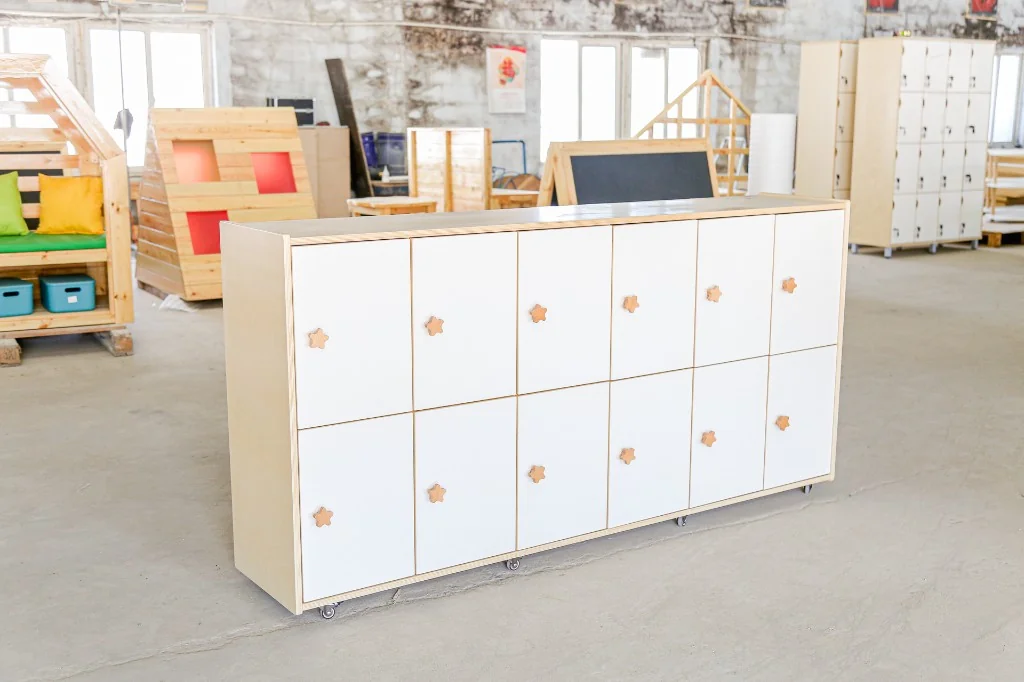
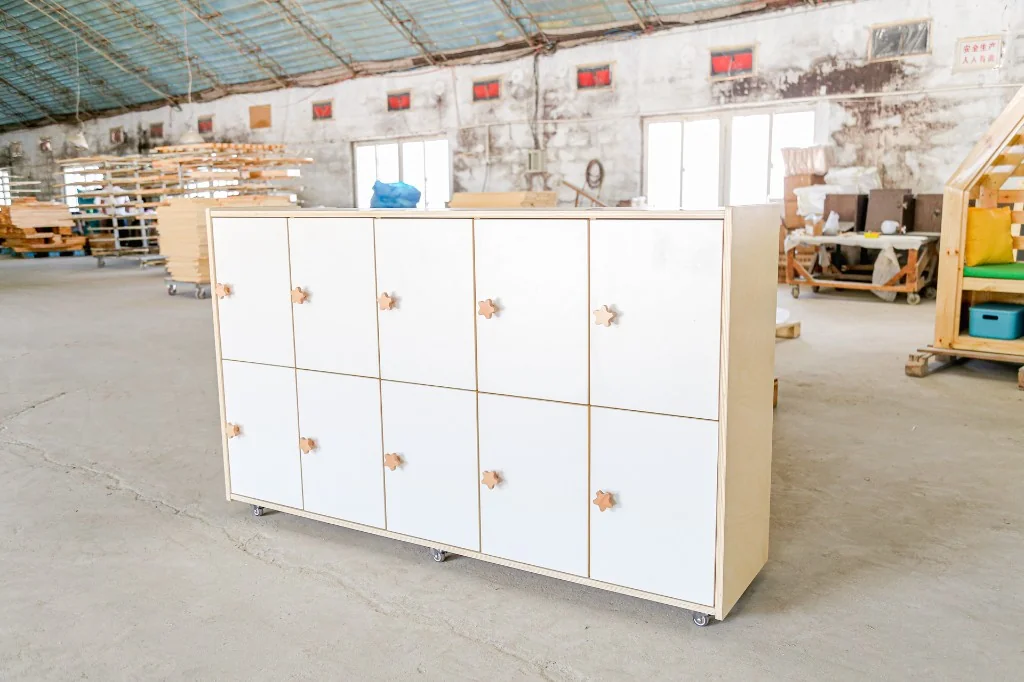
A cubby order is a wall, not a photograph. The 15-door locker below is one factory piece. It does not tell you how many bays fit beside your door. That number comes from the clear wall, after the door swing, divided by a whole bay.
The inch bands below are the common overall sizes already published on the locker and cubby dimensions guide. They are ranges, not the cut size of the photographed unit. Millimetres here are that guide’s inches × 25.4, so a US plan and a metric plan are the same wall. The room dollar bands are on the classroom cost guide. A shared coat run sits outside the single-room figure.
Pick the wall before you pick the unit
Coats live in one place. A closed run at the door the children actually use, or open bays inside the room. A full run in both places is a second line, and it belongs on the drawing only when two groups arrive through different doors.
| Where you mark it | Usual piece | What has to be true |
|---|---|---|
| The arrival door | Closed locker. Bags stay out of the corridor | There is still a walking width after the locker depth. The door swing is drawn, and the run is outside that swing |
| Inside the room | Open bays. A child sees the hook without opening a door | The wall is not the cot row and not the wet art wall |
| Both | Two lines, two walls | Two real arrival doors. Otherwise you are buying the same coat twice |
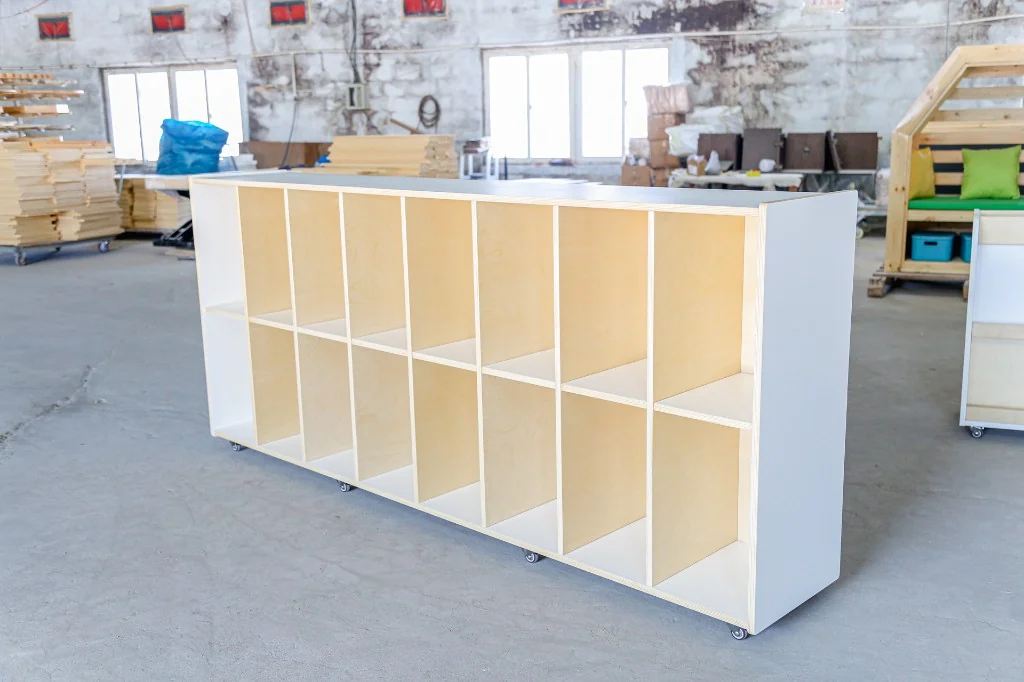
Infant rooms usually keep a short open run in the room. Those children are not hanging a coat at a shared primary-school door. A toddler or preschool room can use one entrance the whole centre shares, and then the in-room wall stays free for tables. Write the age on the plan. Do not give the infant room the preschool entrance locker by default.
Sizes you can actually divide a wall by
These are the dimensions guide’s common overall sizes, converted at 25.4 mm to the inch. The factory still confirms the cut size of the unit you freeze. A range is how you test whether two units fit. It is not a promise that your unit will land on the small end.
Coat lockers, closed
| Sections | Guide width | In millimetres | Guide depth |
|---|---|---|---|
| 3 | 36–42 in | 914–1,067 mm | 14–18 in (356–457 mm) |
| 4 | 42–48 in | 1,067–1,219 mm | 14–18 in (356–457 mm) |
| 5 | 48–60 in | 1,219–1,524 mm | 14–18 in (356–457 mm) |
| 6 | 60–72 in | 1,524–1,829 mm | 14–18 in (356–457 mm) |
| 8 | 72–96 in | 1,829–2,438 mm | 14–18 in (356–457 mm) |
Heights on that guide run about 42–60 in (1,067–1,524 mm), depending on the section count. A preschool entrance can take the taller locker. A toddler room often cannot. If the children cannot reach the hook, it is the wrong height even when the width fits.
Open cubby units
| Bays | Guide width | In millimetres | Guide depth |
|---|---|---|---|
| 6 | 30–40 in | 762–1,016 mm | 12–15 in (305–381 mm) |
| 8 | 40–48 in | 1,016–1,219 mm | 12–15 in (305–381 mm) |
| 9 | 36–48 in | 914–1,219 mm | 12–15 in (305–381 mm) |
| 10 | 48–60 in | 1,219–1,524 mm | 12–15 in (305–381 mm) |
| 12 | 48–72 in | 1,219–1,829 mm | 12–15 in (305–381 mm) |
Open cubbies are shallower than coat lockers. That is why an open unit sometimes fits an in-room wall that a coat locker would block. It is also why an open unit is a poor entrance piece when bags stick into the corridor.
A 3,600 mm entrance wall, worked through
Say the clear wall beside the arrival door is 3,600 mm after you have drawn the door swing. You are testing an 8-section coat locker, because the guide puts 8-section units in hallways and cloakrooms.
| If the unit comes back at | Wall used | Gap left on 3,600 mm | Will a 3-section locker fit in the gap? |
|---|---|---|---|
| 1,829 mm (72 in, the small end) | 1,829 mm | 1,771 mm | Yes. A 3-section is 914–1,067 mm, so 704–857 mm is still unused |
| 2,438 mm (96 in, the long end) | 2,438 mm | 1,162 mm | Yes. After 914–1,067 mm, only 95–248 mm remains |
Two 8-section lockers do not fit. The small end of two is 3,658 mm, which is already longer than 3,600 mm. The honest order on this wall is one 8-section locker, plus a 3-section only if you still want that second unit, and then a gap. The last 95 mm, or the last 800 mm, is not a sliced bay. A bag that fits the other openings will not fit a bay you narrowed to use the gap.
Depth is the other check. A coat locker is commonly 356–457 mm deep. If the corridor in front of it is only that deep, children cannot pass while someone is at the hooks. That wall is not an entrance run. Move the coats inside the room, onto the shallower open unit (305–381 mm deep), or choose a different wall. Do not solve it by ordering the locker and hoping the corridor grows.
Send the clear wall, not a door count from a photo
A 3,600 mm wall does not become a 15-door locker because the factory photo had 15 doors. On the classroom cost guide, one preschool room is commonly $4,800–$9,500 and one toddler room is commonly $6,500–$12,500. The entrance run is an extra line, priced after the wall is measured.
Get Free Daycare DesignWhat the drawing has to show
- The arrival door, the swing, and the clear length that remains, in millimetres.
- Entrance locker, in-room open bays, or both. If both, which door belongs to which group.
- The section count you are testing (3, 5, 8, or whatever the wall survived), not “a cubby unit.”
- Depth: coat locker or open cubby. They are not interchangeable.
- Height against the age. Toddler hooks have to be reachable. A 1,524 mm locker is a preschool piece.
- Casters or fixed feet. Casters suit a run that must pull off the wall for cleaning. Fixed feet suit a run that must not creep into the door swing. Write one.
- The opening date, so this run is cut with the rooms that use it.
Coatings and any test report are matched to this unit and this destination when the drawing is frozen. West Shore does not hold one safety mark that covers every cubby in every country. Name the country.
Mistakes that come back as a second quote
- Ordering the 15-door photo for a wall that cannot take it, then asking the factory to “make it fit.”
- Putting a closed locker and a full open run on the same room, with one door.
- Ignoring the door swing, then discovering the first two bays sit inside it.
- Shrinking the last bay to eat a 100 mm gap.
- Specifying a preschool locker height in a toddler room because the entrance photo looked sturdy.
West Shore Furniture has manufactured in Dalian since 2003, for 5,000+ institutions in 50+ countries. Minimum order quantity varies. The product range is cubbies and lockers. The same floor plan is the sheet on daycare floor plans.
Conclusion
Measure the clear wall after the door swing. Test it against a whole unit from the size table. One 8-section locker fits a 3,600 mm wall. Two do not. A 3-section can take part of the gap. Whatever is left stays empty. Choose the entrance or the room, and write the depth that matches that choice.
On the classroom cost guide, one preschool room is commonly $4,800–$9,500 and one toddler room is commonly $6,500–$12,500. A shared entrance run sits outside that room figure. Send the floor plan, the ages and the opening date. Production is 30–45 days after the drawing is frozen, and a classroom package is commonly 10–14 weeks door to door.
Not ready to send a floor plan? Request the preschool furniture catalog.
FAQ
Should cubbies go at the entrance or in the classroom?
At the door the children use, if one arrival covers the centre and the corridor still has walking width after a 356–457 mm locker depth. Inside the room, on the shallower open unit, if that group does not pass a shared coat wall. Both only when two arrival doors are on the plan.
Is the 15-door locker the standard order?
No. It is one factory piece in the photograph. Your count is how many whole sections fit the clear wall. A 3,600 mm wall takes one 8-section locker, not two, and not “15” as a headcount.
Can the last bay be cut narrower to finish the wall?
No. On the worked example the leftover is anywhere from 95 mm to more than 800 mm, depending on which end of the size range the unit comes back at. That gap is not a bay. A narrowed opening will not take the bag the other bays take.
Why are open cubbies shallower?
The dimensions guide puts open cubbies at 12–15 in deep (305–381 mm) and coat lockers at 14–18 in (356–457 mm). The open unit is the in-room piece. The locker is the entrance piece, and only where the corridor can spare that depth.
Do entrance cubbies ship with the classrooms?
Yes, when they are on the same drawing and the same opening date. Production is 30–45 days after the drawing is frozen. A classroom package is commonly 10–14 weeks door to door. Minimum order quantity varies.
Where does the price sit?
A preschool room is commonly $4,800–$9,500 and a toddler room $6,500–$12,500 on the classroom cost guide. Those figures are the furniture inside the room. The shared entrance run is its own line after the wall is measured.