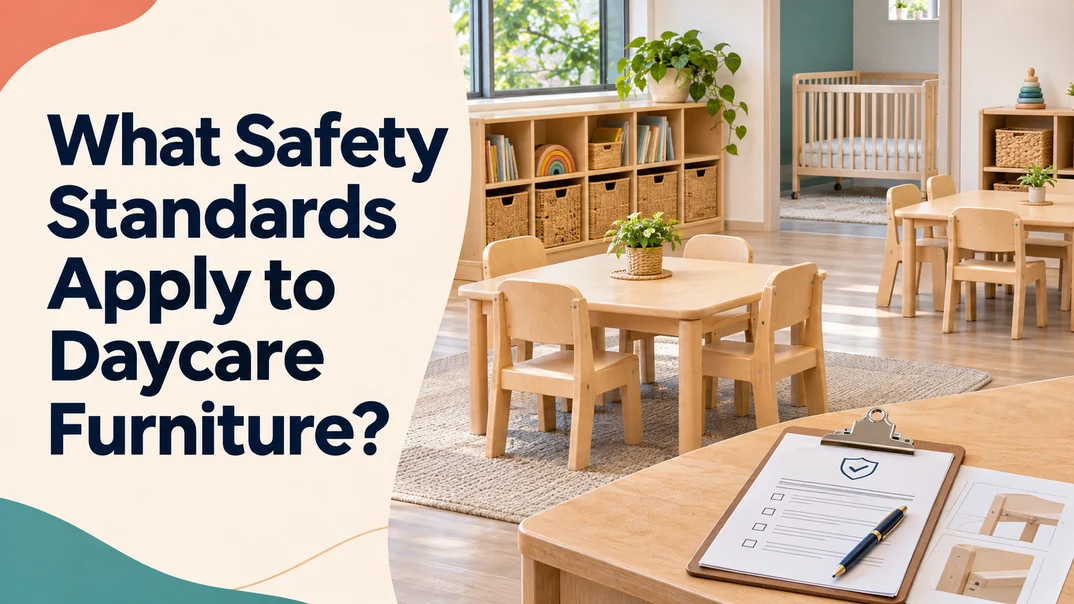
There is no single safety standard that covers every item in a daycare. A child-size table, folding chair, crib, changing unit, play kitchen, upholstered seat, and staff cabinet may all be used in the same building, but they do not automatically follow the same rules.
To compare daycare furniture safety standards by country, you need to start with five facts: where the product will be sold, what the product is, who will use it, how it will be used, and what materials and moving parts it contains. You can then match the exact model to the applicable law, mandatory standard, voluntary standard, and daycare licensing requirement.
This guide gives you a practical international framework. It is not a substitute for a determination by the product safety authority, testing laboratory, importer, or licensing agency in your destination market.
Start With The Product
Do not start by asking a supplier whether its furniture is “ASTM certified,” “EN71 approved,” or “CPSIA compliant.” Those phrases are too broad to tell you whether a particular product is suitable for your market.
Start with these details instead:
| Detail | What You Need To Record | Why It Changes The Requirements |
|---|---|---|
| Destination | Country, state, province, or territory | Product laws and daycare licensing rules differ by location |
| Product Type | Fixed chair, folding chair, table, cubby, crib, cot, changing unit, high chair, toy, or outdoor product | Different product categories can have different mandatory rules |
| Intended User | Child age range, staff, or both | A child-size product may be classified differently from general-use furniture |
| Intended Use | Sitting, sleeping, feeding, changing, storage, climbing, or play | A product’s function can place it within a specific regulation |
| Construction | Dimensions, materials, coating, hardware, moving parts, and restraint system | Chemical, stability, entrapment, pinch, and labeling requirements depend on the construction |
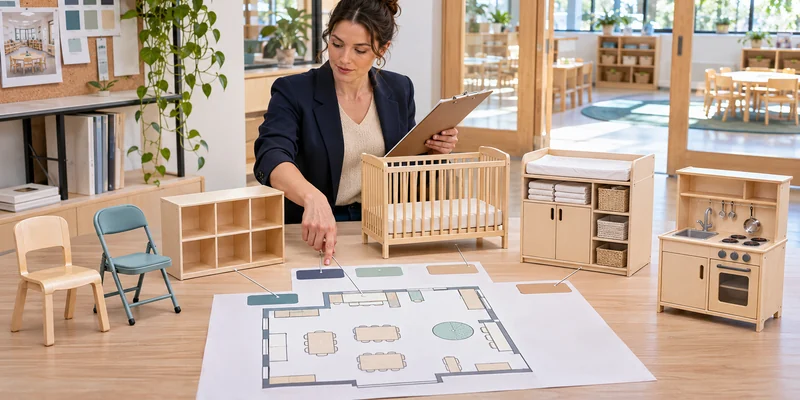
In a full daycare project, you should classify every line on the room list before requesting documents. A classroom package is not one product. West Shore Furniture separates fixed furniture, sleep products, changing products, feeding products, toys, and outdoor equipment during product review because one report cannot normally represent all of those categories.
Separate Rules From Standards
The words law, regulation, standard, test report, and certificate do not mean the same thing.
| Term | What It Means | What You Should Check |
|---|---|---|
| Law Or Regulation | A legal requirement in the destination market | The exact act, regulation, or code citation and its scope |
| Mandatory Standard | A technical standard made compulsory by law or regulation | The edition accepted or incorporated by the regulator |
| Voluntary Standard | A technical method that may help demonstrate safety but is not automatically a legal requirement | Whether a buyer, licensing body, contract, or regulator expects it |
| Test Report | Results for a defined sample tested to stated clauses and an identified edition | Product model, sample, materials, lab, date, results, and scope |
| Certificate Or Declaration | A responsible party’s statement that an identified product complies with listed requirements | Who issued it, who is legally responsible, and what evidence supports it |
An ASTM or EN standard may be voluntary in one situation and legally required in another because a regulation incorporates it. It may also be completely outside the scope of the product you are buying. The standard number and edition matter more than a logo on a brochure.
Requirements By Market
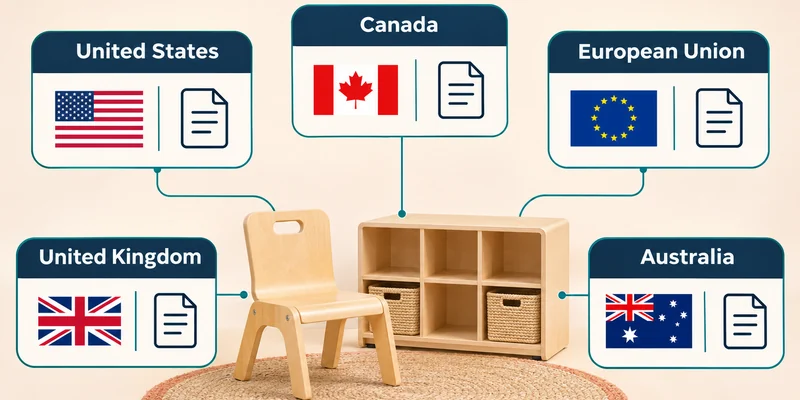
The following market map is a starting point, not a complete legal list. You still need a product-specific review.
| Market | Starting Framework | Examples Of Product-Specific Requirements | Main Buyer Check |
|---|---|---|---|
| United States | CPSC rules, CPSIA, and other federal product regulations | Children’s products, painted furniture, cribs, high chairs, changing products, folding children’s chairs, toys, and certain storage products | Which 16 CFR rules apply to this SKU, and does it require a CPC or GCC? |
| Canada | Canada Consumer Product Safety Act and its regulations | Surface coatings, consumer products containing lead, toys, cribs, cradles, bassinets, playpens, and other regulated products | Which federal regulations cover the exact product, plus what the province requires for childcare use |
| European Union | General Product Safety Regulation and product-specific EU legislation | General furniture safety, toys, chemicals, electrical features, and market traceability | Whether the item is ordinary furniture or an in-scope regulated product such as a toy |
| United Kingdom | UK general product safety and product-specific regulations | Toys, upholstered products, sleep products, and other regulated categories | Which GB or Northern Ireland framework applies and whether a conformity mark is required |
| Australia | Australian Consumer Law and mandatory product safety standards | Household cots, folding cots, bunk beds, infant sleep products, and other listed categories | Whether a mandatory standard applies and what the state or territory childcare regulator requires |
Do not assume that a report prepared for one market can be used in another. A U.S. toy report, Canadian crib document, EU declaration, or Australian cot report answers a particular set of requirements. It does not create worldwide approval.
United States
In the United States, the first question is whether the item is a children’s product, a general-use product, or a more specific regulated product.
The CPSC considers factors such as the manufacturer’s intended use, marketing, child-size features, decoration, and how consumers commonly recognize the product. Child-size furniture designed primarily for children age 12 or younger can be a children’s product. However, the fact that an ordinary shelf or staff chair is located in a daycare does not automatically change its classification. The CPSC’s children’s product guidance includes examples of both situations.
If a children’s product is subject to an applicable children’s product safety rule, the domestic manufacturer or importer must issue a Children’s Product Certificate based on the required evidence, including third-party testing by a CPSC-accepted laboratory when required. The laboratory supplies the test results; it does not take over the manufacturer’s or importer’s legal responsibility for the CPC.
For imports, certification now also affects customs filing. The CPSC states that, beginning July 8, 2026, importers of most regulated consumer products must electronically file certificate data with U.S. Customs and Border Protection. Confirm whether the exact product and entry are within the current eFiling requirement before shipment.
Your U.S. review may include:
- lead in paint and similar surface coatings on furniture;
- total lead in accessible components of children’s products;
- tracking labels for children’s products;
- product-specific rules for full-size and non-full-size cribs, high chairs, baby changing products, play yards, toddler beds, and other durable infant or toddler products;
- 16 CFR part 1232 for children’s folding chairs and stools;
- ASTM F963 as incorporated into 16 CFR part 1250 for toys and toy counterparts, not ordinary furniture;
- tip-over requirements for storage products that fall within a regulated product definition;
- formaldehyde requirements for finished goods containing regulated composite wood.
If you are buying for the U.S., use the separate U.S. daycare furniture safety standards guide to map common classroom SKUs to the relevant federal rules. Also remember that U.S. state childcare licensing, fire rules, building requirements, and insurer conditions remain separate from federal product compliance.
Canada
In Canada, consumer products are governed by the Canada Consumer Product Safety Act and its regulations. The exact requirements still depend on the product.
For example, a crib, cradle, or bassinet sold in Canada must meet the current Cribs, Cradles and Bassinets Regulations. A playpen has its own safety considerations, while a product intended for learning or play may fall within Canada’s toy requirements. Applied surface coatings and accessible materials can also be subject to chemical limits.
Do not treat a U.S. CPC or an ASTM report as proof of Canadian compliance. It may contain useful evidence, but you still need to compare the product with the Canadian definition, regulation, test method, warnings, labels, and recordkeeping requirements that apply. Health Canada’s guidance makes clear that toy requirements depend on design, construction, contents, and marketing.
You also need to check provincial childcare licensing rules. A federally compliant product may still be unsuitable for your center’s permitted age group, sleep practice, sanitation plan, placement, or supervision requirements. If you are planning a Canadian center, the daycare furniture Canada page provides the project context, while the regulator must make the final compliance or licensing determination.
European Union
For ordinary consumer furniture in the European Union, the General Product Safety Regulation provides the general safety framework. It requires businesses to place only safe products on the market and to assess risks that may arise during normal or reasonably foreseeable use. Product identification, traceability, warnings, technical information, and the responsible economic operator also matter.
The EU framework then adds product-specific legislation when the product falls within a regulated category. A play kitchen intended as a plaything may be a toy. A standard classroom table is not automatically a toy merely because children use it. Electrical components, chemical substances, and other features may add separate obligations.
EN 71 is a toy safety series. It is not a universal European furniture certificate. If the item is a toy, the applicable toy rules and relevant EN 71 parts may matter. If the item is ordinary furniture, you need the relevant furniture risk assessment and standards instead.
CE marking follows the same scope principle. It is only required for products covered by EU rules that mandate it. You should not request a CE mark for every wooden shelf or table. Ask first which EU legislation places that product within the CE-marking system.
The EU product safety framework also distinguishes general product safety, harmonized legislation, and technical standards. Your supplier’s document package should show which route applies to the exact model.
United Kingdom
The United Kingdom requires a separate market review. Great Britain and Northern Ireland do not always follow the same product-market route, and the rules for toys, upholstered products, sleep products, and ordinary furniture differ.
If an item is designed or intended for play by children under 14, the UK toy rules may apply. Ordinary furniture should not be reclassified as a toy simply to attach an EN 71 report. Upholstery, mattresses, and padded products also need a product-specific fire-safety review because scope and exclusions can differ by product.
Ask your supplier or importer to state:
- whether the product is being placed on the market in Great Britain or Northern Ireland;
- the legal product category;
- the regulations and designated standards used;
- whether UKCA, CE, or no conformity mark is required for that product;
- the responsible business, technical documentation, warnings, and traceability information.
A statement such as “UK approved” is not enough. You need the legal route and supporting file for the named model.
Australia
Australia does not apply one mandatory standard to every piece of childcare furniture. Mandatory product safety standards cover defined product categories, and general consumer-law safety duties apply more broadly.
Products such as household cots, folding cots, infant sleep products, and bunk beds can have specific mandatory requirements. Other items may use relevant Australian, Australian/New Zealand, or international standards as evidence of safety even when the standard is not automatically mandatory. For example, Australia’s product safety guidance confirms that mandatory standards apply to household cots, while its current high-chair guidance states that no mandatory high-chair standard applies nationally. That difference is why you must classify the product before listing a standard.
You must also check the National Quality Framework and the rules, policies, and licensing conditions that apply in your state or territory. Product compliance does not decide whether a room layout provides suitable supervision, access, hygiene, sleep arrangements, or risk controls. The childcare furniture Australia page can help you plan a room package, but the relevant authorities and your approved provider determine what is acceptable for your service.
Check Each Product Category
You can use this table to identify the next questions. It does not assign a universal standard.
| Product | Main Questions | Evidence You May Need |
|---|---|---|
| Fixed Tables And Chairs | Is it intended primarily for children? Is it coated? What load, stability, and durability method is suitable? | Product specification, material and coating reports, structural test report, instructions, and labels |
| Folding Chairs And Stools | Can fingers reach folding or shear points? Is there a locking mechanism? Is the product within a mandatory category? | Product-specific folding-chair report, lock and stability tests, warnings, and traceability |
| Cubbies And Shelving | Can the unit tip, collapse, trap a child, or expose hardware? Is it a regulated clothing-storage unit? | Stability and load information, anchor instructions, dimensions, hardware specification, and coating documents |
| Cribs And Sleep Products | Is it legally a crib, cot, bassinet, play yard, mat, or another sleep product? Which age and weight limits apply? | Product-specific mandatory test report, mattress specification, labels, warnings, instructions, and registration information where required |
| Changing Products | Does the surface meet the regulated definition? Are barriers, restraints, steps, and storage part of the tested model? | Product-specific report, load and barrier tests, warning labels, assembly instructions, and cleaning information |
| High Chairs | Which market rules apply to the seat, tray, restraint, folding mechanism, stability, and warnings? | High-chair test report, restraint and lock details, instructions, labels, and age or weight limits |
| Play Furniture | Is it functional furniture, a toy counterpart, or both? Does it invite climbing or contain toy features? | Written classification, applicable toy or furniture test reports, age grading, warnings, and material tests |
| Soft Seating And Mats | What are the cover, filling, seams, zipper access, cleaning method, and flammability requirements? | Material specification, chemical and fire-safety evidence where applicable, cleaning instructions, and durability results |
| Outdoor Equipment | Is it furniture, play equipment, or a climbing structure? What installation zone and surfacing are required? | Product-specific structural report, installation manual, use-zone plan, anchoring details, inspection schedule, and age range |
When a product combines functions, assess every function. A storage unit with a play panel is not necessarily covered by one report. A changing unit with steps, doors, a pad, and restraints must be reviewed as the assembled product, not as four unrelated components.
Check Materials And Finishes
Mechanical strength is only one part of safety. You also need to identify the materials children can touch, mouth, scratch, or expose through normal wear.
Paint And Surface Coatings
Ask for the exact finish code and the coated components covered by the report. A report for white paint does not automatically cover a later color or a different coating system. In the United States, paint and similar surface coatings on furniture are subject to the federal lead limit. Other markets have their own chemical and coating rules.
Composite Wood
If a U.S. order contains hardwood plywood, medium-density fiberboard, particleboard, or finished goods made from those products, check the TSCA Title VI composite wood requirements. The invoice, supplier records, labeling, panel producer, and certification information may all be relevant. “Low formaldehyde” is a marketing phrase unless it is connected to the applicable requirement and supporting records.
Plastics, Foam, And Textiles
Do not ask for a generic “non-toxic certificate.” Identify the plastic, foam, textile, adhesive, printing ink, or treatment and then map the applicable restricted-substance, flammability, migration, or accessibility requirement. U.S. phthalate limits, for example, apply to defined children’s toys and child care articles; they are not a universal phthalate certificate for every daycare cabinet.
Hardware
Include hinges, fasteners, magnets, casters, brakes, glides, handles, locks, and restraint components in your review. Check whether they can detach, create a sharp point, form a pinch area, or become accessible after foreseeable use. A material report alone cannot answer those mechanical questions.
Review Mechanical Risks
Whatever market you buy for, your product review should address the hazards created by its actual design and use:
- structural strength and fatigue under the intended load;
- forward, rearward, and sideways stability;
- tip-over risk and the correct anchoring method;
- head, neck, finger, limb, and clothing entrapment;
- sharp edges, points, burrs, and protrusions;
- detachable parts and accessible fasteners;
- folding, hinge, shear, and pinch areas;
- caster movement and brake performance;
- guard, barrier, restraint, and lock performance;
- age, height, weight, and use limitations;
- assembly accuracy and the effect of incorrect assembly.
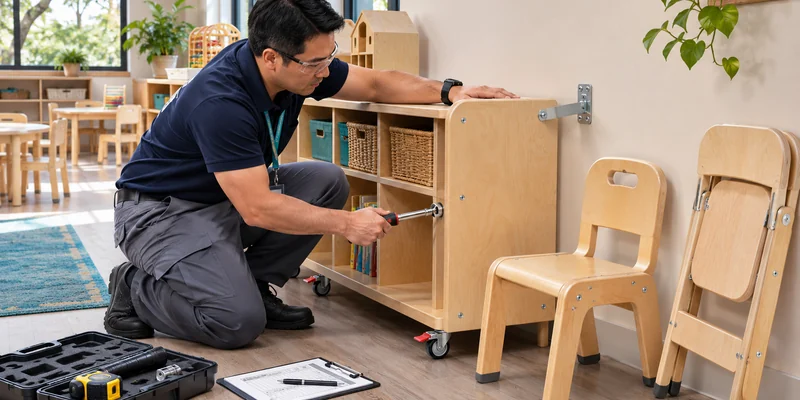
Rounded corners are useful, but they do not prove that the product is stable, strong, free from entrapment, or correctly labeled. Similarly, a water-based finish does not replace a chemical test or a full product assessment.
Check Daycare Licensing Rules
Product safety rules govern the product. Daycare licensing and facility rules govern how the product is selected, installed, placed, cleaned, inspected, and used in your center.
Your local review may cover:
- furniture condition and repair;
- anchoring of tall or climbable storage;
- safe sleep products and spacing;
- changing-station barriers, hygiene, and staff access;
- supervision sightlines;
- clear exits and circulation paths;
- fire behavior and separation from heat sources;
- accessibility and usable clearances;
- cleaning and disinfection procedures;
- inspection records and recall checks.
A product test report cannot approve your floor plan. A successful licensing inspection also does not replace the manufacturer’s or importer’s product obligations. Keep the product-compliance file and the center-licensing file connected but separate.
Ask For The Right Documents
For each SKU, request a short compliance record before you approve production or purchase. It should include:
- Product name, model, dimensions, photo, and intended age range.
- Destination country and intended use.
- Written product classification.
- Applicable regulation, standard number, and edition.
- Test report for the same model, construction, materials, and finish.
- Laboratory name, accreditation scope, report number, sample details, and test date.
- Required certificate or declaration issued by the legally responsible party.
- Materials, coatings, adhesives, foam, textile, and hardware specifications.
- Product and packaging labels, warnings, traceability, and instructions.
- Assembly, anchoring, inspection, cleaning, and maintenance instructions.
- A list of differences between the tested sample and the product you will receive.
- A change-control process for custom dimensions, colors, materials, and hardware.
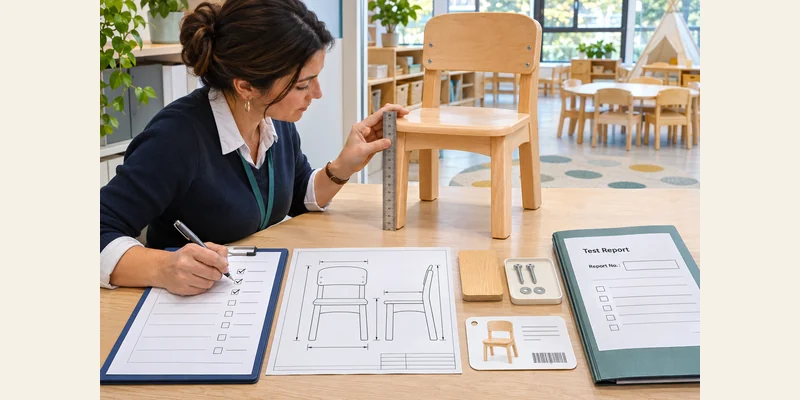
Use the separate guide to verify EN 71 and ASTM test reports against the product, lab, date, sample, standard, and edition. A genuine report for a different chair still does not prove that your chair was tested.
Review Custom Changes
Customization can change more than appearance. A new height may affect stability. A different opening may create an entrapment risk. Added casters can change the base, load path, and brake requirements. A new coating can make an existing chemical report irrelevant. A revised hinge or restraint can change the safety function.
Before approving a custom item, record:
- what changed from the tested model;
- which hazards the change could affect;
- whether the existing evidence still applies;
- whether an engineering review, additional test, or new report is needed;
- which drawing and specification version will enter production.
Do not accept “same series” as the whole analysis. Ask the responsible technical party to explain why the existing evidence covers the changed product.
Buyer Checklist
Before you approve daycare furniture, confirm that you can answer these questions:
- What is the legal product category in the destination market?
- Is the item a children’s product, general-use product, toy, sleep product, feeding product, changing product, or play equipment?
- Which rules are mandatory, and which standards are voluntary or contractual?
- Does every cited report match the exact SKU, dimensions, materials, finish, and hardware?
- Is the standard edition current for the production date?
- Who is legally responsible for the certificate or declaration?
- Are the labels, warnings, instructions, and traceability details ready?
- Have custom changes been reviewed against the tested model?
- Do the facility layout and installation meet local licensing, fire, building, and accessibility requirements?
- Is there a process for recalls, inspections, repairs, and document retention after delivery?
If any answer is missing, treat it as an open purchasing item rather than filling the gap with a broad compliance slogan.
FAQ
Does All Daycare Furniture Need A Safety Certificate?
No single certificate applies to all daycare furniture. The required document depends on the destination market and product. In the United States, a children’s product subject to an applicable children’s product safety rule generally needs a CPC. A regulated general-use product may need a GCC. Other markets use different declarations, technical files, test reports, or recordkeeping systems.
Does ASTM F963 Apply To Daycare Tables And Chairs?
ASTM F963 applies to children’s toys in the United States through 16 CFR part 1250. Ordinary functional furniture is generally outside the toy standard unless it is a toy counterpart. A play kitchen may require a different analysis from a classroom table, even when both are made from wood.
Is EN 71 Enough For Daycare Furniture In Europe?
No. EN 71 is a toy safety series. If the product is a toy, the relevant parts may support toy compliance. Ordinary furniture still needs the correct general product safety and furniture assessment. Materials, electrical features, upholstery, and other functions may create additional requirements.
Does A CE Mark Prove That Furniture Is Safe?
No. CE marking only applies when specific EU legislation requires it, and it represents the manufacturer’s declaration of conformity. Many ordinary furniture products are not within a CE-marking law. You still need to confirm the product category, applicable requirements, technical evidence, and traceability.
Can One Test Report Cover An Entire Classroom Package?
Usually not. Tables, fixed chairs, folding chairs, shelves, cribs, changing products, toys, and outdoor equipment have different designs and may fall within different rules. A report may cover a defined product family when the scope and technical justification support it, but the model list and differences must be explicit.
Do Custom Colors Or Dimensions Require New Testing?
Sometimes. A color or coating change can affect chemical evidence. A dimension, caster, hinge, opening, or restraint change can affect stability, strength, entrapment, or other mechanical results. Review the change against the tested sample before deciding whether the existing report remains valid.
Confirm The Rule Before Production
The safest buying process is not to collect as many logos as possible. It is to classify each product, name the destination market, identify the applicable rules and current editions, match the evidence to the exact SKU, and confirm how the item will be installed and used in your center.
If you are planning a multi-room daycare project, send West Shore Furniture your destination, floor plan, child age groups, product list, and required documentation before approving the final specification. You can then review an organized room list, product details, and available supporting documents with the responsible local professionals before approving each item.