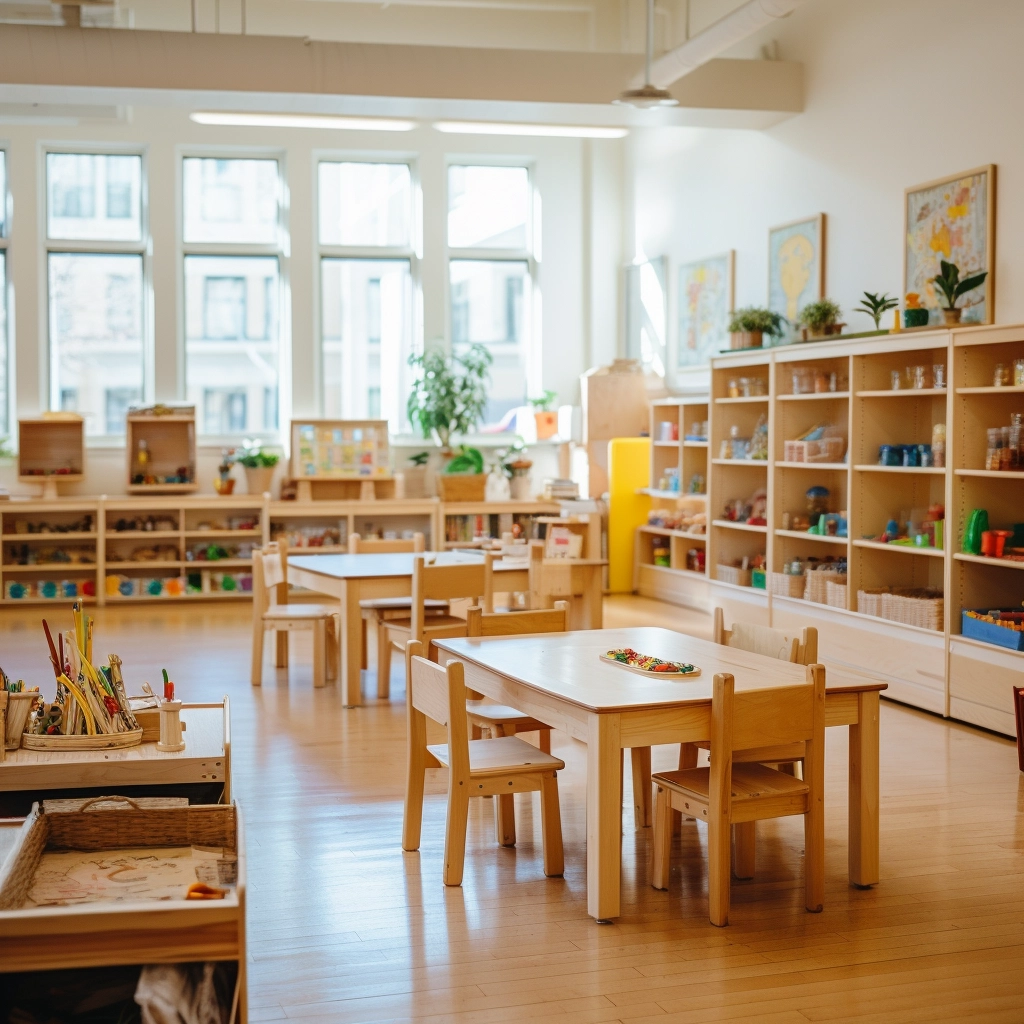
When planning a new preschool classroom, many directors and childcare owners start with two practical questions:
I am setting up a new preschool classroom from scratch. Where should I start?
How many learning centers do I really need?
You may already know that your classroom needs areas for reading, art, blocks, dramatic play, sensory activities, and quiet time. But the harder part is deciding which centers should come first, how much space each area needs, and how to keep the room easy to supervise once children begin using it every day.
This guide walks you through How to Set Up Learning Centers in the Classroom step by step. You will learn how to choose the right learning centers, plan the classroom layout, create clear boundaries, select suitable furniture, organize materials, and build daily routines that make the space easier for teachers and children to use.
What are Learning Centers in Preschool?
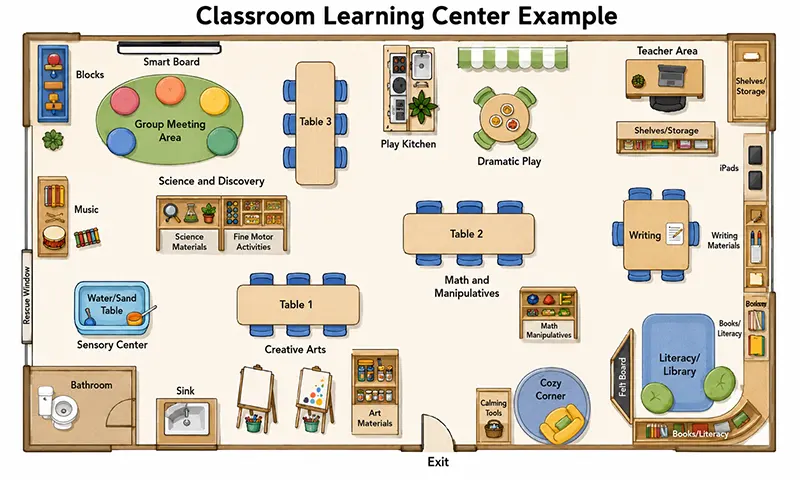
Before you decide how many learning centers your classroom needs, it helps to look at the areas children will use every day. In preschool, a learning center is a planned space for one main type of activity, with suitable furniture, materials children can reach, and enough room for safe movement.
A reading corner is a simple example of a learning center. It works well when children can see the book covers, choose a book by themselves, sit comfortably, and return the book to the same shelf after reading. With this setup, the area has a clear purpose and is easier for teachers to keep organized.
Common preschool learning centers include:
- Reading and Literacy Center: A quiet area for books, storytelling, early language activities, and independent reading.
–How to Create the Perfect Classroom Reading Corner?–
- Art Center: A creative space for drawing, painting, cutting, gluing, and hands-on art projects.
–How to Set Up and Manage a Preschool Art Center?–
- Math and Manipulatives Center: A small activity area for counting, sorting, matching, puzzles, patterns, and fine motor practice.
- Science and Discovery Center: A place for children to observe, compare, and explore natural materials, simple tools, and discovery trays.
–How to Set up the Preschool Science Center?–
- Dramatic Play Center: A role-play area where children act out real-life scenes such as cooking, shopping, caring, or working.
- Block and Construction Center: An open floor area for building, problem-solving, teamwork, and spatial thinking.
- Sensory or Sand and Water Center: A hands-on area for pouring, scooping, filling, measuring, and exploring different textures.
–How to Set Up a Sensory Room for Early Childhood Programs?–
- Calm or Cozy Corner: A soft, quiet space where children can rest, self-regulate, or take a short break from a busy classroom.
–How to set up a Calming Corner for Children?–
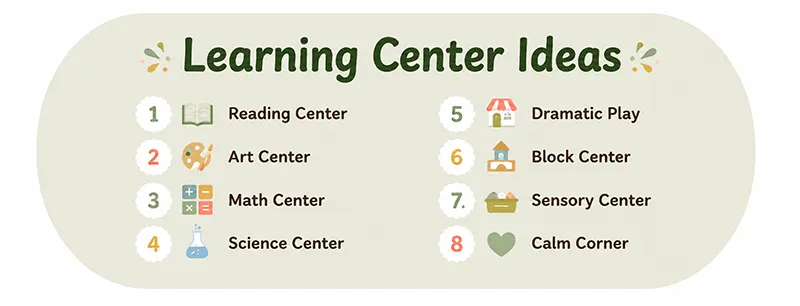
You do not need to make each center large. The key is to give every area a clear purpose, proper storage, and enough space for children to use materials safely.
How to Set Up Learning Centers in the Classroom?
A good learning center setup starts with two things: your children’s needs and your classroom space. Once you understand the age group, daily routine, available space, and supervision needs, it becomes much easier to decide which centers to set up first and how each area should be arranged.
Step 1: Determine Your Classroom Needs
Start with three simple questions: How old are your children? What are they learning right now? What skills do they need to practice through daily play? These questions will help you decide which learning centers should come first and how each area should be designed.
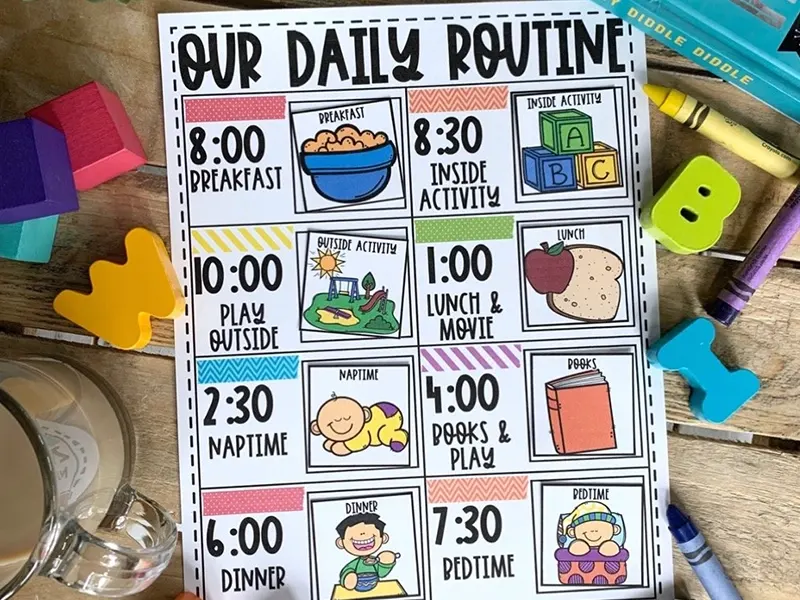
You should also look at your daily preschool routine. Think about when children will use each center. Will they use centers during arrival time, free choice, small-group activities, quiet play, or transition periods? A center that works well during free choice may need open access and clear storage, while a center used during small-group time may need a table, chairs, trays, and teacher guidance.
Some centers, such as reading and quiet areas, are useful in almost every early childhood classroom. The real difference is how you set them up. A toddler reading area may need soft seating, board books, and very low book displays, while an older preschool classroom may include more picture books, story cards, alphabet materials, and space for independent reading.
For age-based planning, look more closely at the centers that change with children’s development. Toddlers usually need simple sensory play, open floor space, fine motor activities, soft boundaries, and areas that are easy to supervise closely. Older preschoolers can handle more defined centers, such as dramatic play, blocks, science discovery, math manipulatives, art, and early writing, because they are ready for longer play, more materials, and clearer routines.
The content children are learning should also guide your choices. If your class is learning about plants, weather, or animals, a science and discovery center can support that topic. If children are learning about community helpers, a dramatic play center can become a post office, clinic, shop, or restaurant. If the focus is counting, sorting, shapes, or patterns, a math and manipulatives center may need more attention.
You should also consider the skills children need to practice most. Fine motor skills may require art, puzzles, threading, sorting trays, or manipulatives. Social language and cooperation may point to dramatic play and block building. Self-regulation may require a calm corner or sensory area. Once these needs are clear, you can choose learning centers based on your actual classroom instead of following a fixed list.
Step 2: Assess Your Classroom Space
Classroom space is always limited, so each learning center needs a clear place and a realistic size. Before arranging the room, decide where each center will go and how much space it can use without blocking walkways, doors, storage areas, or teacher supervision.
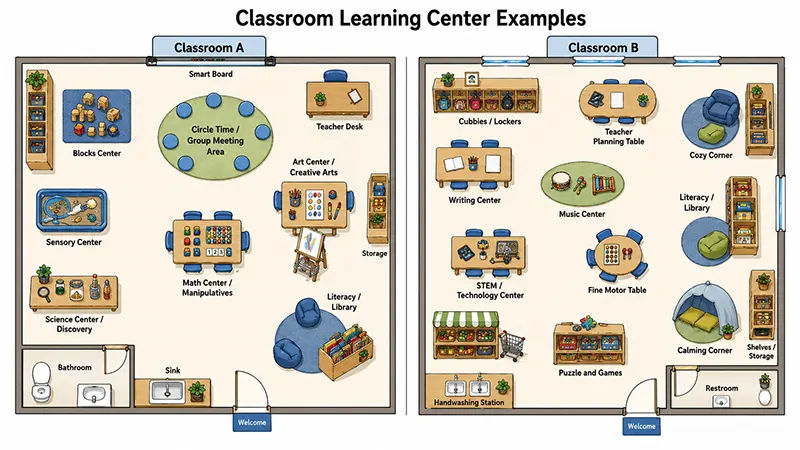
For each center, ask yourself: How many children will use this area at one time? Will they sit at a table, work on the floor, or use a rug? Do they need chairs, shelves, trays, soft seating, or open floor space? For example, an art center may need a child-sized table and easy-clean storage, while a block center needs more floor space and a rug. After checking these details, you can decide how many learning centers your classroom can realistically support.
Step 3: Prepare Furniture and Materials for Each Center
After you know your children’s needs and the available classroom space, you can start preparing the furniture and materials for each learning center. Each area should have the furniture that supports its main activity and enough materials for children to use without making the space crowded.
For daycare centers and preschools that want to set up learning centers more efficiently, West Shore Furniture can help provide coordinated classroom furniture sets. This makes it easier to plan each area as a complete center instead of choosing separate pieces one by one.
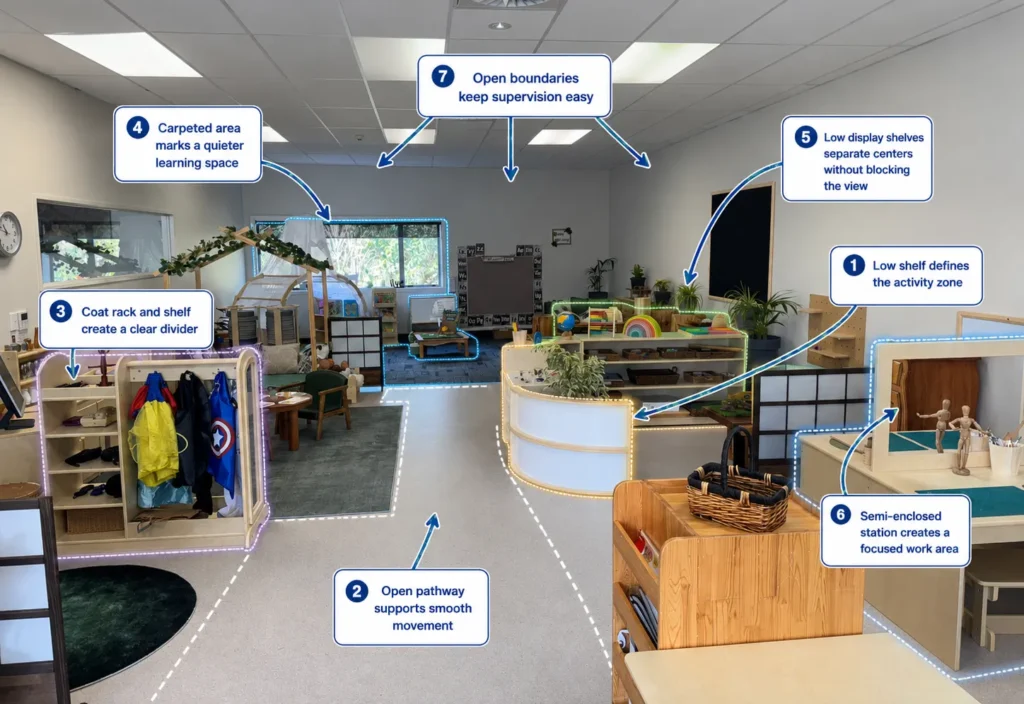
Step 4: Create Clear Boundaries Between Each Learning Center
Clear boundaries help children understand where each activity starts and ends. You can use low shelves, rugs, child-sized tables, soft seating, storage units, or room dividers to separate different centers. For example, a rug can define the block area, a low shelf can separate the reading corner, and a table with storage can mark the art center. The boundary should guide children without blocking teachers’ view. In preschool classrooms, low and open dividers usually work better because they create structure while still allowing easy supervision.
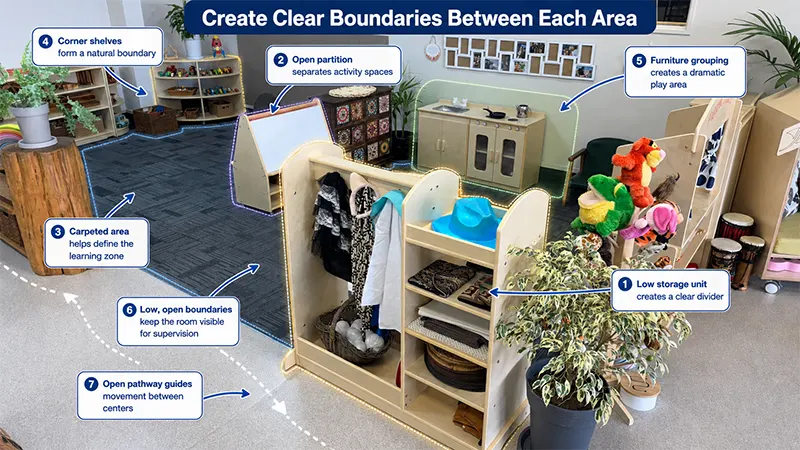
Step 5: Place Decorations
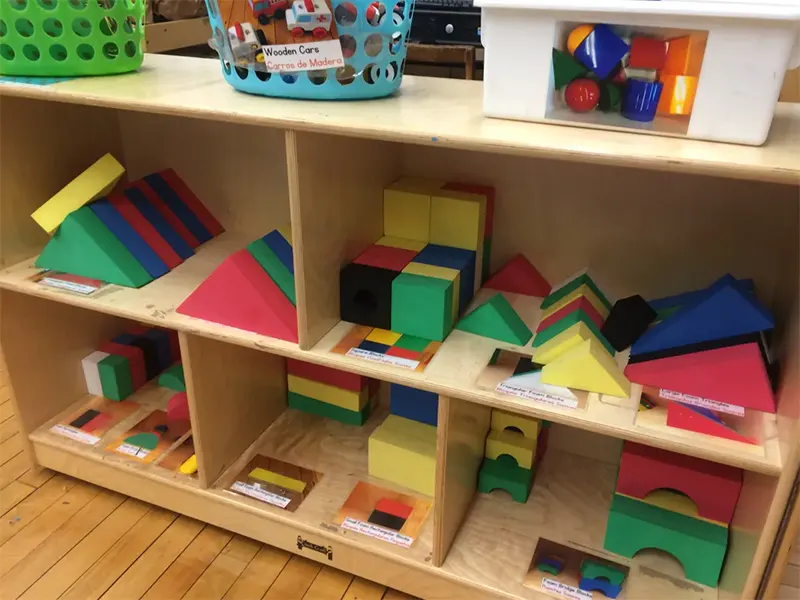
Labels and simple visual instructions help children use each center with less teacher support. Use picture labels on bins and shelves so children know where materials belong. You can also add a small visual rule card for each center, such as how many children can play there, how to use materials, and how to clean up. Keep the rules short and easy to understand. For younger children, pictures work better than long written directions. When expectations are visible, children can follow routines more independently, and teachers spend less time repeating the same instructions.
Managing Learning Areas on a Daily Basis
A well-planned classroom layout helps, but learning centers only work smoothly when children know the daily routine. You need to teach them how to choose a center, how to use materials, how many children can stay in one area, and how to clean up before moving on.
Choose a Management Style That Fits Your Class
For most preschool classrooms, I recommend starting with a simple small-group rotation or a limited free-choice system first. Full free choice can work very well, but only when children already understand the rules, the materials, and the cleanup routine.
Small-group rotation is easier to manage at the beginning because you can control how many children use each center at one time. This is especially helpful for younger children, larger classes, or classrooms that are still building daily routines. For example, one group can work at the art table, another group can use the block area, and another group can read or use manipulatives. Children know where to go, and teachers can supervise more easily.
As children become more familiar with the classroom, you can gradually allow more free choice. For example, children may choose between two or three open centers, while messier or more active areas, such as sensory play or art, still have a clear limit. This gives children independence without making the classroom feel uncontrolled.
Teaching Children How to Use Learning Areas
Children need to be taught how to use each learning center before they can use it independently. When introducing a center, show children the whole process. Walk them through where the materials are stored, how to choose one item, where to sit or work, how to use the furniture safely, and where everything goes after the activity. For example, in the art center, you can show children how to take paper, choose crayons or glue, work at the table, place finished work in the drying area, and return tools to the right bin.
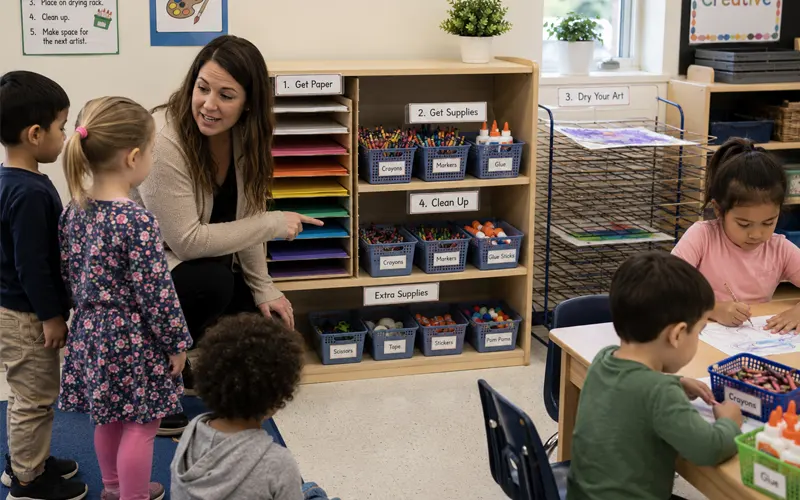
You can also practice with children before full center time begins. Let them watch the teacher model the steps, then ask a few children to try it while the rest of the class observes. This makes expectations clearer and reduces repeated reminders later. For areas like blocks, sensory play, dramatic play, and art, this step is especially important because these centers can quickly become messy or crowded.
Build Cleanup into the Routine
Cleanup should be taught as part of using the center, not treated as a separate task at the end. Children need to know that choosing a material also means returning it to the right place. You can also give children a short warning before cleanup, such as “five more minutes,” then use the same cleanup signal every day. Younger children may need the teacher to clean with them at first. Instead of only saying “clean up,” show them exactly what to do: blocks go back on this shelf, crayons go in this cup, puzzle pieces go in this tray, and dress-up clothes go on this hook.
Rotating Materials
You can keep the same furniture and center layout while changing the materials inside each area. This keeps the classroom familiar for children but still gives them something new to explore. The key is to rotate materials in a controlled way. Do not put out too many new items at once. Keep the main routine the same, introduce new materials clearly, and remove items that are no longer being used. This helps learning centers stay fresh without making the whole classroom feel unfamiliar.
West Shore Furniture Toddler Learning Center Set
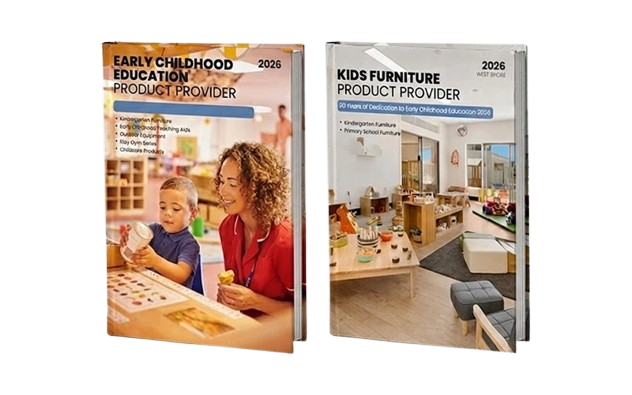
For toddler classrooms, learning centers should be simple, safe, and easy to manage. West Shore Furniture helps daycare centers and preschools build complete toddler learning center sets with coordinated furniture, storage, and classroom layout support. Instead of purchasing single items one by one, you can plan the room by area and create a more organized classroom from the beginning.
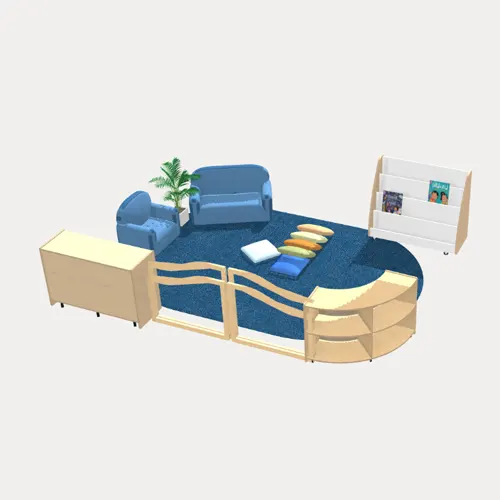
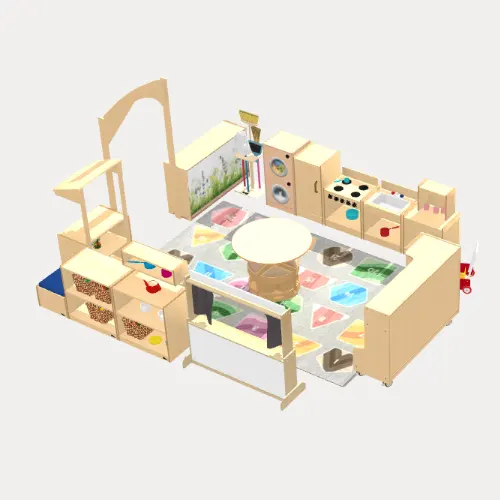
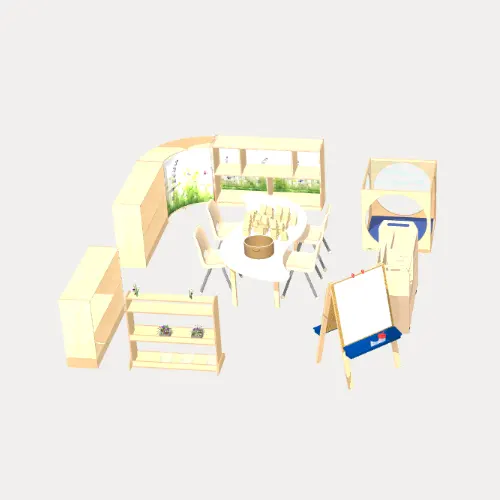
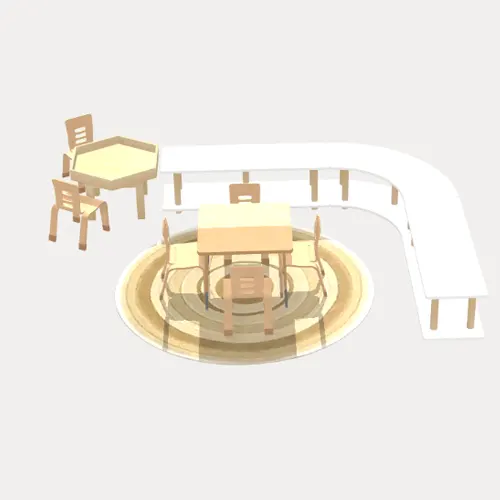
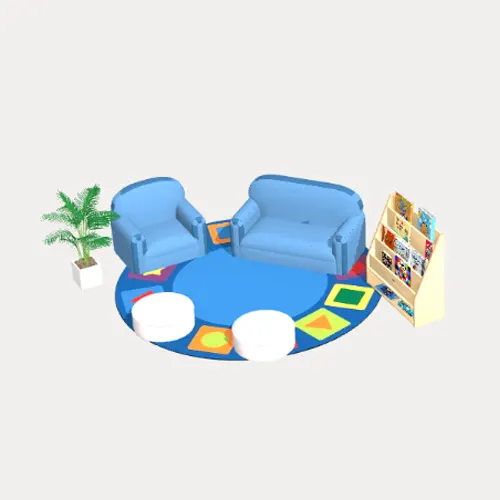
These sets can be adjusted based on classroom size, children’s age, curriculum needs, and project budget. For new daycare projects or classroom renovations, West Shore Furniture can also provide layout suggestions, customized sizes, color matching, bulk production, and export-ready packaging, helping schools set up toddler learning centers faster and with fewer mismatched furniture problems.
Connect Learning Centers with a Classroom Theme
Sometimes, even when all the learning centers are set up, the activities can still feel separate. A simple classroom theme can solve this by giving several centers the same topic to work around. Children meet the same idea through books, art, objects, role play, and hands-on materials, so the classroom feels more connected and easier to follow.
You can start with one simple theme and choose a few learning centers to connect with it. The reading center can include related books, the art center can offer matching craft materials, the science center can provide real objects or observation trays, and the dramatic play center can use simple props from the same topic. You do not need to force every center to follow the theme. It works better to connect the centers where the theme feels natural.
Themes do not need to change too often. Many preschool classrooms use a theme for one or two weeks, while seasonal themes can last longer. The goal is to give children enough time to explore the materials deeply before changing them. When it is time to refresh the theme, keep the furniture and center layout the same, and only rotate books, props, labels, display cards, and hands-on materials.
FAQs About Setting Up Learning Centers
What learning centers should be included in a preschool classroom?
A preschool classroom can include reading and literacy, art, math and manipulatives, science and discovery, dramatic play, block and construction, sensory play, and a calm or cozy corner. You do not need to set up all of them at once. Start with the centers that match your classroom size, curriculum, and daily routine, then add or rotate other areas as needed.
How much space do preschool learning centers need?
There is no fixed size for every learning center, because it depends on the activity and the number of children using it. Quiet centers, such as reading or math, can work in a smaller corner. Active centers, such as blocks, dramatic play, and sensory play, need more open floor space. The most important point is to leave enough room for children to sit, move, use materials safely, and pass between centers without crowding.
Should learning centers be fixed or flexible?
A preschool classroom usually works best with a mix of fixed and flexible learning centers. Some areas, such as the reading corner, block center, or calm corner, are better kept in the same place because children need a stable routine. Other centers, such as art, science, sensory play, or dramatic play themes, can be changed or combined based on the curriculum, season, or available space. This gives the classroom structure without making the layout too rigid.
How do you divide learning centers in an open classroom?
You can divide learning centers in an open classroom with low shelves, rugs, child-sized tables, soft seating, storage units, or low room dividers. The goal is to make each area easy for children to recognize without closing off the teacher’s view. For example, a rug can define the block area, a book display can mark the reading corner, and a low shelf can separate art materials from dramatic play props. Clear boundaries make the classroom easier to manage and supervise.
How do you keep learning center materials organized?
Keep materials visible, limited, and easy for children to return. Open shelves, labeled bins, picture labels, trays, baskets, and cubby storage can help children understand where each item belongs. Avoid putting too many materials in one center at the same time, because it often creates clutter and makes cleanup harder. A better approach is to keep a simple set of materials in each center and rotate them regularly.
Are learning centers suitable for toddlers, preschoolers, or mixed-age classrooms?
Yes, learning centers can work for toddlers, preschoolers, and mixed-age classrooms, but the setup should match the children’s age and ability. Toddlers need fewer materials, lower furniture, softer boundaries, and close supervision. Preschoolers can use more defined centers with simple rules, labels, and independent cleanup routines. In mixed-age classrooms, materials should be arranged by difficulty, with safe toddler-accessible items at lower levels and more advanced materials placed where older children can use them with guidance.
How long should children stay at each center?
The time depends on the children’s age, attention span, and classroom routine. Younger children may only stay in one center for a short time, while older preschoolers may stay longer when they are deeply engaged. Some classrooms use free choice, allowing children to move when they are ready. Others use small-group rotations with a simple time limit. Instead of focusing only on minutes, watch whether children are still engaged, whether the center is crowded, and whether transitions are running smoothly.
Conclusion
Learning centers work best when they are planned around real classroom use, not simply added as separate activity corners. If you want to understand How to Set Up Learning Centers in the Classroom, start with your room size, daily routine, number of children, and teacher supervision needs. Then decide which centers are truly necessary, use clear boundaries, choose child-sized furniture, organize materials within children’s reach, and adjust the layout after observing how children use the space.
A well-planned learning center layout can make a preschool classroom easier to manage, safer to supervise, and more inviting for children. Whether you are creating new preschool learning centers or improving an existing classroom, the right furniture makes the setup much easier to maintain over time. For schools and daycare projects that need coordinated classroom furniture, storage, dividers, activity tables, and layout support, Meubles West Shore can help turn the plan into a practical classroom setup without making the process more complicated.