
Direct answer
West Shore Furniture budgets a preschool playground as a site project: commonly $10,000–$25,000 for a basic outdoor play area, $25,000–$60,000 for a standard preschool playground, and $60,000–$100,000+ for a complete custom job. On a $40,000 plan, the structure is often $14,000–$20,000; surfacing, site, install and freight take the rest. West Shore builds the indoor rooms. The outdoor structure is a contractor file.
Owners and playground investors search this title because a slide price is not a yard. Noah’s Play and the big commercial catalogues already sell the climber. This page keeps the planning bands this URL has used and writes the split a director can take to a board: what is equipment, what is ground, what is indoor furniture West Shore actually makes.
Indoor classroom dollars stay on cost to furnish a daycare classroom. The whole-centre envelope is on the daycare startup cost breakdown. The measuring sequence — yard, ages, fence, surfacing — is on preschool playground design. Do not steal the outdoor line to finish the cubbies, or steal the cubby line to finish the rubber.
Equipment price is not the project
A preschool playground quote that shows only a climber is a product page, not a budget. The finished yard usually has five invoices.
| Line | What it actually buys | Typical share of a $40,000 plan |
|---|---|---|
| Playground equipment | Main structure plus freestanding slides, climbers, sensory panels, pretend-play units | 35%–50% · about $14,000–$20,000 |
| Safety surfacing | Impact-absorbing surface inside use zones, borders, base | 15%–30% · about $6,000–$12,000 |
| Site preparation | Clearing, grading, drainage, a level pad | 5%–15% · about $2,000–$6,000 on an easy site |
| Installation | Assembly, footings, punch list | 15%–25% · about $6,000–$10,000 |
| Shipping and delivery | Freight, local cartage, unload | 5%–10% · about $2,000 |
Those shares are planning maths on a $40,000 “standard” yard — the same worked example this page has used — not a West Shore outdoor SKU. A rocky slope, a retaining wall or a long crane day will blow the site line first. Poured-in-place rubber will blow the surface line first.
Planning bands owners actually use
| Yard | Planning band | What you usually get |
|---|---|---|
| Basic outdoor play area | $10,000–$25,000 | A few freestanding pieces, a modest surface, little site work |
| Standard preschool playground | $25,000–$60,000 | A main structure, surfacing, ordinary install, ordinary freight |
| Complete custom project | $60,000–$100,000+ | A designed yard, heavier surfacing, awkward site, shade or fencing extras |
The top of the range is not a luxury tax. It is shade structures, fencing upgrades, accessible routes, and the day the excavator finds a drain. Write a contingency on the outdoor line the same way you write one on the fit-out.
The $1,000-per-child envelope
Commercial playground sellers often start at about $1,000 per child using the playground at one time. That is a capacity figure, not licensed places for the whole centre. A 60-place preschool that only puts 18 children in the yard at once is an 18-child envelope, not a 60-child envelope. Use it to see whether the board is in the right decade, then get a contractor price for the actual pad.
Budget the yard and the classrooms as two invoices
Share the floor plan, outdoor dimensions, ages and opening date. West Shore prices the indoor rooms and indoor play pieces. You take the outdoor structure to a playground contractor.
Get the indoor furniture layoutSurfaces, site work and the papers installers cite
The structure is what photographs well. The surface is what the inspector and the insurer read. CPSC’s playground education page is playground safety guidance. Contractors in the US commonly cite ASTM F1487 for public-use playground equipment and ASTM F1292 for impact attenuation of surfacing. West Shore does not write those reports. Name the contractor who will.
- Engineered wood fibre is usually the cheaper surface and the higher-maintenance one.
- Rubber tiles sit in the middle: cleaner than fibre, more joints than a pour.
- Poured-in-place rubber is the line that turns a $25,000 yard into a $45,000 yard when the use zone grows.
- A surface that does not cover the use zone is not a saving. It is an incomplete install.
Site work is the silent killer on conversions: a car park that must become a yard, a slope, a flood-prone corner, a fence the fire officer will not accept. Price the pad before you fall in love with a climber rendering.
Indoor play furniture versus the outdoor structure
Google also ranks backyard cedar playsets and “preschool playground design” catalogues on nearby queries. Those pages sell a structure. West Shore sells the rooms the children still have to live in when it rains.
| Invoice | Who should quote it | Examples |
|---|---|---|
| Outdoor play structure and surfacing | A playground contractor / commercial play OEM | Climber, slide, swing bay, poured rubber, EWF, fence, shade |
| Indoor classroom furniture | West Shore classroom package | Tables, chairs, cubbies, shelves, infant changing wall |
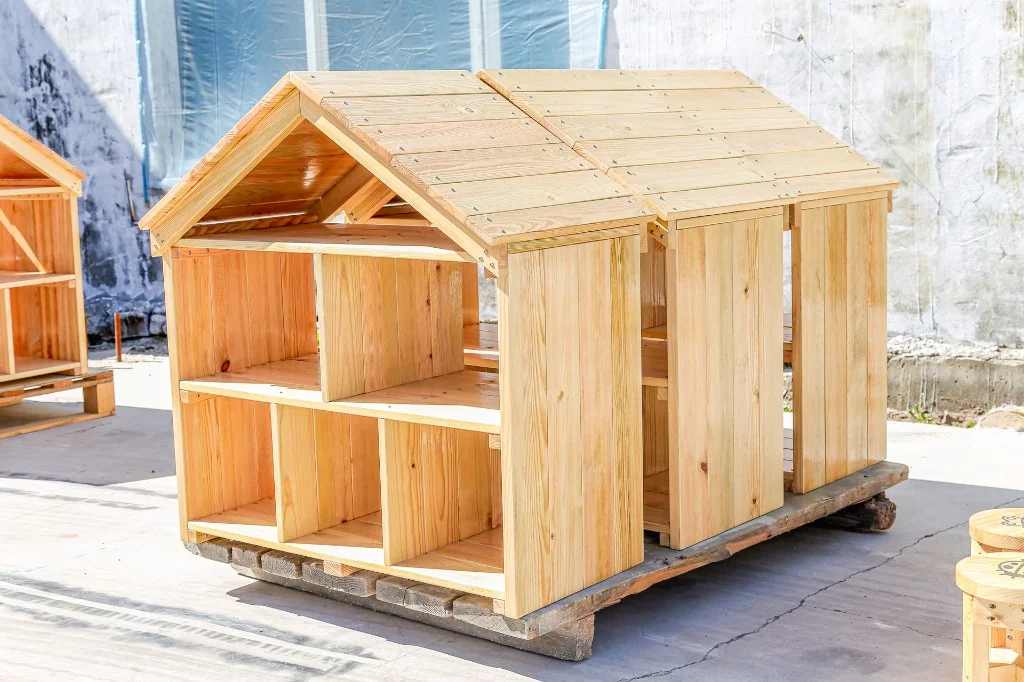
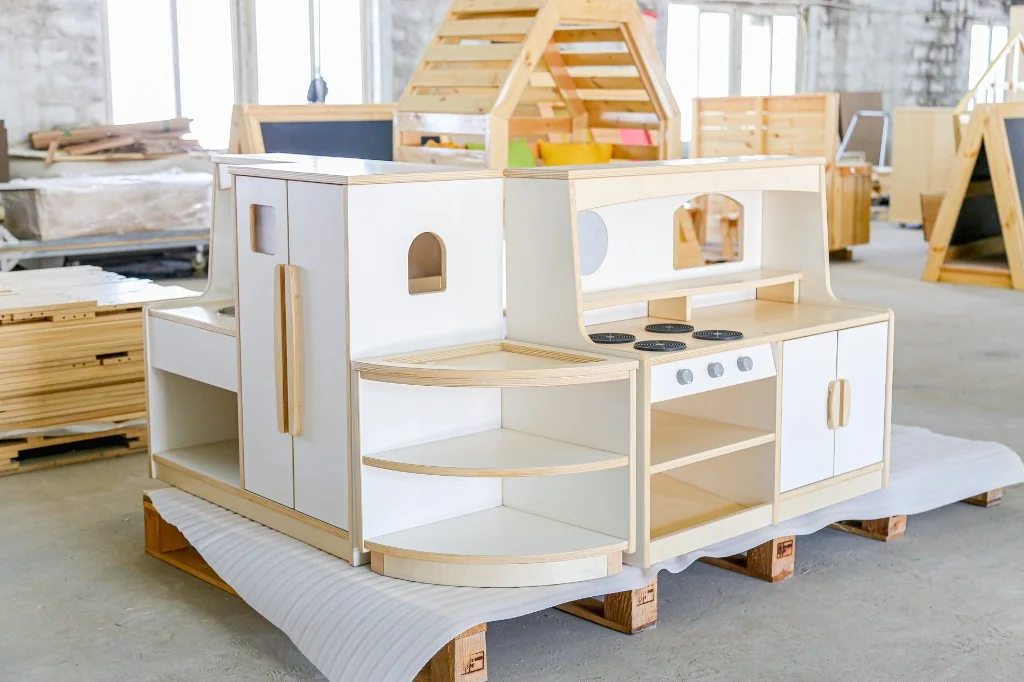
| Indoor play pieces | West Shore, on the same finish as the rooms | Playhouse cubby, play kitchen, water/sand table, benches |
If the outdoor budget is thin, phase the yard: a safe surface and one structure this season, the second bay next year. Do not fill the gap with a residential playset that will not survive a daycare week. Do not fill it by skipping cubbies so the rubber can be thicker. Those are two licences in the same building, not one pot of cash.
The yard keeps costing money after opening day
The five invoices above are the opening cheque. Owners who have already opened ask a different question: what disappears in year two. Loose fill walks away from the swings. Poured rubber cracks. Plastic fades and chips. A quote that stops on installation day has not priced the yard.
The U.S. Consumer Product Safety Commission’s Public Playground Safety Handbook is the paper US contractors hand an owner for this. Loose-fill compresses at least 25 percent from use and weather. The handbook’s own example: a yard that needs 9 inches of wood chips should be filled to 12 inches on day one. It also says not to run loose-fill thinner than 9 inches, except shredded or recycled rubber, where it recommends 6 inches. Grass and dirt are not a safety surface. Child-care yards and schools should be checked often, especially under swings and at slide exits, and the target depth should be marked on the posts so staff can see the hole before an inspector does.
Poured rubber and rubber tile are the other surface. The handbook treats them as a unitary system: install to the maker’s instructions, and ask for ASTM F1292 impact data for the fall height you actually have. It does not publish a preschool replacement price, and this page will not invent one. Public parks show the shape of the later invoice. San Francisco’s West Sunset Playground let a poured surface go about 15 years until it crumbled, and the city was told a full tear-out and replacement was nearly $600,000. Salem, Oregon, closed one park to replace failing rubber tile and another to replace a 28-year-old structure. Those are city parks with city access rules. A centre yard is smaller. The lesson is the same shape: the coloured wear layer and the cushion underneath are a contractor invoice after opening, and the board should see a line for it before the first child uses the yard.
The structure wears where it moves and where the sun sits on it. The handbook says to follow the manufacturer’s inspection schedule, look at swing hangers and other moving parts, fix what the inspection finds, and keep the signed record. On playground forums, people who sell commercial equipment describe the cheap online structure the same way: the rotomolded plastic goes brittle, then the replacement part and the local installer are the parts you cannot get. That is why a residential playset is not a way to close a gap in a daycare yard.
Put three lines on the outdoor budget besides the opening bands: who rakes and how often, who holds the manufacturer’s checklist, and a named reserve for top-up or resurfacing. West Shore Furniture does not price that reserve and does not build the climber. We price the indoor rooms that have to open the same week, built in Dalian since 2003. Production is commonly 30–45 days after the drawing is frozen, and a classroom package is commonly 10–14 weeks door to door.
What to take to the board
- Three bands: basic / standard / custom — with the $10k–$25k / $25k–$60k / $60k–$100k+ ranges written.
- A $40,000 worked split so nobody thinks the climber is the whole cheque.
- A named playground contractor for structure and surfacing.
- A named indoor package — start from classroom furnish cost — so the rooms still open if the yard slips a month.
- A maintenance line: who checks the fill depth, who signs the inspection, and a reserve for top-up or resurfacing. The opening bands do not include it.
- A phase plan if the first outdoor cheque is $10,000.
FAQs
How much does a preschool playground cost?
West Shore Furniture treats a preschool playground as a site project, not a catalogue slide. This page’s planning bands stay $10,000–$25,000 for a basic outdoor play area, $25,000–$60,000 for a standard preschool playground, and $60,000–$100,000+ for a complete custom project. The equipment invoice is often less than half. Surfacing, site work, installation and freight fill the rest. Ask a local playground contractor for the structure. Ask West Shore for the indoor rooms that still have to open.
Is $10,000 enough for a preschool playground?
It can cover a small, simple outdoor corner — a couple of freestanding pieces and a modest surface — if the ground is already clean and level. It will not cover a main climbing structure, poured-rubber surfacing and a difficult site. Owners who open on a $10,000 outdoor line should write what was deferred, not pretend the playground is finished.
How much should I budget per child for a preschool playground?
A common planning rule on commercial playground quotes is about $1,000 per child using the playground at one time — not per licensed place in the whole centre. Treat that as a first envelope, then price surfacing and site work. West Shore does not sell that rule as a West Shore SKU.
Does playground equipment pricing include installation?
Usually not. The equipment line is the structure. Installation, footings, surfacing, borders, drainage and freight are separate. A quote that is only a slide price is not a project price. West Shore will not install poured rubber or stamp a playground as “done” from a furniture PO.
Can a daycare operate without an on-site playground?
Some licences allow a nearby park or a shared yard. That is a licensing and insurance question for your jurisdiction, not a furniture question. If you use a park, write the walk, the ratio and the rain plan. Do not skip indoor active play because the park exists. Indoor playhouses and kitchens are a different PO.
Does West Shore manufacture commercial playground structures?
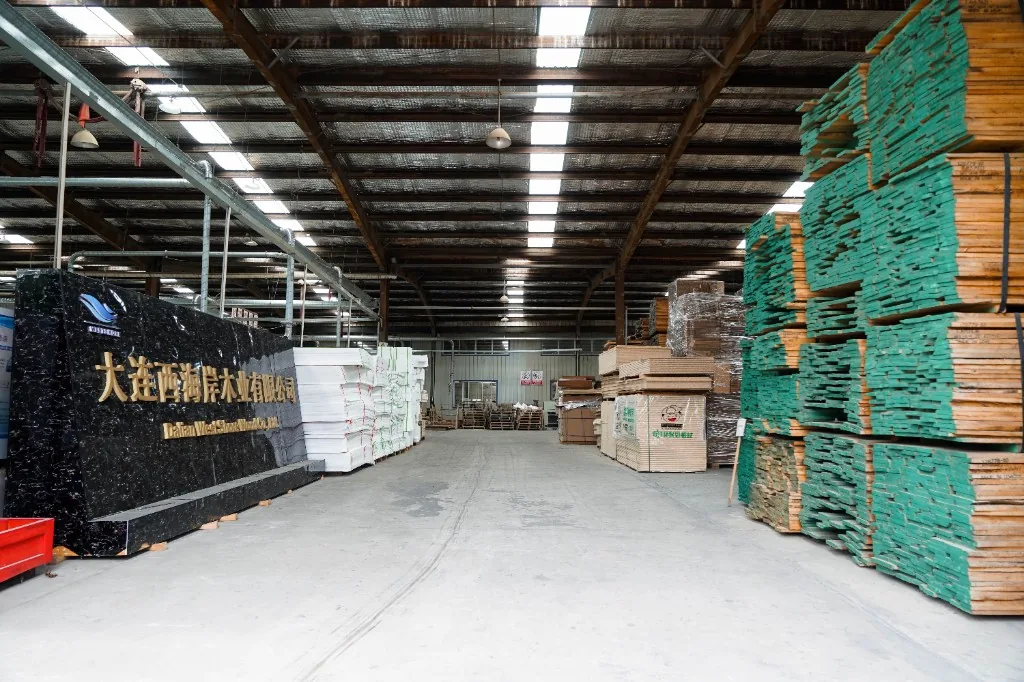
No. West Shore manufactures classroom furniture and indoor play pieces — playhouses, play kitchens, benches, water-play tables — in Dalian since 2003. A Landscape Structures-class outdoor climber, engineered wood fibre or poured-in-place rubber belongs to a playground contractor who will cite ASTM F1487 and the CPSC playground handbook. This page exists so owners and investors do not confuse those two invoices.
What does the yard cost after it opens?
The opening bands on this page do not include upkeep. The CPSC Public Playground Safety Handbook says loose-fill compresses at least 25 percent, so a wood-chip yard that needs 9 inches should start at 12 inches, and child-care yards should be checked often under swings and at slide exits. Poured rubber and tile fail later, as a wear layer and a cushion, and the handbook does not publish a preschool replacement price. Ask the playground contractor for the manufacturer’s inspection schedule and a reserve for top-up or resurfacing. West Shore prices the indoor rooms, not that reserve.
Send the floor plan, outdoor dimensions, ages and opening date. West Shore returns the classroom list and indoor play pieces. You keep the climber and the rubber with a playground contractor.
Not ready to send a floor plan? read classroom furnish cost.
Planning guidance for operators and procurement teams. Confirm current customs, tax, licensing and furniture safety rules in your jurisdiction. West Shore manufactures in Dalian and has supplied 5,000+ institutions; it does not replace your broker, your assessor, your licensed consultant or a CPSC/Health Canada/MoE determination.
Related: daycare startup cost · preschool furniture solution · product catalogues.