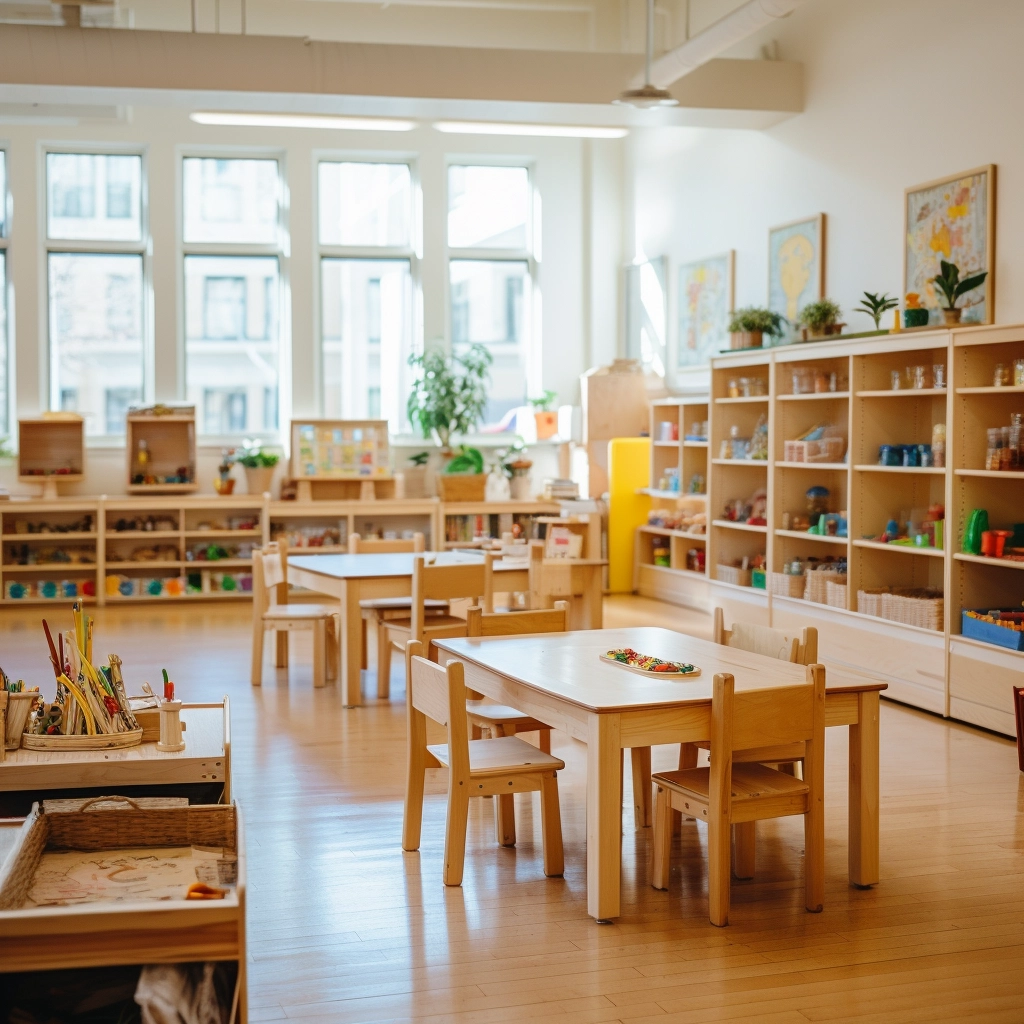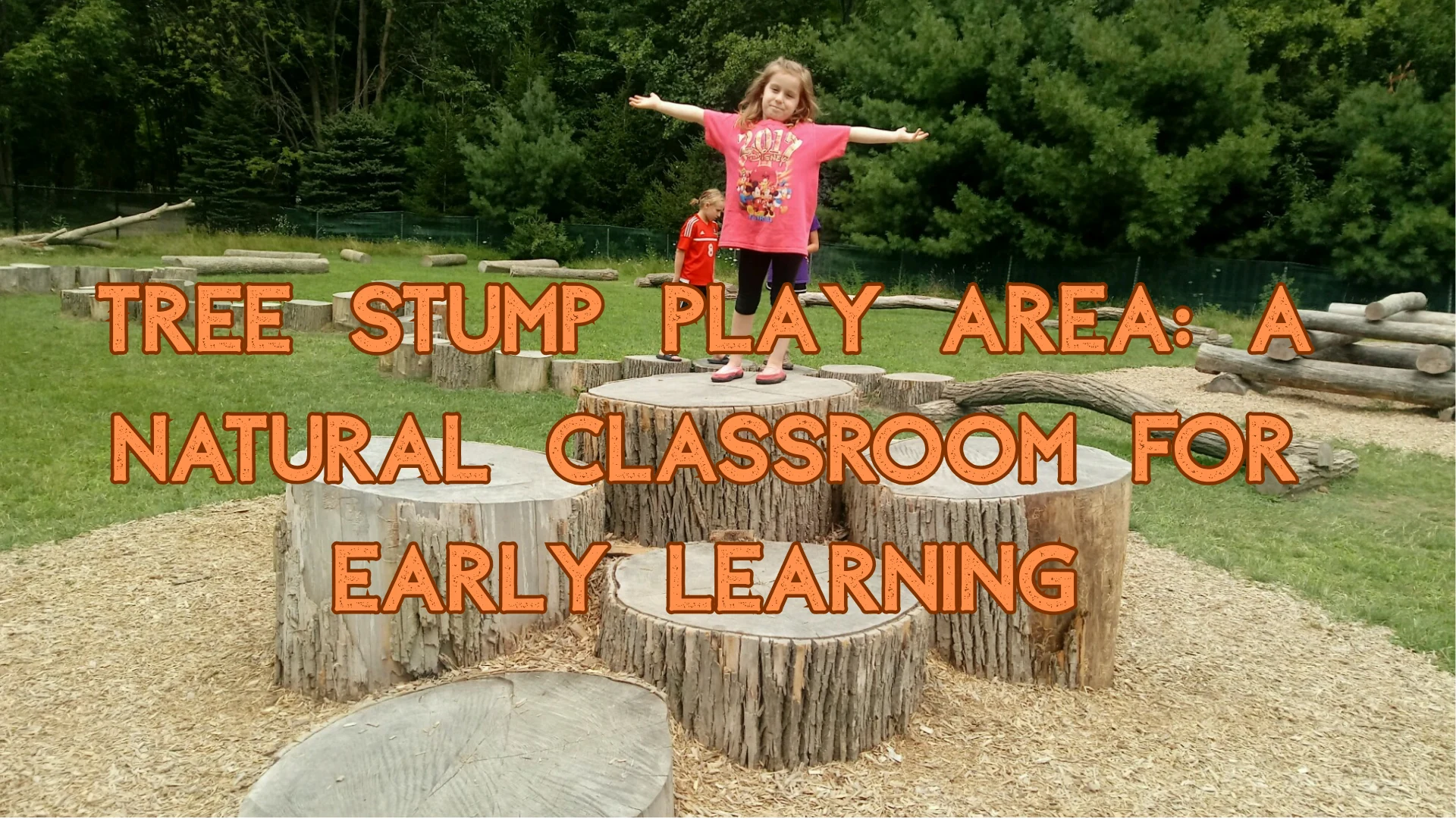
In many early years settings, play is carefully organised, timed, and contained. Children move from one planned activity to the next, often indoors, often on smooth and predictable surfaces. There is less space for uneven ground, natural materials, and open-ended exploration, even though these experiences are exactly what help young children test their bodies, make their own choices, and build real confidence.
A tree stump play area offers a simple, almost primitive counterbalance to this trend. It does not need bright plastic, complex technology, or expensive equipment, just thoughtfully arranged stumps and logs that invite children to climb, jump, balance, and imagine. This kind of space is easy to overlook, yet incredibly powerful when used with intention.
This article looks at a tree stump play area as a real early learning classroom in its own right. We will explore how this natural, flexible space supports physical, cognitive, social, and emotional growth, and how small design choices can turn a simple group of stumps into a powerful everyday learning environment for young children.
Why Tree Stumps? A Natural Choice for Early Learning
Choosing tree stumps as the core elements of a tree stump play area is not just a design preference, it is a pedagogical decision. Instead of relying only on fixed playground equipment, we bring children into contact with real wood, natural irregularity and meaningful physical challenge, all of which directly support early learning goals.
Tree Stumps as Open-Ended Learning Materials
In early childhood education, open-ended materials are highly valued because they can be used in many ways and at many levels. Tree stumps fit this definition perfectly. In a tree stump play area, the same stump may function as a seat, a platform, a shop counter, a drum or a meeting point. Children decide how to use it, which supports symbolic play, flexible thinking and autonomy. The material does not prescribe a single action, so the learning is driven by the child’s intentions and ideas.
Motor Development and Risk Competence in a Tree Stump Play Area
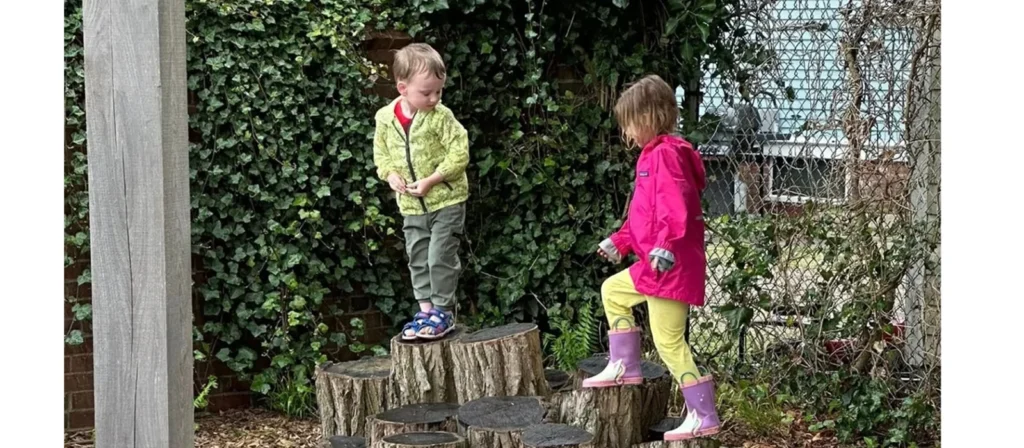
From a physical development perspective, tree stumps offer clear, graded challenges. Children step up, jump down, stretch to reach the next stump and adjust their balance on uneven surfaces. By varying stump height and spacing within the tree stump play area, adults can create a progression from very easy to more demanding tasks. This helps children build balance, coordination, core strength and what many educators now call “risk competence” the ability to judge what feels safe, what feels challenging and when to try something new.
Sensory Integration and Early Scientific Thinking
Tree stumps provide a dense mix of sensory input that supports both sensory integration and early science learning. Children feel rough bark, smooth cut faces and temperature changes across the day. They see rings, cracks, fungal growth and insects moving in and out of the wood. In a well used tree stump play area, these observations often turn into questions about trees, decay, habitats and seasons. Without formal lessons, children begin to classify, compare and hypothesise, which are core scientific habits of mind.
Ecological Literacy and Sustainable Practice
Using stumps as primary features in an outdoor learning space also carries an ecological message. A tree stump play area often reuses timber from necessary tree work instead of importing large amounts of manufactured equipment. Children see that local trees continue to have a role even after they are cut down. This supports early ideas of cycles, reuse and care for place. For educators, it aligns the physical environment with curriculum goals around sustainability, nature connection and respect for living systems.
What Children Learn in a Tree Stump Play Area?
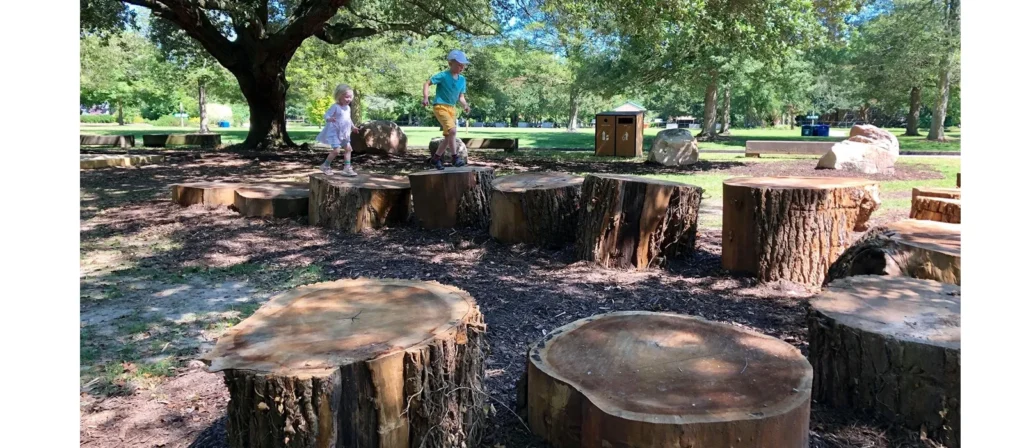
When adults look at a tree stump play area, they often see movement: climbing, jumping, balancing, running around. From an educational point of view, this space is doing much more. Each decision a child makes on a stump choosing a route, inviting a friend to join, testing a new jump is directly linked to physical, cognitive, language, social and emotional learning. Understanding these layers helps teachers and parents use the space intentionally, not just as outdoor time, but as part of their early learning programme.
Gross Motor Skills and Body Awareness
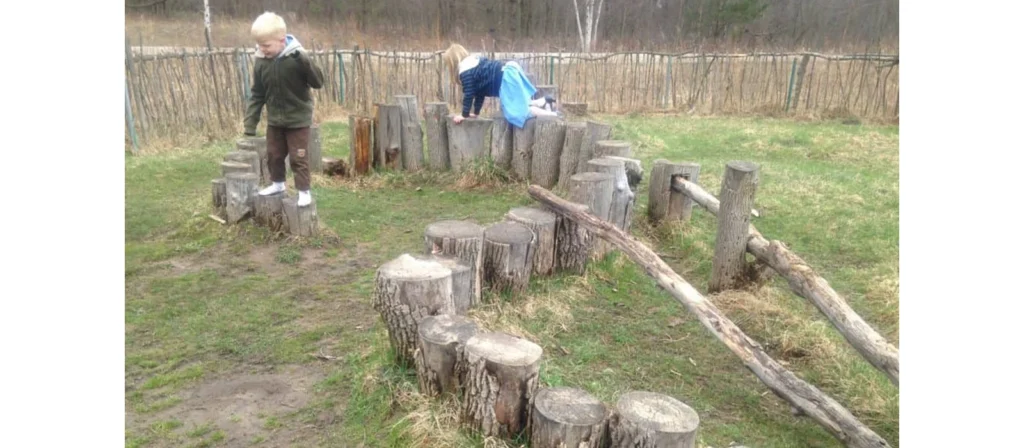
On the surface, a tree stump play area is a place to practise balance, coordination and strength. Children step up and down, stretch to reach the next stump, land after small jumps and adjust to slightly uneven surfaces. As they do this, they refine core stability, ankle strength and spatial awareness. They learn how far their bodies can safely reach, how quickly they can change direction and how to control their movements in a dynamic environment, which directly supports later skills such as sports, dance and even sitting with good posture for table work.
Executive Function and Problem Solving
Every route across the stumps is a small planning task. Children scan the layout, choose where to start, predict which steps they can manage and adjust their plan if something feels too hard. In this way, a tree stump play area becomes daily training for executive function skills such as working memory, inhibition and cognitive flexibility. When a child steps back, tries a different path or decides to practise on lower stumps before attempting a higher one, they are rehearsing the kind of self management that supports successful learning indoors.
Language, Communication and Narrative Skills
Tree stumps naturally become settings for stories and social play. Children name parts of the space my house, the shop, the dragon cave and negotiate roles within those stories. This gives rich opportunities for oral language practice: explaining rules, persuading peers, solving disagreements and keeping a shared narrative going. Educators can extend this by bringing simple prompts or vocabulary into the tree stump play area, but even without added materials, the space encourages children to talk, listen and build more complex sentences around their play.
Social Skills, Empathy and Self Regulation
Because a tree stump play area usually draws small groups at the same time, it is a natural arena for social learning. Children wait for a turn on a favourite stump, decide whether to help a younger peer, respond when someone is nervous about jumping or cope with the disappointment of falling off during a game. These everyday moments support self regulation, perspective taking and conflict resolution. With sensitive adult support, children learn to read others cues, offer encouragement and express their own needs clearly while they play.
Creativity, Symbolic Play and Imagination
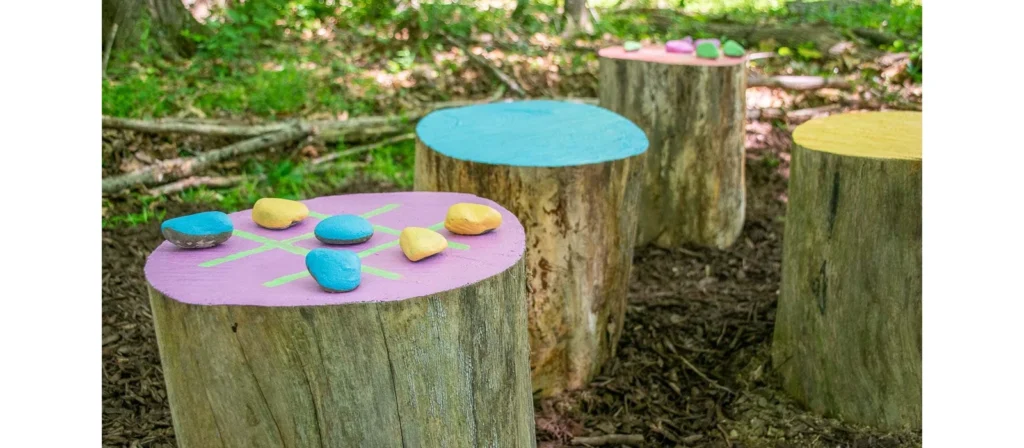
The simplicity of tree stumps is exactly what makes them powerful prompts for imaginative play. With no fixed theme or bright branding, they can transform into anything children need: a train, a castle wall, stepping stones over lava or seats in a woodland theatre. This kind of symbolic play is closely linked to later abstract thinking and literacy. When a child decides this stump is the shop counter and that one is the cooking fire and sustains that idea with peers, they are practising representation, role taking and flexible thinking that will later support reading, writing and problem solving.
Early Scientific Thinking and Observation
A tree stump play area places children in direct contact with slow, observable change. They notice how stumps feel after rain or frost, see new cracks or fungi appear and spot insects using the wood as habitat. These small observations are the starting points for scientific thinking: comparing, classifying, asking why and what if. When adults respond to children’s interest with open questions rather than quick answers, the play space becomes an informal science lab, where curiosity about trees, seasons and living things is treated as a normal and valued part of play.
From Zero to One: Building Your Own Tree Stump Natural Classroom
Creating a tree stump play area from scratch is less about buying equipment and more about making a series of clear, thoughtful choices. Each decision what you want children to learn, where you place the stumps, how you manage risk, how you use the space in your daily routine turns a simple group of logs into a real outdoor classroom.
Step 1 Clarify Your Aims for Early Learning
Before you move a single stump, decide what you want this space to support. You might focus on balance and gross motor skills, on social cooperation, on imaginative play, on early science observation or on all of these together. Writing down two or three priorities helps you design the tree stump play area with intention. For example, if your main aim is confidence with physical risk, you will choose a clearer sequence of gradually higher stumps. If your focus is language and storytelling, you might plan a central sitting circle with a few feature stumps that naturally act as stages or story points.
Step 2 Read the Site and Safety Conditions
Next, stand in the space where you want the tree stump play area and read it as an educator. Notice sun and shade through the day, drainage after rain, nearby doors and paths, and how adults will supervise. Check for existing hazards such as sharp roots, low branches or hard edges from walls and paving. Think about how children currently move through the area and how the new layout will change that pattern. The goal is not to make the space risk free but to ensure that risks are visible, manageable and appropriate for the age group you serve.
Step 3 Choose and Prepare the Tree Stumps
Once you understand the site, you can select the stumps themselves. Look for solid, untreated wood in a range of diameters and heights. Cut tops flat so children have secure footing and lightly smooth sharp edges while keeping some natural texture. Decide which pieces will become stepping stumps, which will act as seats or tables and which might serve as visual anchors such as a central “meeting stump”. Before you install anything, test each stump yourself for stability and check that the height fits your target age range.
Step 4 Plan Layout, Routes and Levels of Challenge
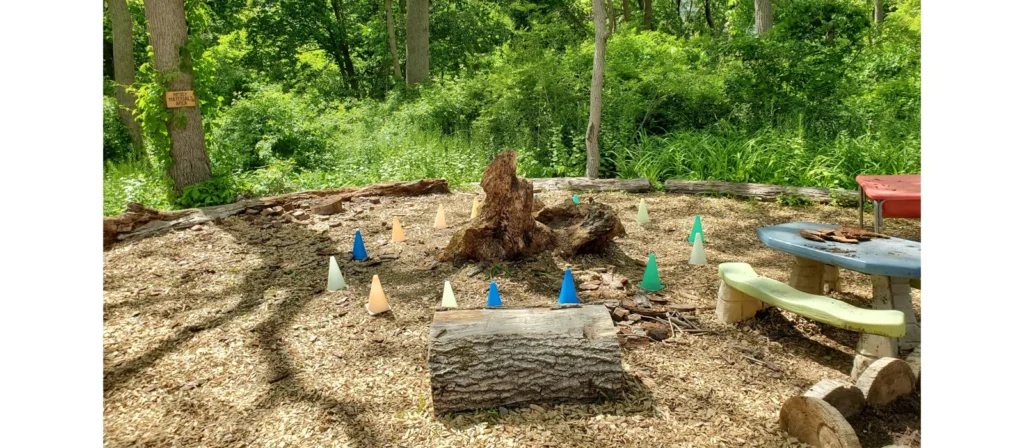
Now you can design the actual tree stump play area. Place lower and wider stumps near entry points so nervous or younger children can engage immediately. Arrange medium and higher pieces deeper into the space to create gentle progression. Think in terms of routes: simple straight paths for beginners, slightly angled or irregular paths for children seeking more challenge, and branching options for problem solving and imaginative games. Leave clear landing zones beside higher stumps and preserve open lines of sight so one adult can see the whole area from several common positions.
Step 5 Integrate the Space into Daily Practice and Curriculum
Finally, plan how this new tree stump play area will live inside your daily rhythm. Decide when children will have open access and when you will use the space for specific learning invitations such as counting steps, retelling a story with each stump as a scene, or observing seasonal changes in the wood. Agree simple shared language with your team for safety cues and reflection questions, for example asking Which stump felt just right for you today and What helped you decide to try the next one. When the space is consistently referenced in your planning and observations, it stops being only a playground feature and becomes a recognised, valued learning environment in your setting.
Tree Stump Play Area Ideas
Once the basic structure is in place, the question becomes how to keep your tree stump play area fresh, engaging and clearly linked to early learning goals. The ideas below are examples, not prescriptions. They show how the same stumps can support different kinds of play and curriculum focus without turning the space into a cluttered outdoor classroom.
Stepping Pathways and Balance Courses
Arrange stumps in simple and then more complex pathways so children can choose their preferred level of challenge. Start with a short, straight line of low stumps near the edge of the tree stump play area, then add gently curved or zigzag routes with slightly higher pieces further in. Use these paths for balance games, counting steps, comparing distances and talking about words like near, far, higher and lower.
Story Circle and Gathering Space
Create a circular cluster of wider, lower stumps that can act as a meeting place. This part of the tree stump play area works well for morning gatherings, story time, small group discussions or reflection after more active play. You can invite children to retell a story by moving from stump to stump, or to share what they tried that day, using the circle to support turn taking and listening skills.
Imagination Zones and Role Play Corners
Use the natural shapes and positions of certain stumps to suggest simple role play areas. One group might become a pretend shop, another a woodland home, another the deck of a ship. You do not need permanent signs. A few loose prompts, such as simple baskets, fabric or wooden blocks introduced occasionally, can help children see new possibilities in the tree stump play area and deepen their imaginative play without fixing any stump into a single function.
Investigation Spots for Nature and Science
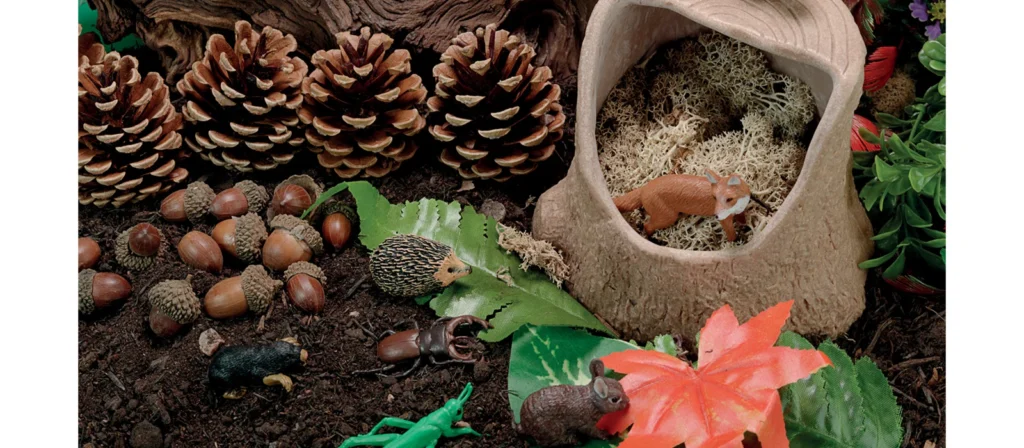
Designate one part of the tree stump play area as an observation zone. Here, you might place stumps closer to planting beds, logs with visible rings or pieces that are allowed to show more natural change over time. Bring magnifiers, clipboards or simple drawing tools on some days so children can look closely at patterns, insects and fungi. Use this area for short, repeated investigations about weather effects, seasonal changes and habitats.
Inclusive and Rest Points
Not every child will want or be able to move across the whole tree stump play area. Include a few stumps near accessible paths that work as rest points, viewing spots or gentle challenges. These can be slightly wider, lower pieces where children can sit with a friend, watch others or join in social and language play without needing to cross the full course. This helps the space support mixed abilities and energy levels while keeping everyone part of the shared outdoor experience.
Tree Stump Play Area Compared with Traditional Play Equipment
This part can stay very simple. The table below gives a clear, at–a–glance comparison between a tree stump play area and more typical fixed playground equipment, from an early learning point of view.
| 側面 | Tree stump play area | Traditional play equipment |
|---|---|---|
| Main learning style | Open ended, child led exploration and problem solving | Repetitive practice of a few set actions |
| Role of materials | Natural, flexible learning materials that can represent many things | Single function structures designed for one main purpose |
| Physical challenge | Graduated, easily adjusted by stump height and spacing, self chosen by children | Fixed levels of difficulty set by the manufacturer |
| Cognitive and executive skills | Strong focus on planning routes, adapting strategies and managing risk | Some planning, but often more automatic and less varied |
| Social and language learning | Rich role play, shared storytelling and negotiation around how to use the stumps | More turn taking on specific items, fewer options for complex roles |
| Sensory and science value | Direct contact with wood, texture, weather, insects and slow natural change | Limited sensory variety, less connection to living systems |
| Visual and environmental fit | Blends into the landscape, supports nature based identity of the setting | Stands out visually, can feel separate from the natural environment |
| Cost and flexibility | Can start small, grow over time and be reconfigured with minimal tools | Higher one time cost, fixed layout and functions |
| Safety mindset | Encourages active, ongoing risk assessment shared with children | Can create a belief that design alone is responsible for safety |
Maintenance: Keeping Your Tree Stump Play Area Safe and Alive
A well designed tree stump play area needs regular attention to stay safe, inviting and educational. Maintenance is less about heavy technical work and more about building simple habits of looking closely, recording what you see and acting early when something changes.
Routine Safety Checks
Plan a basic visual check of the tree stump play area at least once a week, and after any major weather event. Walk the whole space at child height. Press each stump to check stability, feel for loose or sharp fragments and look for exposed roots or trip points around the bases. Check the ground surface for compacted areas or bare patches where falls would be harder. Small, frequent inspections reduce the chance that a minor issue turns into a serious risk.
Seasonal and Weather Related Care
Tree stumps respond to rain, frost, heat and strong sun. Build seasonal routines into your calendar. In wet periods, look for pooling water on stump tops and around bases, and improve drainage if needed. After frost, check for new cracks or lifted fibres that might catch small hands. In hot climates, notice which stumps become very warm and consider adding shade or adjusting how and when children use that part of the tree stump play area. Regular sweeping or gentle brushing keeps surfaces free from slippery leaves, mud or algae.
Managing Wear, Damage and Replacement
Over time, some stumps in the tree stump play area will soften, split or begin to decompose. This is natural, but you need clear thresholds for action. Mark any stump that feels spongy or unstable and remove it from active use until you can repair or replace it. Shortening a stump, turning it, or pairing it with a new piece can all extend its life, but do not hesitate to retire wood that no longer feels safe. Treat replacement as an opportunity to review heights, spacing and routes so the learning value of the space continues to grow.
Shared Responsibility and Simple Records
Maintenance is easier and more reliable when it is not left to one person. Involve the whole team in watching the tree stump play area, and invite older children to share what they notice. Keep a simple log of checks and actions taken with dates and brief notes. This does not need to be complex to be useful. A short record shows families and inspectors that the tree stump play area is actively managed and also helps you spot patterns, such as particular spots that wear out faster and might need a different design solution.
Conclusion: Tree Stump Play Area as a Natural Classroom
A thoughtfully designed tree stump play area is much more than an attractive corner of the playground. It is a structured yet flexible learning environment where motor skills, executive function, language, social competence and early scientific thinking are all exercised through everyday play. Because stumps are simple, open to interpretation and physically honest, they invite children to choose their own challenges, create their own stories and return again and again with fresh ideas.
From an educator’s point of view, this kind of space sits closely alongside key aims for early learning. It supports self regulation and risk judgement, gives rich material for observation and assessment, and aligns naturally with curricula that value inquiry, sustainability and connection with the local environment. A tree stump play area can grow gradually, respond to the particular group of children you work with and change over time as your practice deepens.
The most important shift is not in the wood itself, but in how we see and use it. When we treat a tree stump play area as a genuine classroom, we plan for it, observe in it and speak about it in the same serious way that we speak about indoor provision. In doing so, we offer children a powerful message: that learning does not only happen at tables and on screens, but also with their whole bodies, in fresh air, on real ground, in conversation with the living world around them.
FAQ: Common Questions About Tree Stump Play Areas
Are tree stump play areas safe for young children?
They can be, when they are designed and maintained with care. The key is to keep stump heights suitable for your youngest regular users, provide impact absorbing surfacing around the whole tree stump play area and check the space frequently for loose pieces, sharp edges and tripping points. Safety comes from design, supervision and routine inspection working together, not from any single feature.
What if our outdoor space is very small?
A useful tree stump play area does not need a large field. Even a narrow strip or corner can hold a short stepping path and a small circle of sitting stumps. In tight spaces, focus on clear routes, safe landings and one or two simple functions, for example a path plus a story circle, rather than trying to include every possible idea.
How do I respond to families who worry about risk or mess?
Start by explaining the educational purpose of the tree stump play area. Share how it supports balance, confidence, language and social skills, and show that you have clear routines for safety checks and clothing management. Invite families to visit the space, watch children using it and see your maintenance log. When parents understand that risk is being managed and used to support growth, they are usually more comfortable with mud, bark and uneven ground.
What about insects, fungi and natural change in the wood?
Some change is expected and can be used as a learning opportunity. Children can observe moss, insects and weather effects as part of early science. At the same time, adults need clear limits. If you see active wasp nests, large areas of soft, decayed wood or fungi in places where children put hands and feet, you treat those stumps as out of use until you can remove or replace them. The aim is to welcome nature while still protecting children from specific, manageable hazards.
Do we need special permission or inspection for a tree stump play area?
This depends on your local regulations and the type of setting. Many private homes can add a tree stump play area without formal approval. Schools, early years centres and public sites are more likely to need to follow local playground guidance and insurance conditions. As a rule, it is wise to check with your governing body, landlord or insurer before you build, keep simple records of your design choices and inspections, and be ready to show how you manage risk in the space.

 Japanese
  English
  Korean
  Italian
  German
  Arabic
  Spanish
  French
  Thai
Thai