Last updated: 22 November 2026 · By Briar Lee

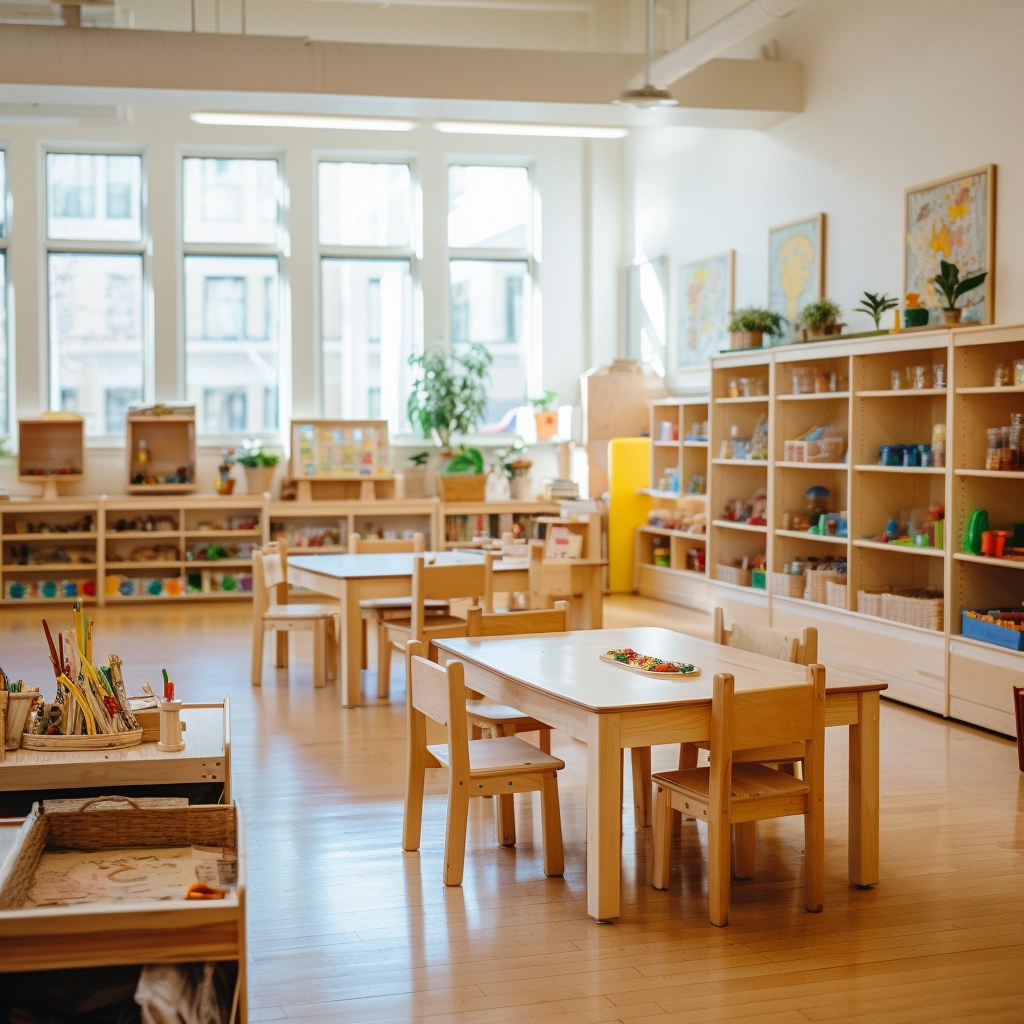
Reggio Emilia classroom furniture is low, open, natural-wood furniture (child-height shelves, combinable tables and chairs, display surfaces and light-play pieces) arranged so the room works as the “third teacher”. A typical Reggio room has nine zones: a central piazza, an atelier, provocation tables, a light-and-shadow area, construction and loose parts, dramatic play, a reading nook, documentation walls and an entry with cubbies. Below: what to buy for each zone, how to check quality, and the lead time to allow.
Planning a Reggio room?
Send your floor plan and age groups, and the West Shore Design Team will place every zone and piece of furniture to scale before you order anything.
West Shore Furniture is a factory-direct manufacturer of Montessori, Reggio Emilia and Waldorf classroom furniture. It was founded in 2003 in Dalian, China, and has furnished early learning programmes across Australia, Canada, the UK, Singapore and beyond.
Who this guide is for
It is for people buying furniture for a Reggio-inspired room: centre owners opening a new centre, directors converting an existing room, and fit-out or procurement managers comparing quotes. For philosophy and activities, read our Reggio Emilia approach guide.
What makes furniture “Reggio”?
Furniture is “Reggio” when it is low, open, natural-looking and movable, so children can reach materials themselves and educators can reshape the room as projects change. For a buyer, that means six criteria:
- Low, open shelving that children can reach and educators can see over.
- Natural materials: wood grain, woven baskets and tactile surfaces instead of moulded plastic.
- A neutral palette, so children’s work and natural objects provide the colour.
- Light and transparency: mirrors, light tables and clear containers.
- Flexibility: tables that combine and shelves that move as projects change.
- Space for documentation: wall panels and ledges that make children’s thinking visible to families.
Reggio Emilia classroom furniture by zone
Buy by zone, not by catalogue page: each of the nine zones needs only a few key pieces, and every piece should have a job.
1. Piazza (central gathering area)
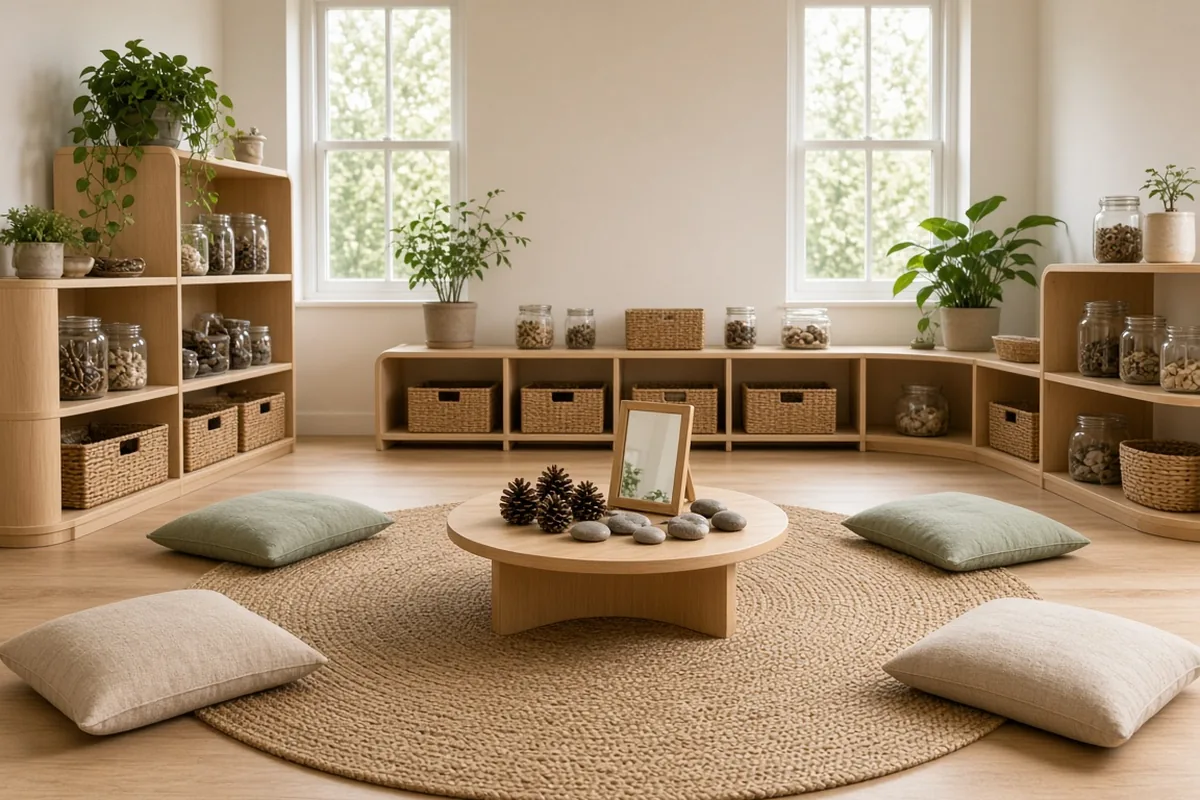
Buy: low shelves used as soft dividers, a neutral rug, floor cushions and a low table for shared provocations. Tip: shelves that double as zone boundaries keep the piazza open without fixed walls. Avoid: bulky sofas that block movement.
2. Atelier (art studio)
Buy: a preschool paint easel, wipe-clean worktables, a drying rack and open shelving for sorted art media (see our preschool art centre guide). Tip: open cubbies keep clay, wire, paper and brushes visible and sorted. Avoid: deep closed cupboards where children always need an adult to fetch supplies.
3. Mini-atelier: provocation and project tables

Buy: small-group and provocation tables with matching preschool tables and chairs, plus a low shelf or trolley for project trays that stay out for days. Tip: choose shapes that work as two-child stations and push together into one project surface. Avoid: mixed table heights in one room, so tables can’t be joined.
4. Light and shadow
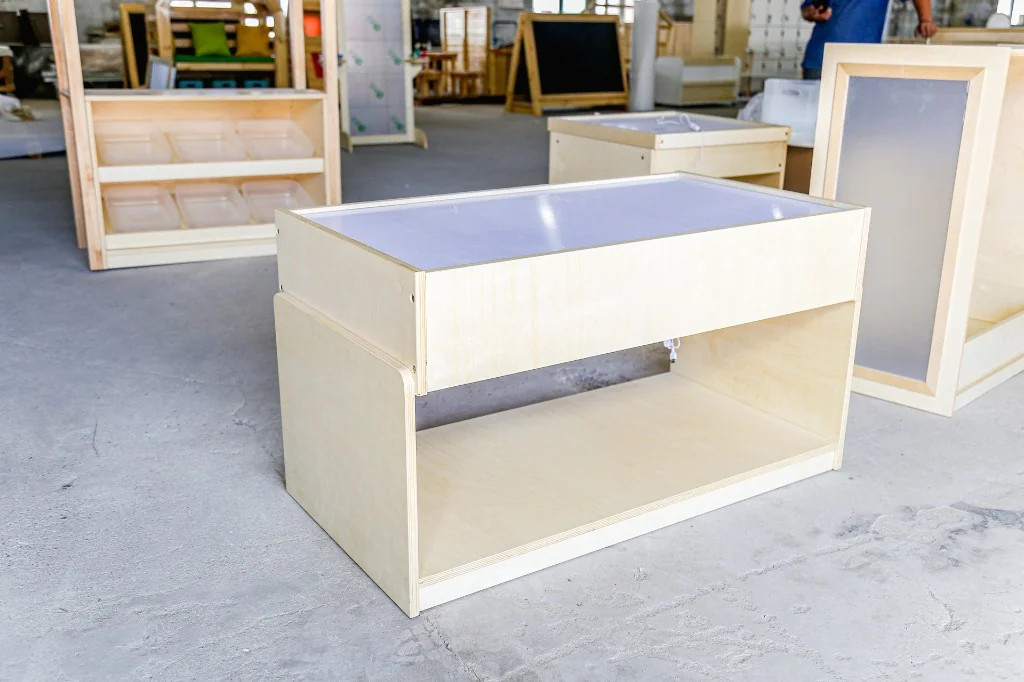
Buy: a daycare light table, shatter-resistant mirrors and a low shelf of translucent loose parts. Tip: mark power points on the floor plan early so there is no trailing cable. Avoid: placing the light table in direct midday sun, which washes out the effect.
5. Construction and loose parts

Buy: sturdy low preschool storage units, a block trolley, wide trays and open-ended Reggio materials. Tip: open compartments wide enough for blocks and baskets, not narrow pigeonholes. Avoid: light shelving that slides when children pull out heavy block trays.
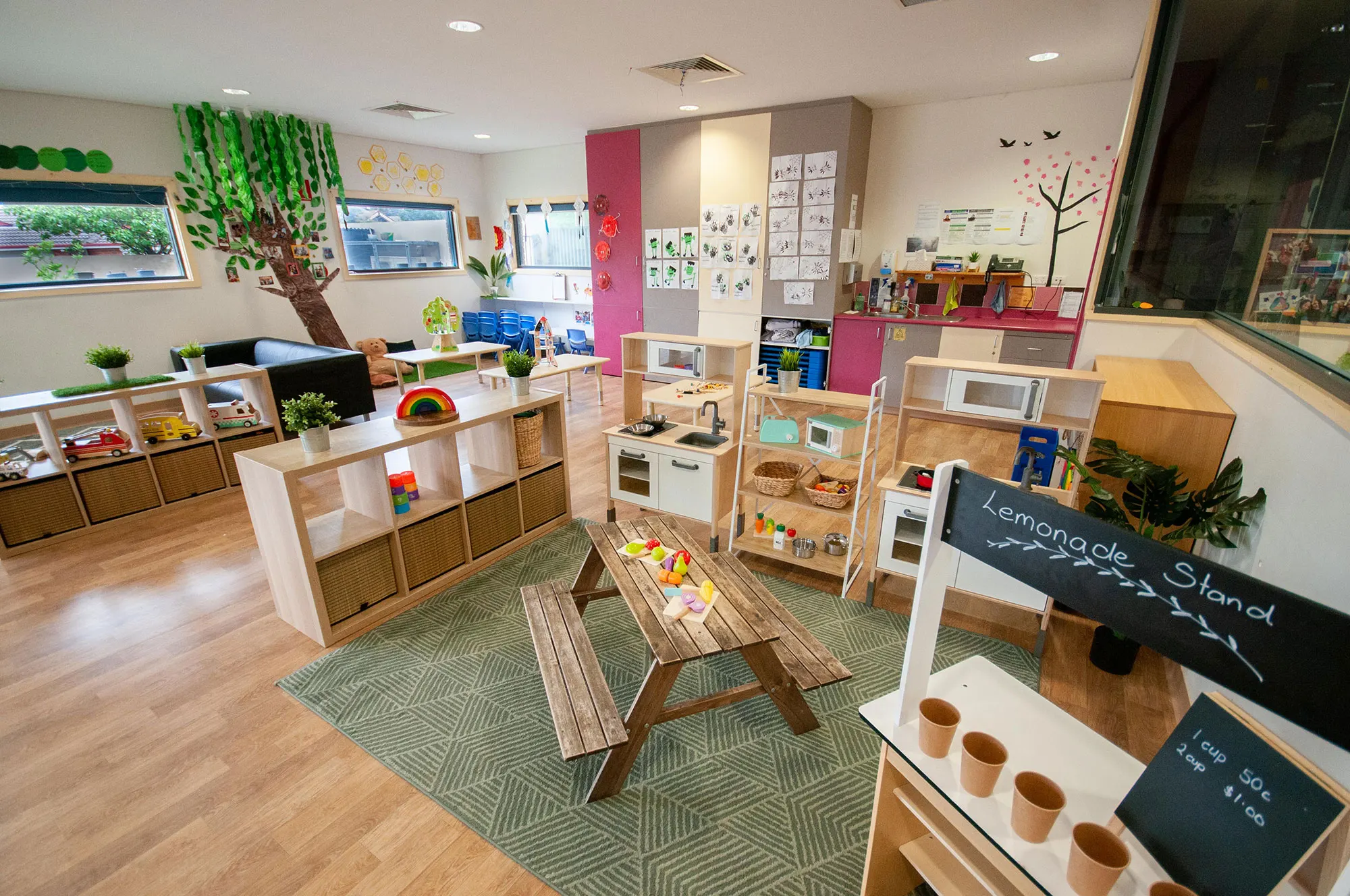
6. Dramatic play (home corner)
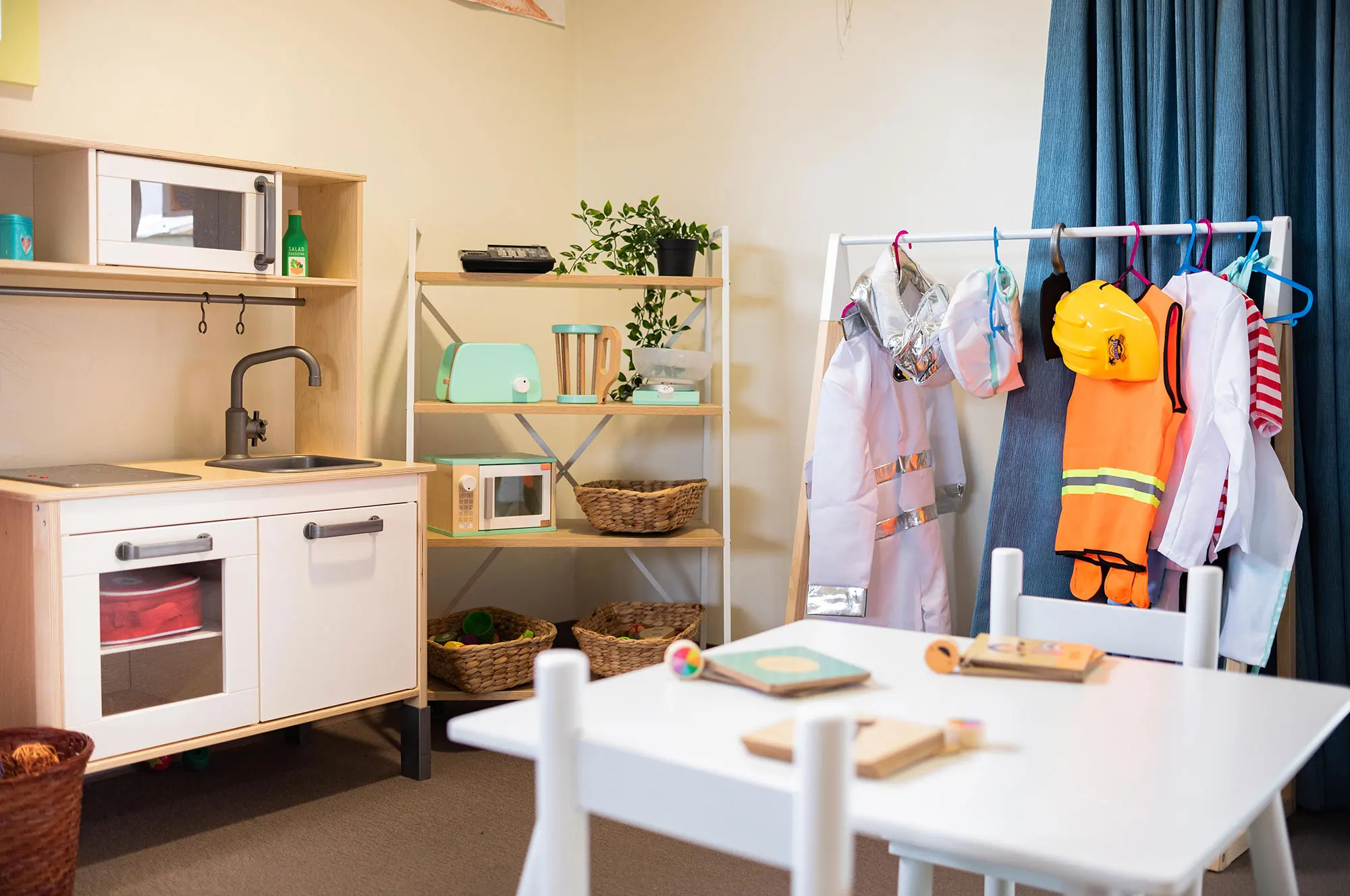
Buy: neutral wooden kitchen units, a child-size dining table, a dress-up rack and plain dramatic play furniture. Tip: plain timber counters can become a kitchen, bakery, clinic or shop as the children’s inquiry changes. Avoid: brightly printed single-theme kitchens.
7. Quiet reading nook
Buy: a front-facing classroom bookshelf or a reading tree bookshelf, soft neutral seating with washable covers and a low divider. Tip: front-facing display helps young children choose and return books themselves. Avoid: placing the nook beside the block area or the main door.
8. Documentation and display
Buy: wall-mounted documentation panels, pinnable boards, narrow picture ledges and shelf tops for 3D work in progress. Tip: hang panels at two heights, adult eye level for families and child eye level for children. Avoid: taping paper straight onto painted walls.
9. Entry and transition (cubbies)

Buy: child-height cubbies and lockers with a bench, hooks and name-card slots. Tip: leave space underneath for boots and wet bags. Avoid: a tall cubby bank right inside the door, which causes a drop-off bottleneck.
Reggio furniture spec sheet
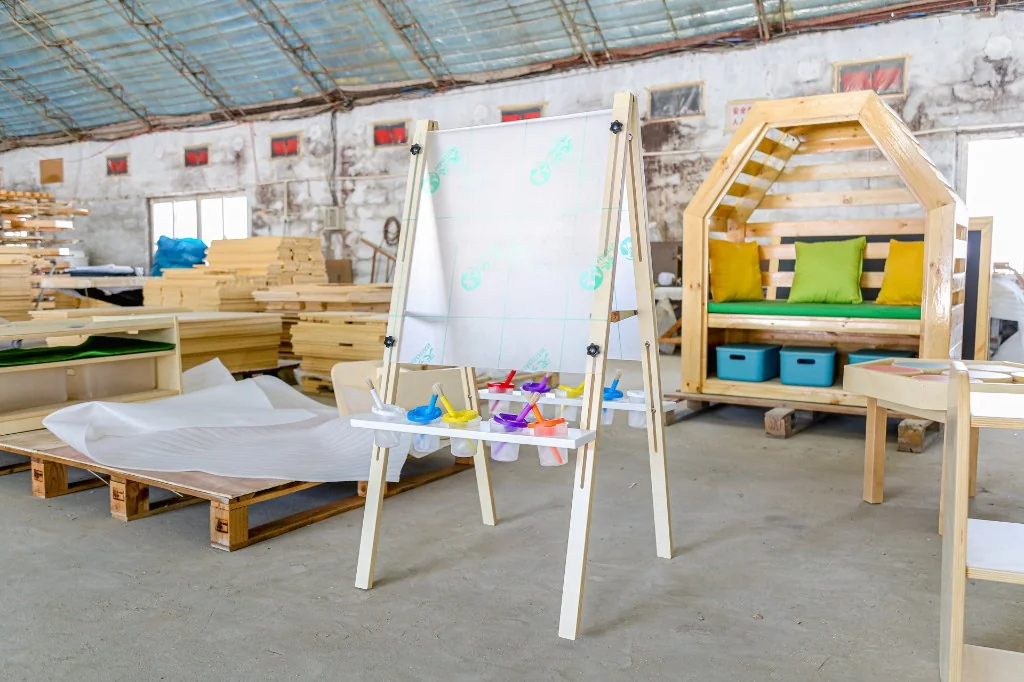
The pieces that matter most are open shelves, height-matched tables and chairs, a light table, an easel, cubbies and documentation panels. The sizes below are general guidance; confirm exact sizes for each age group on your quote.
| Piece | What to look for | Sizing guidance | Why it matters |
|---|---|---|---|
| Open shelf | Plywood carcass, rounded corners, open or low back | Low shelves in early childhood rooms are typically about 60–90 cm high, lower for infants and toddlers | Defines zones; adults can see across the room |
| Provocation and group tables | Smooth wipe-clean top, stable legs, shapes that combine | One table height per age room; see the table and chair height guide | Tables can be joined for group projects |
| Children’s chairs | Solid wood or plywood, splayed legs, stackable if space is tight | Seat height matched to table height | Posture during long studio sessions |
| Light table | Even LED light, safe cable exit, raised lip | Tabletop light box or child-height table, by age group | Daily light and colour investigation |
| Easel | Stable base, washable surface, paint-pot tray | Working height suited to the children standing at it | Painting without using table space |
| Cubbies and lockers | Open compartments, hooks, bench, wall-fixing points | One space per enrolled child plus a clear aisle | Independence at arrival |
| Documentation panel | Cork, felt or timber frame, rail or clip system | Mounted at child and adult heights | Makes project progress visible |
Industry reference for chair and table sizes: EN 1729-1, the European standard for educational chairs and tables, gives reference pairs such as size 0 (seat 210 mm, table 400 mm), size 1 (seat 260 mm, table 460 mm) and size 2 (seat 310 mm, table 530 mm). Use them as a shared reference with suppliers and confirm sizes per age group on your quote.
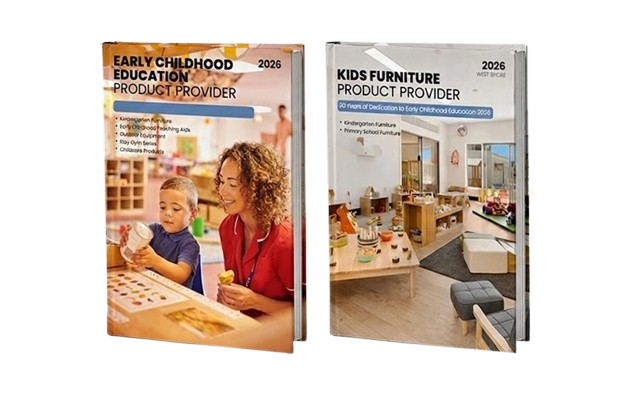
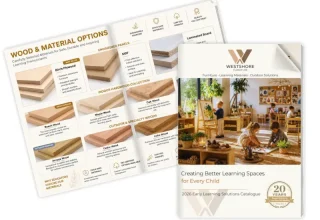
Want to see sizes, finishes and the full range?
It covers classroom furniture for every zone above, and it is free.
Reggio vs Montessori vs conventional classroom furniture
Reggio furniture is built for group projects and change, Montessori furniture for individual work in a consistent order, and conventional furniture for whole-group teaching. See Montessori vs Reggio Emilia for the teaching differences.
| Feature | Reggio Emilia | Montessori | Conventional |
|---|---|---|---|
| Shelving | Low open shelves that define zones and display loose parts | Low open shelves, materials in a set order, one per tray | Tall closed cupboards and tub racks |
| Tables | Combinable group, provocation and studio tables | Mostly individual and two-child tables, plus floor mats | Uniform tables for whole-group activities |
| Colour | Natural wood and neutrals | Natural wood and muted tones | Often bright primaries |
| Flexibility | High: the room changes with projects | Moderate: the layout stays consistent on purpose | Low: fixed stations |
How to plan furniture for a Reggio room
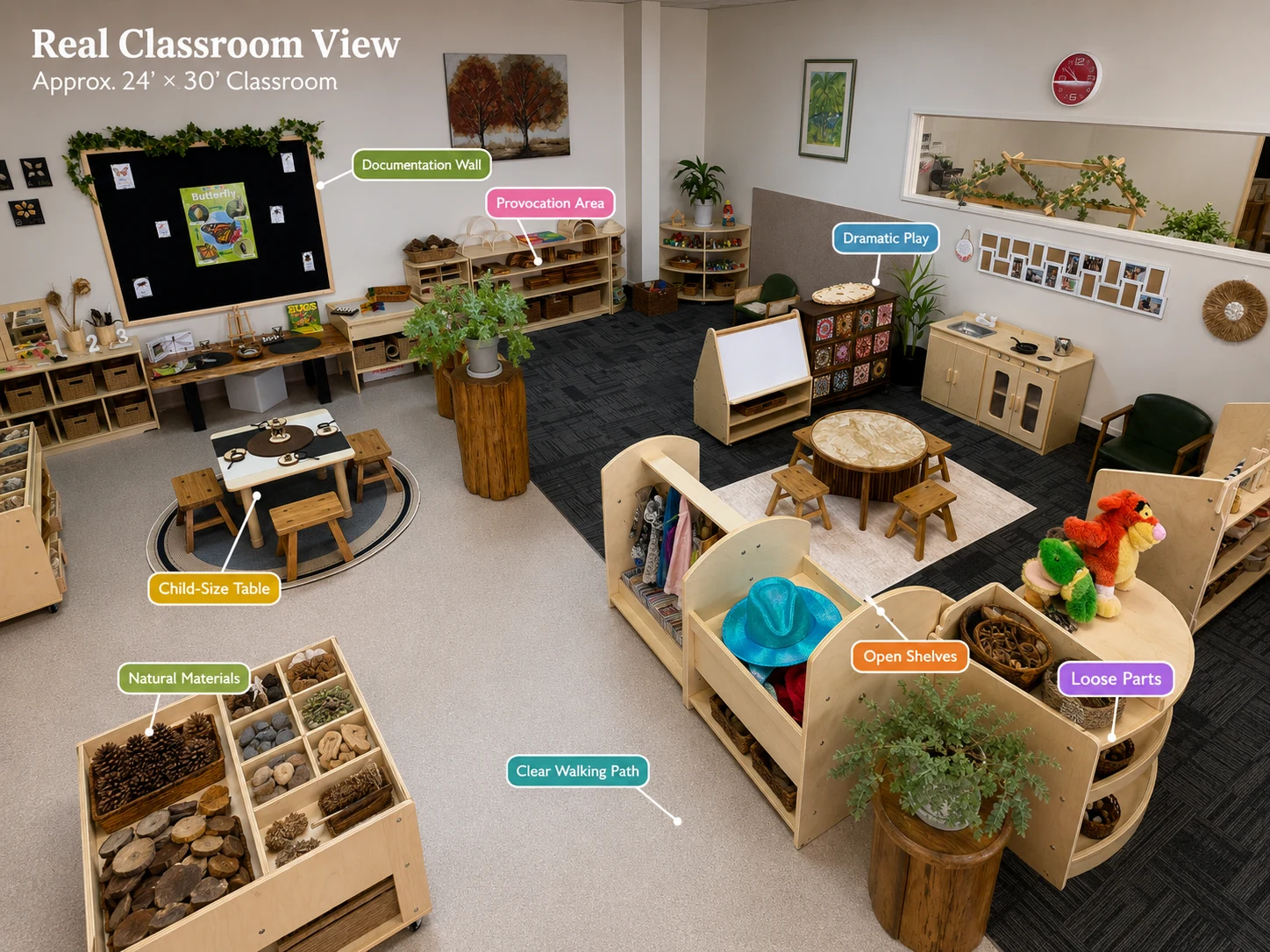
Plan in four steps: measure, mark light and fixed points, set zones and a walking path, then size the furniture.
- Measure the room and mark doors, windows, sinks, power points and the outdoor exit.
- Place light-dependent zones (atelier, light table, reading nook) where the light suits them.
- Set the zones and one clear walking path, using low shelves as dividers, and leave empty floor for block building.
- Size the furniture for the age group and check everything on a 2D/3D layout. Our Reggio Emilia classroom layout case studies show three real room sizes:
- 17 × 28 ft (about 5.2 × 8.5 m): dramatic play, one or two provocation tables, low shelves for zoning, a small reading corner and accessible storage.
- 24 × 30 ft (about 7.3 × 9.1 m): adds a documentation wall, loose-parts storage and a clear central path.
- 30 × 40 ft (about 9.1 × 12.2 m): adds a large project table, a connected quiet zone and an indoor–outdoor link.
Quality and safety checks before you order
Check five things before ordering: core material, edges, finish, anti-tip fixing and test documentation for your country.
- Core material. Ask what each part is made of. West Shore uses 18 mm birch plywood (11 layers of birch veneer) for key structural parts such as shelves, frames and side panels, because wide plywood panels stay flatter than solid boards; see birch plywood furniture benefits. Be wary of quotes that only say “engineered wood”.
- Edges and corners. Every exposed corner should be rounded and every edge sealed.
- Finish. A water-based finish that copes with paint, clay and daily cleaning.
- Stability. Tall cabinets and locker banks need anti-tip wall fixings; see how to secure storage cabinets to the wall.
- Test documentation. Requirements differ between Australia, New Zealand, Canada, the UK, the US and Singapore; our overview of daycare furniture safety standards explains what applies where. Relevant test reports and certificates for West Shore products are available on request with your quote.
Budget and timeline
What you pay depends on three things: standard versus custom pieces, the number of rooms, and freight. Allow about 11–14 weeks including shipping. West Shore does not publish a single price per room, because every quote is built room by room from your furniture list.
Catalogue items cost less and are quicker to confirm than custom sizes. A multi-room fit-out ships more efficiently than a single-room top-up. Ocean freight, customs clearance and delivery access all affect the landed cost.
Count the 11–14 weeks back from your licensing inspection and staff set-up week, not from the first day with children. For how drawings and custom items affect timing, see custom preschool furniture lead time.
Pre-order checklist for centre directors
Before you sign a purchase order, you should be able to tick all ten items:
- ☐ Room-by-room floor plans confirmed, with doors, windows and age groups marked.
- ☐ Chair seat heights checked against table heights for every age room.
- ☐ Low shelves keep clear educator sightlines across every zone.
- ☐ Wall-fixing points identified for every tall cabinet and cubby bank.
- ☐ Power points located for light tables.
- ☐ Core material, edges and finish written on the quote for each item.
- ☐ Test reports and certificates requested for your country.
- ☐ Standard and custom items listed separately on the quote.
- ☐ Freight terms, delivery access and assembly responsibility agreed.
- ☐ At least 11–14 weeks counted back from your on-site date, plus time for assembly.
Reggio projects West Shore has furnished

West Shore has furnished Reggio-inspired centres in Brisbane, Sydney and Adelaide:
- Reggio Emilia early learning centre, Brisbane: about 2,000 m², 150+ children, 15 classrooms. Combinable tables and chairs, open shelving, reading nooks and custom natural-wood exploration tables.
- Reggio kindergarten, Sydney: about 900 m², 80+ children, 6 classrooms.
- Treehouse Childcare & Early Learning Centre, Adelaide: 109 approved places, 6 purpose-built rooms and 2 outdoor playgrounds, with customised indoor and outdoor furniture.

Ready to price your rooms?
We reply within 24 hours, include a free 2D/3D layout, and send relevant test reports on request.
About West Shore Furniture
West Shore Furniture (West Shore Wood) has made Montessori, Reggio Emilia and Waldorf classroom furniture since 2003 at its own factory in Dalian, China. This guide was written by the West Shore Design Team, who prepare the room layouts and furniture lists for our projects. See completed projects.
Frequently asked questions
What furniture does a Reggio Emilia classroom need?
Low open shelves, combinable child-size tables and chairs, at least one provocation table, an atelier with an easel and open art storage, a light table or mirrors, plain dramatic play pieces, a front-facing bookshelf with soft seating, documentation panels and entry cubbies. Room size decides how many of each.
What is the difference between Reggio Emilia and Montessori furniture?
Both use child-height, natural-wood open shelving. Reggio rooms add combinable group tables, atelier and light-play pieces and documentation panels. Montessori rooms centre on individual work tables and materials kept in a set order.
Who makes Reggio Emilia classroom furniture for childcare centres?
Specialist early-childhood manufacturers and distributors. West Shore Furniture is a factory-direct manufacturer that has made Montessori, Reggio Emilia and Waldorf classroom furniture since 2003, including furniture for Reggio-inspired centres in Brisbane, Sydney and Adelaide, and it offers a free 2D/3D layout with every quote.
How long does it take to get classroom furniture shipped to Australia or New Zealand?
West Shore’s standard lead time is about 11–14 weeks including shipping. Order well ahead of your installation and licensing dates.
Do you design the classroom layout before we order?
Yes. West Shore prepares a free 2D/3D layout and a factory-direct quote, and replies within 24 hours. Send your floor plan, room measurements and age groups.