A second classroom is a measuring job. “Same as last time” is not a height, a top size, or a cubby opening. The new room is often shorter than the first. The pieces that do fit have to match. The pieces that do not fit come off. They do not get shaved down until they look close.
The seat heights the factory already cuts are on the Australia table and chair height guide: 200 mm, 260 mm, 300 mm, 350 mm and 380 mm, with table tops about 150–200 mm above the seat. Those are cut steps, not a law that every country must sit at 300 mm. A second room in the US, Canada, the UK or anywhere else still uses the height you measure. The steps are how the factory reads that measurement.
What to measure in the room you already have
| Measure | How | What the new drawing says |
|---|---|---|
| Table height | Floor to the top of a table in use, not to the apron | That millimetre. Not “preschool height” |
| Table top | Length and width of the top, edge to edge | The same top, unless the new room cannot take that footprint |
| Seat height | Floor to the top of the seat the children use at that table | The same seat. Check the gap to the top |
| Cubby opening | Width and height of one bay a current bag fits, inside the frame | The same opening. Fewer bays if the new wall is shorter |
| Finish | The words on the last quote or drawing | Those words. “Natural” and “same wood” are not a finish |
Measure three tables if the first room was not built in one delivery. A room that has already been patched will have two heights. Match the height the staff actually want repeated, and say which table you measured.
A measured room, and the mistake to avoid
Suppose the table you want matched measures 1,200 × 600 mm on the top and 500 mm from the floor to that top. The seat measures 310 mm. The gap is 190 mm, which sits inside the 150–200 mm band on the height guide. The cubby opening a bag already fits measures 280 mm wide by 320 mm high. The old quote says birch.
The new drawing then says: rectangular top 1,200 × 600 mm, top height 500 mm, seat 310 mm, cubby opening 280 × 320 mm, birch. Quantity of tables and bays comes from the new floor plan. The sizes do not.
Now suppose someone “rounds it to a standard preschool set”: top 480 mm, seat 300 mm, because 300 mm is one of the factory steps for children from about three years. The gap is still plausible, and the room is still wrong. Every table in the new room is 20 mm lower than the room the staff already know, and the chairs do not line up with the first building. The factory steps are a reading aid when you do not have a number. They are not a reason to throw a number away once you have measured it.
The other failed match is a mixed pair. A 500 mm top with a 260 mm seat is a 240 mm gap, outside the 150–200 mm band. That is usually a toddler chair pulled up to a preschool table, not a set to copy. Measure a chair that belongs to that table. If the gap will not fall between 150 and 200 mm, stop and say so. Do not average them.
A shorter wall loses bays, not millimetres
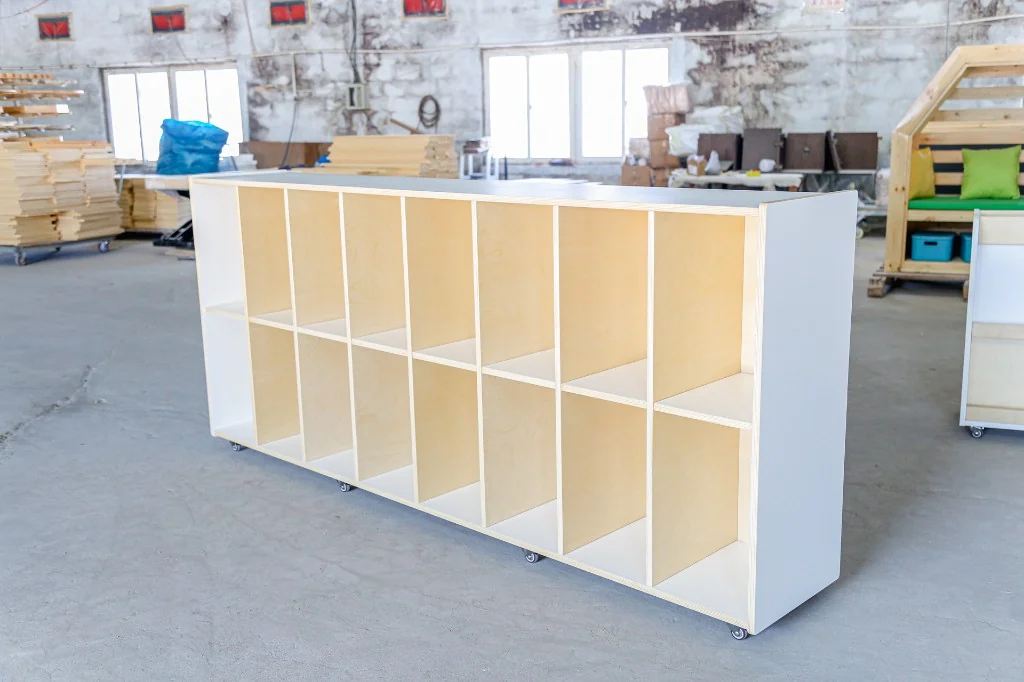
The first room’s cubby wall held eight openings at 280 mm. The new room’s clear wall, after the door swing, is 1,900 mm. Eight openings will not fit, and the fix is not an opening of 230 mm. You keep 280 mm and you drop bays until the run is inside 1,900 mm, including the frames between openings. The factory draws the frames. You do not divide 1,900 by 280 and call that the order, because the dividers take space too. Send 1,900 mm and 280 × 320 mm. The drawing comes back with a whole-bay count and a gap.
The same rule as a first cubby order: the gap stays empty, or it takes a different piece that has its own size. It does not become a custom sliver bay that no bag fits.
When the age changes, the height changes
A preschool table next to a new infant room is not the template for that infant room. Match the finish if you want the building to read as one order. Do not match the 500 mm top. Infant and toddler seats on the factory list start at 200 mm and 260 mm, with lower tops. The full bands are on the height guide. Write the age of the new room in the same sentence as the measurements, so a preschool number is not applied to a cot room.
Send the tape measurements with the new plan
One added preschool room is commonly $4,800–$9,500. One added toddler room is commonly $6,500–$12,500. The $30,000–$55,000 figure is a four-room indoor package, not the price of matching one room.
Get Free Daycare DesignIf the old drawing is gone
- Photograph one table from the side with a tape from the floor to the top. The number has to be readable.
- Photograph the top with length and width.
- Photograph one cubby opening, width and height, inside the frame.
- Photograph the finish in daylight, and copy any finish words still on a carton, an invoice or an email.
- Send the new floor plan in the same email. A photo without the plan is a sample, not an order.
If the first room was not made by West Shore, say that. The factory can match a measured height and a measured opening. It cannot match an unknown brand’s hardware, and it should not be asked to stamp another company’s name on the piece.
What does not transfer from the first order
- A test report. Coatings and any report are matched to this order and this destination when the drawing is frozen. A US report does not travel with a table to another country because the finish looks the same.
- The old lead time. Production is still 30–45 days after this drawing is frozen. The first room’s calendar does not shorten it.
- A verbal MOQ exception. Minimum order quantity varies on this order too. Ask, do not assume the first waiver still stands.
West Shore Furniture has manufactured in Dalian since 2003, for 5,000+ institutions in 50+ countries. How the sheet is sent is on ordering from the factory. Cubby ranges, if you no longer have a bay to measure, are on the dimensions guide. A range is the fallback. A measurement is the order.
Conclusion
Write the millimetres you measured: top, top height, seat, cubby opening, finish. Keep them when the new room is the same age. Drop bays and tables that do not fit the new wall, and leave the gap. Change the height only when the age changes. Do not round a measured 500 mm down to a catalogue step.
One added preschool room is commonly $4,800–$9,500 and one toddler room is commonly $6,500–$12,500 on the classroom cost guide. That is not a second $30,000–$55,000 four-room package. Send the floor plan, the ages and the opening date. Include the measurements. Production is 30–45 days after the drawing is frozen, and a classroom package is commonly 10–14 weeks door to door.
Not ready to send a floor plan? Request the preschool furniture catalog.
FAQ
Can you match furniture we already own?
Yes, if you send table height, top size, seat height, one cubby opening and the finish name. On the worked example that is a 1,200 × 600 mm top at 500 mm, a 310 mm seat, a 280 × 320 mm opening, and birch. Your numbers will differ. The blanks are the same.
Should we round to 300 mm because that is a factory step?
Only when you have no measurement. The factory cuts 200, 260, 300, 350 and 380 mm seats. A measured 310 mm seat with a 190 mm gap to the top is a real set. Rounding it to 300 mm makes the new room sit off the first.
What if the new room is smaller?
Fewer tables, fewer bays, same opening. A 1,900 mm wall does not get eight openings that lived on a longer wall, and it does not get a slimmer bay. The drawing returns a whole-bay count and a gap.
The chair and the table do not seem to belong together. Which do we copy?
Check the gap. It should land between 150 and 200 mm. A 500 mm top and a 260 mm seat is a 240 mm gap. That is a mixed pair. Measure a chair that is used at that table.
Does a second room cost the four-room package again?
No. One preschool room is commonly $4,800–$9,500 and one toddler room $6,500–$12,500. $30,000–$55,000 is the four-room indoor band on the classroom cost guide.
How long does a matching room take?
Production is 30–45 days after this drawing is frozen. A classroom package is commonly 10–14 weeks door to door. The first room’s schedule does not carry over. An opening inside 12 weeks is usually better from local stock.