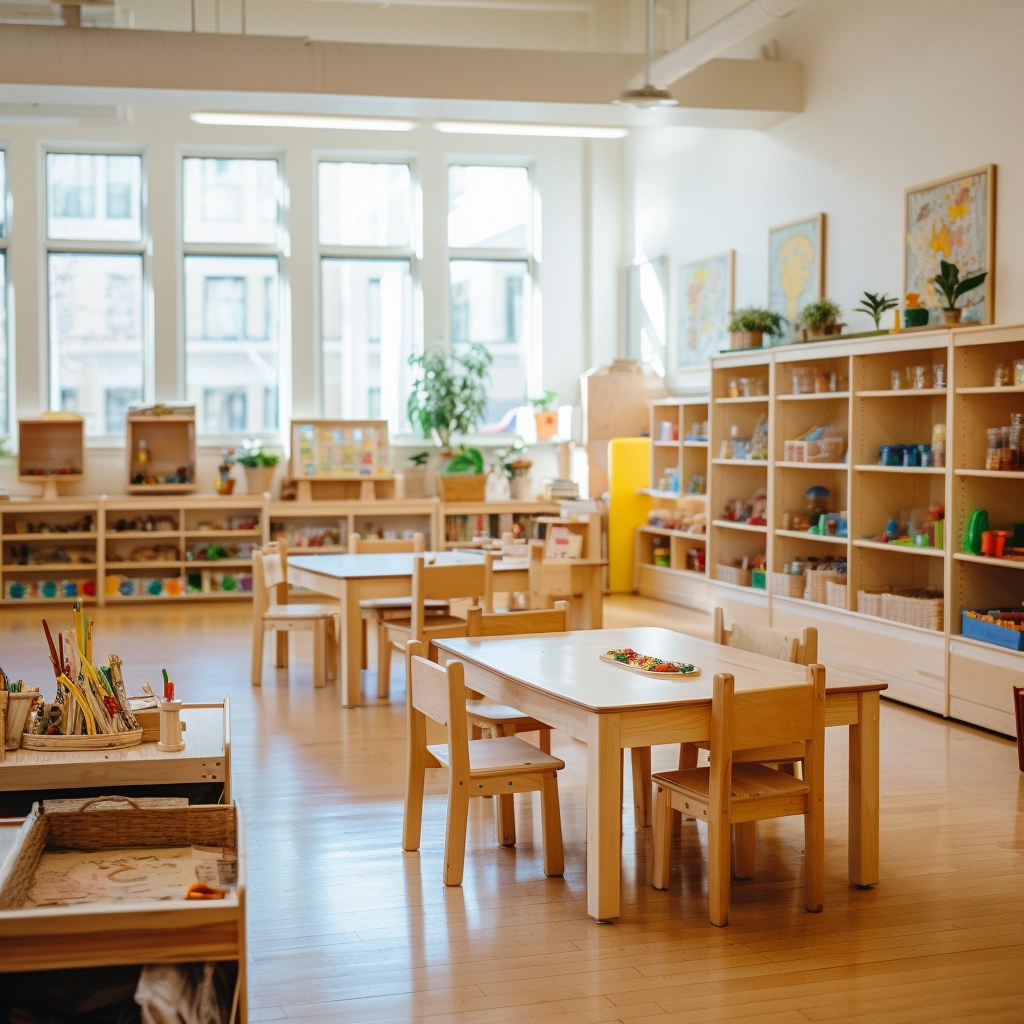
A construction area is one of two things. Children build with interlocking bricks on a studded top, and the loose pieces live in the bins. Or they build on a rug, and that rectangle of floor stays empty. Ordering both, in the same square, is how a building table lands on the only open floor in the room.
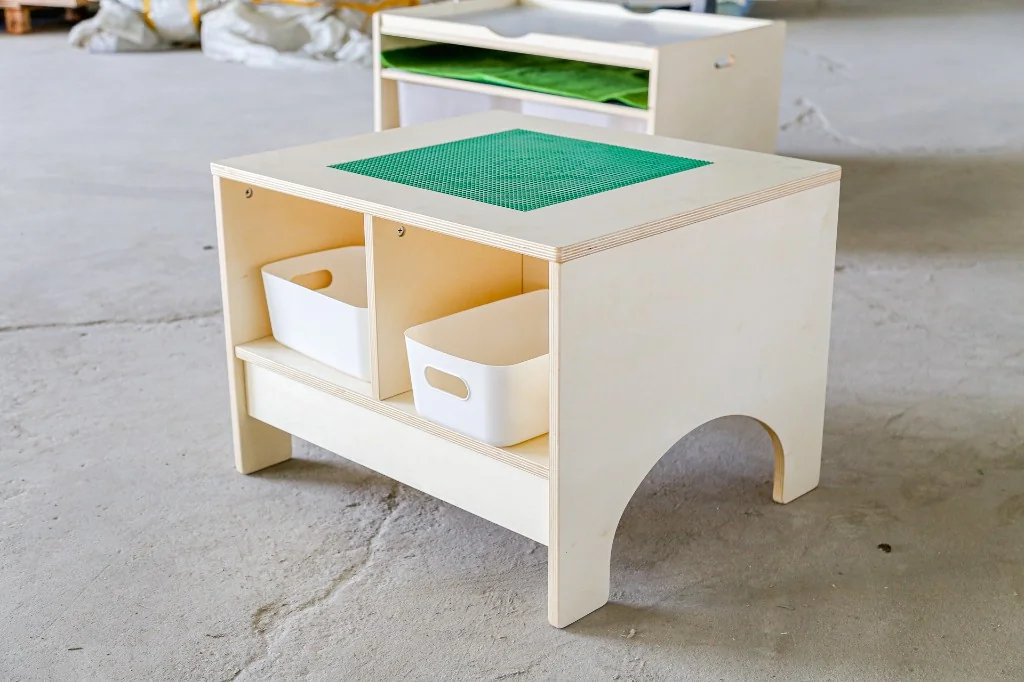
The table in the factory photo has a studded top and two white bins. It is not a light table, and it is not a sensory tray. Those are separate lines, with published sizes, and they get ordered by mistake when a plan just says “activity table.”
Three tops that are not substitutes
| Line | Top | Write it when | Do not write it when |
|---|---|---|---|
| Building table | Studded, two bins under the work | Interlocking bricks stay on the table | The construction area is a rug |
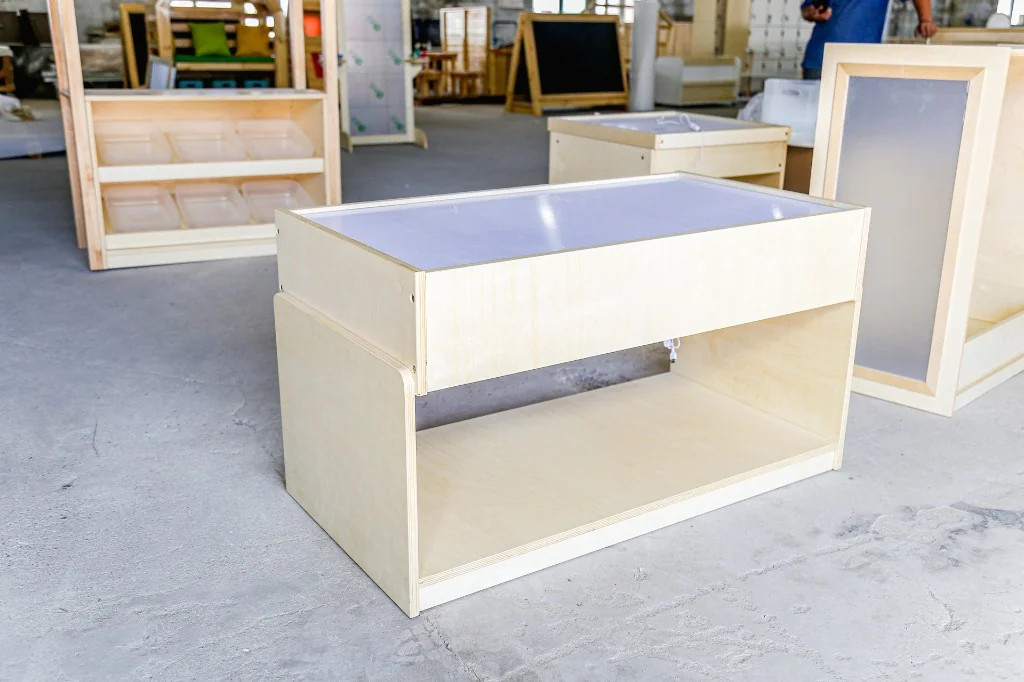
| Light table | A lit panel. Published sizes run from a 15 cm box to a 140 × 70 cm studio top, including 78.5 × 60 × 50 cm for the mirror-back piece | The activity is light | You need a studded brick top. A light panel will not hold bricks |
| Sensory tray table | A deep tray | Sand or water stays in the tray | You need bricks or light. A tray is a third piece |
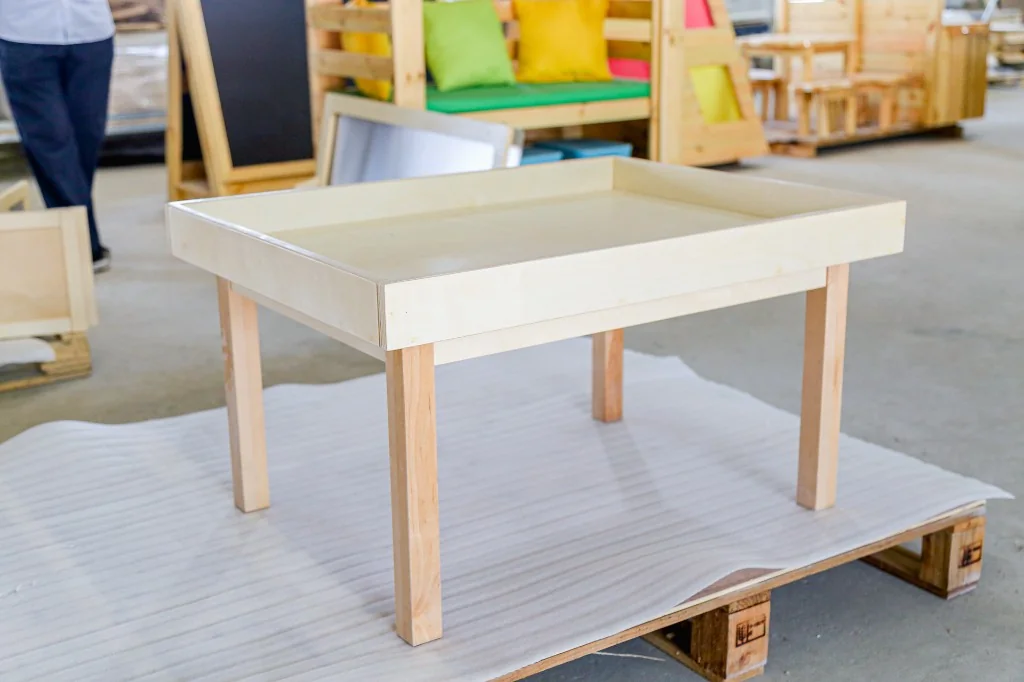
One preschool room takes one building table, unless the plan shows two groups building at once in two separate spots. A second table in the walkway is not a second construction area. An infant room does not get this line. The studded top is a preschool piece.
The rug and the table need two different rectangles
Draw the construction rug as its own rectangle. A common mark on a preschool plan is about 1,500 × 1,500 mm of clear floor where children sit and build. That number is the rug you are protecting, not the size of the table. The factory writes the building table’s top size on the drawing before you freeze it. You then place that top outside the rug, with enough floor to pull a chair.
If the only free floor in the room is that 1,500 × 1,500 mm square, there is no outside. The building table comes off the list. Storage for the bricks sits at the edge of the rug, as a low shelf, not as a table standing on the rug. Leftover floor around a table that does fit stays as circulation. It is not an excuse for a second building table.
Do not approve the quote while the line still says “building table” with no top size next to the rug. That is the same failure as ordering a cubby run from a photograph: the piece is real, and the wall or the floor has not been tested.
Check the top size when the drawing comes back
Suppose the zone you marked is 2,200 mm wide, and the rug takes 1,500 mm of it. 700 mm remains beside the rug. A chair still has to pull back from the top. If the factory returns a top that is 600 mm deep, the top itself fits in the 700 mm strip and the chair does not. The child would pull the chair into the rug you were trying to keep clear.
The fix is one of three, written on the drawing before it is frozen. Move the rug so the strip beside the table is deep enough for the chair. Or turn the top so the deep side runs along the rug and the chair pulls into a different clear edge. Or delete the table. Overlapping the top onto the 1,500 mm square is not a fourth option.
Ask for the top’s length and depth in millimetres on the drawing, and for the side the chair pulls from. A quote line that still says “building table — 1” has not been checked. Send that drawing back. Production does not start on a line the floor has not accepted.
What the two bins are for
The two bins are the piece storage. If the room’s bricks fit in them, do not add a shelf in the aisle “for the extra bricks.” If they do not fit, the extra storage is a low shelf at the edge of the area, drawn as its own line, with its own width. A shelf parked in the walkway fails for the same reason a second table fails.
Say rug or table, and wait for the top size
One preschool room on the classroom cost guide is commonly $4,800–$9,500. The building table is one line inside that figure, and only after its top is drawn outside the rug.
Get Free Daycare DesignWhat to write on the plan
- “Building table” or “floor building.” One of those. “Activity table” is how this gets swapped for a light table or a tray.
- The rug rectangle, if there is one, with its size.
- The clear floor outside that rug, where a top could stand.
- The age. Preschool only, for this studded top.
- Whether the two bins are enough, or a low shelf is a second line.
- The opening date, so the table is cut with the other tables in the room.
This piece is wood. There is no light panel and no plug. Coatings and any test report are matched to it when the drawing is frozen. West Shore does not hold a blanket mark that covers every table in every country. Name the destination.
West Shore Furniture has manufactured in Dalian since 2003, for 5,000+ institutions in 50+ countries. Minimum order quantity varies. Ordinary tables, if the room also needs them, are on preschool tables and chairs. Where the area sits is on the preschool classroom layout. The order sheet is on how to order from the factory.
Conclusion
Order the studded building table when bricks stay on the top, and only after the top size sits outside the rug. Leave the line off when the 1,500 mm square is the construction area and there is no other floor. Do not replace it with a light table or a sensory tray because the plan was vague.
One preschool room is commonly $4,800–$9,500 on the classroom cost guide. This table is inside that figure when the plan shows a top outside the rug. Send the floor plan, the ages and the opening date. Production is 30–45 days after the drawing is frozen, and a classroom package is commonly 10–14 weeks door to door.
Not ready to send a floor plan? Request the preschool furniture catalog.
FAQ
Does every preschool room need a building table?
No. Only when children build on a table. If they build on a rug, that rectangle stays empty and this line comes off.
Can it stand on the block rug?
Then it is in the way. Draw the rug, for example 1,500 × 1,500 mm, and put the table outside it. If there is no outside, do not order the table.
Is this the same as a light table?
No. Light tables are a lit panel, from a 15 cm box to a 140 × 70 cm top. The building table is a studded top with two bins. A sensory tray is a third piece. The plan has to name which one.
How many for one room?
One, unless two groups have two separate spots on the plan. A second table in the walkway is not a second area.
Does it need power?
No. There is no panel and no plug. Do not specify a voltage for this line.
Does it ship with the other tables?
Yes, on the same drawing and the same opening date. It is one line inside a preschool room commonly priced at $4,800–$9,500. Production is 30–45 days after the drawing is frozen, and a classroom package is commonly 10–14 weeks door to door.