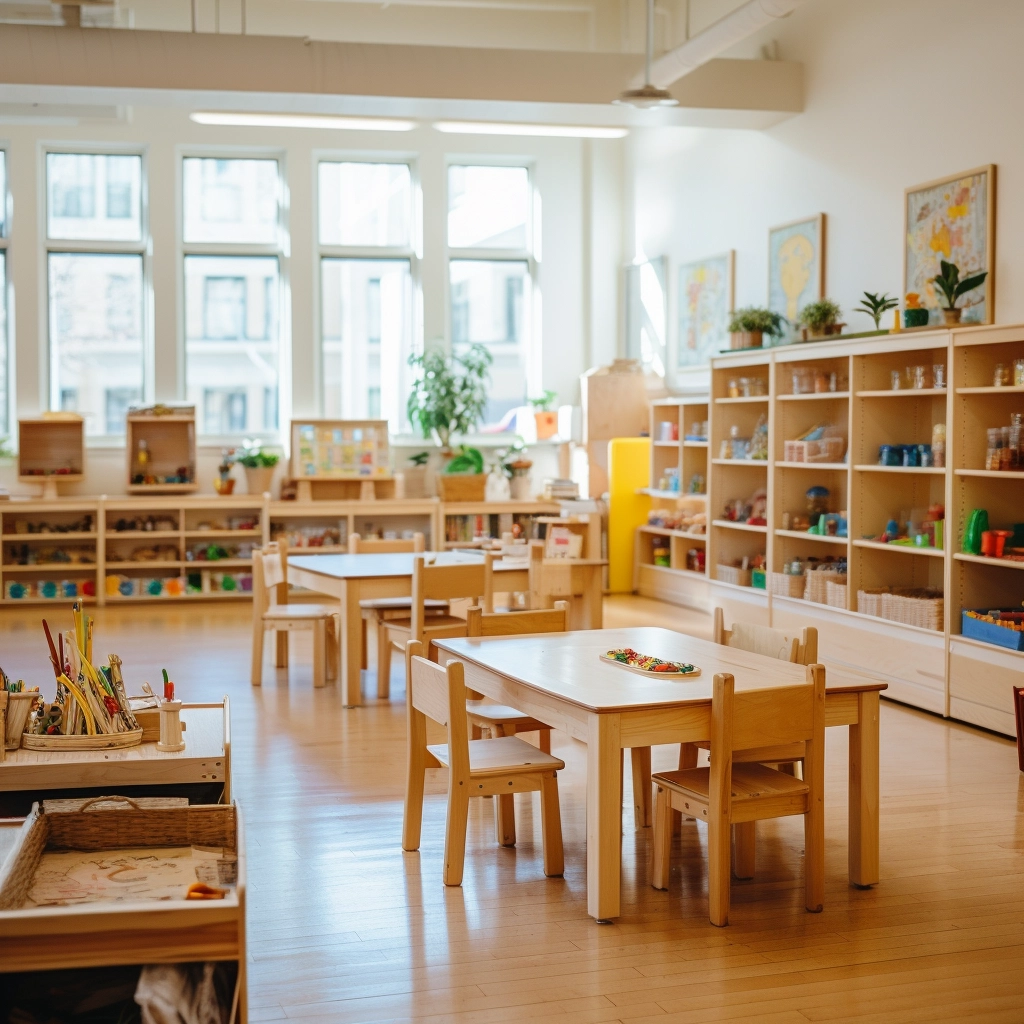
Preschool classroom lighting is one of those things that can really affect a student’s focus, reading ability and overall comfort in the classroom. Do it wrong and you’ll end up with glare, eyestrain or just an uncomfortable room that feels dull. Here we will discuss everything from natural lighting to LED options that you can use to take your lighting in the preschool classroom task to the next level.
Why Natural Light Is the Best
You are all aware of the fact that sunlight offers more than just light. It helps keep people awake, keeps body clocks on time, and is easier on the eyes in comparison to other light sources.
Now, here are the things you can do:
Position the desks in a way that students face the windows at an angle instead of straight on or away from them. It will simply prevent any unpleasant glare on computer screens and paper.
Consider removing any furniture or storage along walls nearby windows. It makes sure sunlight can easily reach other parts of the room.
You need to use lighter curtains instead of heavy ones. Lighter curtains are one of the most effective ways to block strong sunlight while letting the natural light in without any problem.
Just in case the rooms have insufficient windows you can consider adding a big mirror so that you can effectively use it to reflect light into other rooms.
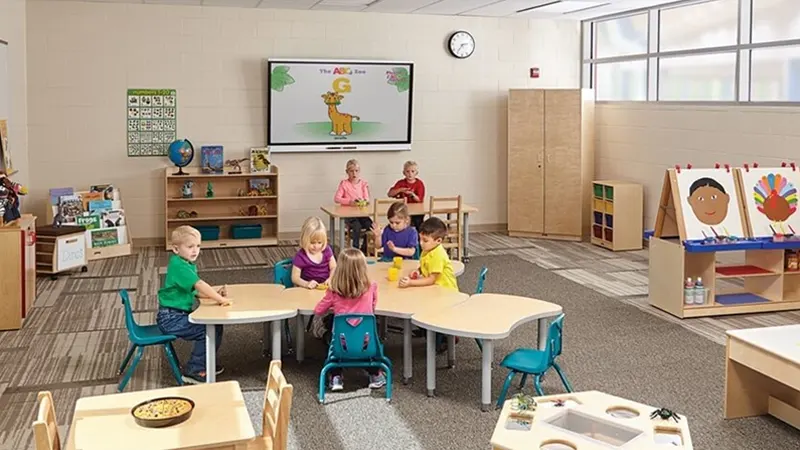
Choosing The Right LED Bulbs
LED has become the new standard for classroom lighting, and that too for good reason. They are much more energy efficient, come with longer life spans, and emit much less heat in comparison to traditional fluorescent tubes.
When choosing bulbs you generally have to look on two factors:
CRI rating
Ideally you need to go for bulbs that’ll have at least an 80+ rating. If you want something that goes best with art, reading etc. then choose bulbs with 90+ rating as it renders colors more accurately.
Flicker
You might not notice but cheap LED bulbs will flicker at a rate that is too fast for your eyes to pick up. They are one of the main causes why you develop an eyestrain over time. To avoid it simply go with reputable brands rated as flicker-free.
Understanding of Lighting Temperatures
Light color temperatures can be measured in kelvin, with the number indicating how cool or warm the light is rather than its brightness.
The lower numbers on the scale tend to lean towards more yellow, orange and red, on the other hand higher numbers lean towards blue-white colors.
We recommend using 3500K-4000K bulbs for regular classroom settings, as it would provide a nice balance between not being too warm and not being too clinically bright.
Just in case you are looking for a more intense environment then you can go for 4000K-5000K bulbs. It will help in making students’ brains active and awake.
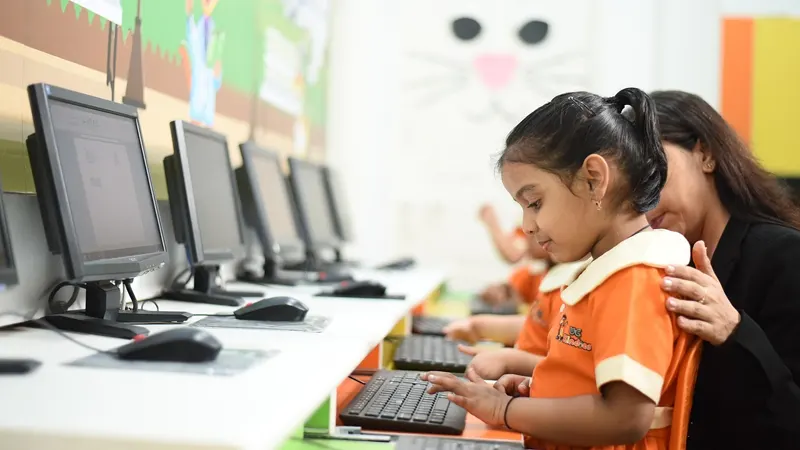
Reducing Glare And Shadows
Glare on the whiteboard or screen feels very irritating as it would be too much struggle to read and focus anything especially for preschool children. Apart from that, shadows can make them feel the same. Here’s what you can do to avoid it:
- Avoid installing light fixtures directly in front or above a white board or story chart. You can angle them in a way that light doesn’t bounce straight back at children.
- Space the fixtures evenly across the ceiling instead of clustering them in the middle. It will make light spread without leaving dark corners.
- Don’t use bare bulbs instead you choose fixtures with diffusers as diffused light spreads more evenly and glares less.
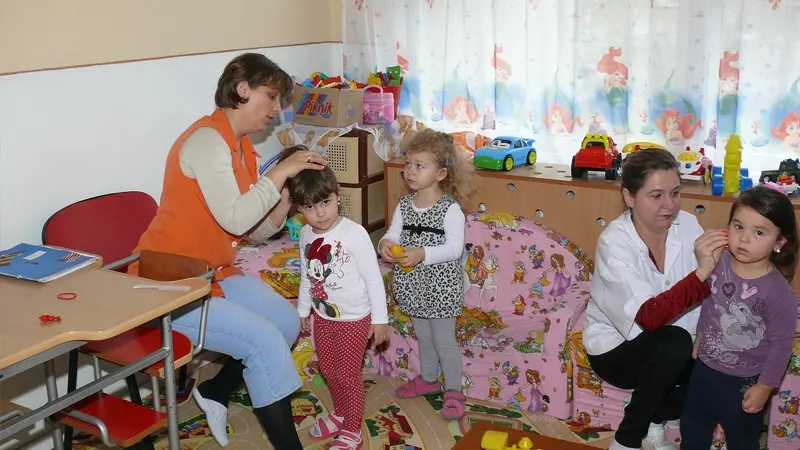
Three Types of Light Every Room Needs
Most preschool rooms only use one type of lighting: a single layer of overhead light. But a room that works well for lots of different activities usually needs three types of light working together.
General Room Light
This is the everyday light that fills the whole room so everyone can move around safely and see each other. It should be spread out evenly, without harsh shadows, and bright enough that staff can keep an eye on every corner.
Extra Light for Specific Spots
This is added light focused on one particular area, like an art table, on top of the general room light. Because it only lights up a small space, it uses less power than brightening the whole room, and it also helps that spot feel like its own little zone.
Soft, Cozy Accent Light
This is the gentlest layer: a warm lamp in the reading corner, or a soft glow near a quiet, calm-down space. It is not there to help with a task. It is there to make a small area feel warm and welcoming.
Bonus: Adding Task Lighting Where Needed
Task lighting is extra, focused light that you can consider to add on top of the room’s general lighting. The main purpose of this light is to focus on a specific spot.
The best recommended places are reading corners, art stations, and lab benches. As it lights a small area only, it uses far less energy in comparison to raising the brightness of the entire room.
Matching Lighting to What Happens in Each Area
A preschool classroom is really made up of several small spaces put together. Each one needs its own brightness level and its own type of fixture, based on how the furniture is actually set up.
| Area | How Bright It Should Be | Best Light Color |
| サークルタイム | Bright and even, no shadows | Balanced (3500K to 4000K) |
| Art & Sensory | Very bright, true colors | Balanced, high color accuracy |
| 読書コーナー | Soft, medium brightness | Warm (2700K to 3000K) |
| 仮眠エリア | Very dim, or off, on its own switch | Warm, or off |
| 劇 | Medium brightness | Warm to balanced |
| Snack Area | Bright enough to spot spills | Balanced (3500K to 4000K) |
| Entry & Cubbies | Medium to bright, for quick tasks | Balanced (3500K to 4000K) |
Circle Time / Group Gathering Area
Choose wide, evenly spread overhead lights instead of one light straight in the middle, which can cast shadows on children sitting at the edge of the rug. Make it dimmable for story time, and keep the light out of children’s direct eyeline when they look up.
Art & Sensory Area
Pick covered fixtures with a high color accuracy rating, placed directly above the tables, so hands are not working in their own shadow. If the area is near water or a sand table, choose fixtures rated safe for damp spots.
読書コーナー
A floor lamp with a soft fabric shade, secured so it cannot tip over and placed close to the seating, feels much cozier than an overhead light and helps this corner feel separate from the rest of the room.
仮眠エリア
Give this area its own switch or dimmer, separate from the rest of the room. Use lights mounted on the wall or pointed away from the cots, rather than anything overhead and directly above sleeping children.
Dramatic Play Corner
Regular room lighting works fine here. Just make sure tall furniture, like a play kitchen, is not blocking the light and creating dark spots where children play out of a teacher’s sight.
Snack Area
Place an easy-to-clean fixture directly above the tables, not over the walking path around them, so the eating area stays bright enough for staff to spot spills quickly.
Entry & Cubby Area
This spot is easy to forget, but it is where staff check name labels each morning and children look for their own belongings. A motion sensor works well here, since the area only gets used in short bursts rather than all day long.
Saving Energy Without Losing Light
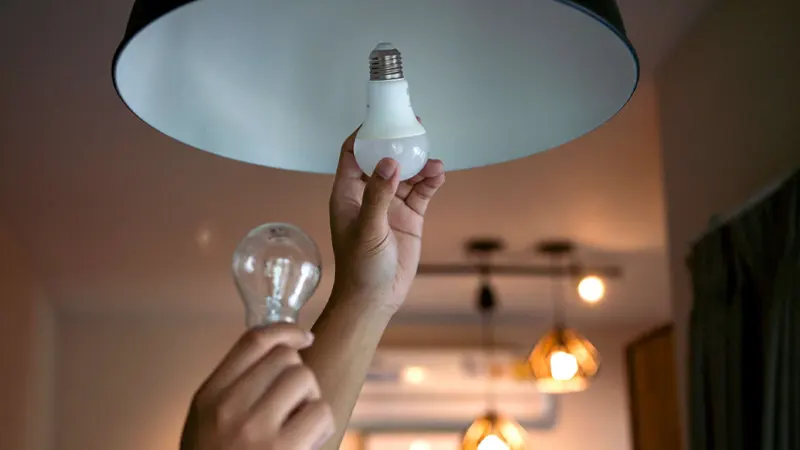
Controlling the electricity bill doesn’t mean you have to sacrifice a bright and comfortable home. Once safety and layout are sorted out, a few simple habits can lower your electricity bill without dimming the room.
Here are some smart ways that are actually useful:
Dimmers
Let staff lower brightness during video lessons or bright afternoons without switching lights off entirely.
Motion or occupancy sensors
Lights turn off automatically in empty rooms, so nothing runs unnecessarily.
Zoning
Split lighting into sections, so rows near windows can dim while rows further back stay at full brightness.

Keeping Classroom Lighting Safe
Safety always comes first in a room built around three- and four-year-olds. These are the same things a licensed electrician or a facility inspector would check.
Fixtures and Cords
- Keep fixtures and cords out of reach of climbing children, and run cords along the baseboards instead of across walkways.
- Choose fixtures with a cover over the bulb, instead of bare bulbs that could break or overheat.
- Make sure each bulb’s wattage matches what the fixture is rated for, so it does not overheat.
Electrical Setup
- Cover every outlet with a tamper-resistant cover (a plug cover that a child cannot easily pull open), and try to avoid using extension cords in the classroom. The CPSC’s electrical safety checklist is a helpful, plain-language guide if you want to check a room yourself.
- Near sinks, water tables, or sensory areas, use a GFCI outlet. This is a special outlet that shuts the power off instantly if it senses moisture nearby, which protects against shocks.
- Have any new wiring installed, or at least checked, by a licensed electrician, and make sure fixtures are UL-listed (meaning they have been tested and approved as safe) and meet your local building code. NAEYC’s program standards are a good general benchmark, even if your program is not formally accredited.
Keeping an Eye on Things Over Time
- Test emergency and exit lights on the same schedule as your fire drills.
- Once a month, check for flickering, discoloration around a fixture, loose covers, or worn cords.
Simple Tips For Small Budgets
Even without a full renovation, schools can improve lighting fast:
- You can swap old fluorescent tubes for LED equivalents, which often fit existing fixtures.
- Clean fixture covers and diffusers regularly as they built-up dust and can quietly cut light output by a noticeable margin.
- Repaint walls and ceilings in light colors, since pale surfaces reflect far more light than dark ones.
- Trim back trees or blinds blocking windows from outside, restoring daylight that’s already free.
よくある質問
What Is The Best Color Temperature For A Classroom?
A neutral 3500K to 4000K works for most general classroom use. Meanwhile, for labs or focused tasks go with cooler tones around 4000K to 5000K.
Are LED Lights Better Than Fluorescent Lights For Schools?
Yes, LEDs are known to use less energy, last far longer, and don’t flicker or hum the way older fluorescent tubes often do.
How Much Natural Light Does A Classroom Need?
As much as the room allows without causing glare. Desks near windows, angled to avoid direct glare, make the biggest difference.
What Is CRI And Why Does It Matter For Classrooms?
CRI measures how accurately a light source shows true colors. Aim for 80 or above, and 90 or above for art or detailed work.
How Can I Reduce Glare On A Whiteboard?
Avoid placing lights directly above or facing the board, use diffused fixtures, and angle lighting away from the viewing area.
What Is Task Lighting And When Should I Use It?
Task lighting is focused light aimed at a specific spot, like a lab bench or reading corner, added on top of general room lighting.
How Do Dimmer Switches Help Save Energy In Schools?
Dimmers let staff lower brightness when full light isn’t needed, cutting energy use without switching lights off completely.
What Is The Ideal Brightness Level For A Reading Corner?
Around 300 lux, slightly warmer and softer than the rest of the classroom, works well for comfortable reading.
Can Painting Walls A Lighter Color Improve Classroom Lighting?
Yes. Light-colored walls and ceilings reflect more light around the room, making the space feel brighter without adding fixtures.
How Often Should Classroom Light Bulbs Be Replaced?
LED bulbs typically last several years under normal school use, but replace any that flicker, dim unevenly, or show visible damage right away.
結論
Good classroom lighting can be achieved easily with less effort. All you need to do is pick the right balance of ideas that we have shared above. Just list down your requirements first and use our guide to get the best lighting for classrooms.