

What is the ideal teacher-to-child ratio? There is no single number for every daycare. A useful quality target is one adult for every 3–4 infants, 4–6 toddlers, and 8–10 preschoolers. You must then apply any stricter local rule and reduce the number of children per adult when individual needs, daily routines, or the room make supervision harder.
The ratio is only one part of the decision. You also need to check maximum group size, staff qualifications, mixed-age rules, break coverage, and whether the adults in the room can actually see and reach the children they supervise.
The Short Answer
Use the following ranges as a planning starting point for center-based care, not as a substitute for your license. They reflect federal child care guidance and recognized early-learning quality benchmarks, but your regulator may use different age bands or stricter limits.
| Age Group | Useful Planning Range | Conservative Group-Size Reference |
|---|---|---|
| Infants, roughly birth to 12–15 months | 1 adult to 3–4 children | 6–8 children |
| Toddlers, roughly 13–35 months | 1 adult to 4–6 children | 8–12 children |
| Three-year-olds | 1 adult to 7–9 children | About 14–18 children |
| Four- and five-year-olds | 1 adult to 8–10 children | About 16–20 children |
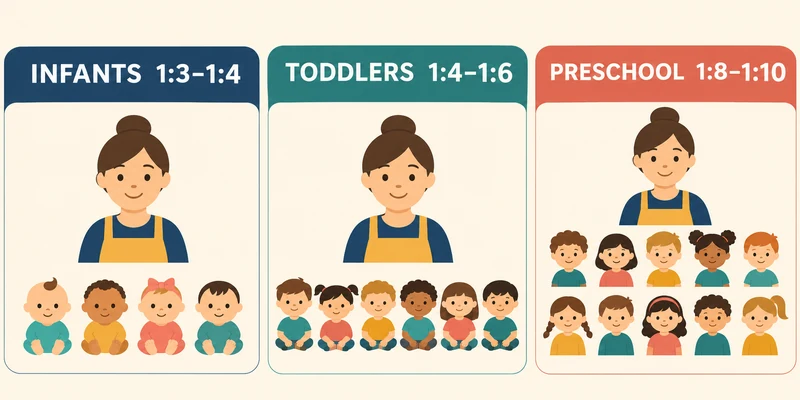
In this article, 1:4 means one adult for four children. A lower ratio means fewer children per adult. For example, 1:3 gives each adult fewer children to supervise than 1:5.
The ranges are intentionally not one fixed answer. A one-year-old who needs feeding, diapering, lifting, and close physical supervision creates a different workload from a five-year-old who can follow a group routine. Even within the same age band, the number that works well can change with mobility, communication, health needs, staff experience, and the activities scheduled that day.
Ratio And Group Size Are Different
Teacher-to-child ratio tells you how many children each adult is responsible for. Group size tells you how many children share the room or defined learning group. You need both numbers.
Consider two infant rooms:
| Room | Adults | Children | Ratio | Group Size |
|---|---|---|---|---|
| Room A | 2 | 8 | 1:4 | 8 |
| Room B | 4 | 16 | 1:4 | 16 |
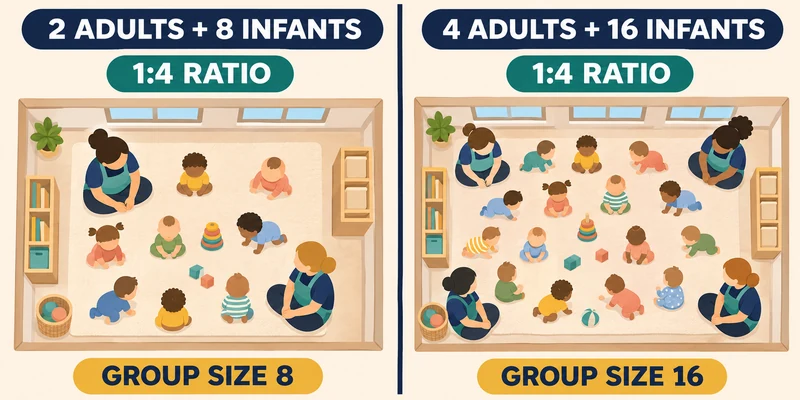
Both rooms have the same ratio, but they do not create the same environment. In the larger group, you have more movement, more simultaneous routines, more noise, and more chances for one need to overlap with another. That is why quality frameworks often pair a ratio with a maximum class or group size. The current benchmark linked above, for example, pairs 1:4 with a maximum class of eight infants and 1:10 with a maximum class of 20 preschool children.
A divider does not automatically turn one large group into two compliant groups. Your licensing rule may define a group by assigned staff, classroom boundaries, shared space, or how children interact during the day. Confirm the definition before you use furniture or partitions to divide a room.
Staff Qualifications Also Matter
The person standing in the room does not always count toward the required ratio. Your local rule may consider the employee’s age, role, qualification, background clearance, first-aid training, or whether that person is working directly with children.
Do not assume that a director in an office, a cook preparing food, a therapist visiting one child, a volunteer, or an employee completing planning time can be counted. Some jurisdictions allow certain people to count under defined conditions; others do not. England’s current rules, for example, change the permitted ratio for children age three and over according to the qualifications of the staff working directly with them.
Build your staffing sheet with two separate columns:
- employees scheduled on site;
- qualified employees who are available and permitted to count in the ratio.
That separation prevents a common planning error: having enough people in the building but not enough countable adults with the children.
The Legal Minimum Is Not Always Your Target
Licensing ratios are minimum operating requirements. They tell you the highest number of children you may assign to the required staff under defined conditions. They do not guarantee that the arrangement is the best fit for every child, room, or part of the day.
There is also no research-based magic number that guarantees a specific developmental result. A recent U.S. federal evidence review did not identify one precise teacher-to-child ratio that consistently produces better outcomes across programs. Ratio still matters for safety, workload, and opportunities for interaction, but it works together with group size, teacher skill, continuity of care, classroom practice, and the physical environment.
You should normally choose the lower number of children per adult when:
- several children are non-mobile or need hands-on care;
- a child has an individualized health, developmental, or behavioral support plan that requires added attention;
- the group has frequent toileting, diapering, feeding, or sleep routines;
- staff are new to the room or the children;
- the schedule includes water play, outings, transport, or other higher-risk activities;
- the room has separated spaces, weak sightlines, or a difficult indoor–outdoor transition;
- one adult regularly leaves direct supervision for meals, cleaning, paperwork, or breaks.
Your ratio target should describe the room when the day is busiest, not only when every child is settled and every employee is present.
Rules Change By Location
Do not copy a ratio from another state, province, or country. Age cutoffs, group-size limits, qualification rules, and the way mixed ages are calculated can all change at a border.
The examples below show why one worldwide answer would be misleading. They are current planning references as of November 2026, not a replacement for the rule attached to your license.
| Location Or Program | Current Example | What You Need To Check |
|---|---|---|
| United States | States and territories set their own child care licensing requirements. Head Start has separate program rules and follows the stricter state or local requirement when one applies. | Your state or territory, care type, exact age band, group size, and staff qualifications |
| Australia | Centre-based ratios include 1:4 from birth to 24 months and generally 1:5 from over 24 to under 36 months, with Victoria using 1:4 for that older band. Ratios for older children vary by jurisdiction. | Your state or territory, age mix, staff working directly with children, and adequate supervision |
| England | Current EYFS rules use 1:3 for children under two, 1:5 for two-year-olds, and generally 1:8 or 1:13 for children age three and over depending on staff qualifications and the setting. | Staff qualification level, provider type, and who is working directly with the children |
| Ontario | Licensed centers use 3 staff for 10 infants, 1:5 for toddlers, and 1:8 for preschool groups, together with maximum group sizes and qualification rules. | The child’s exact age category, group size, qualified employee requirement, and any permitted reduced-ratio period |
In the United States, start with your state or territory’s licensing page rather than a national comparison chart. If you operate Head Start, its center-based requirements add program-specific group sizes and staffing conditions.
In Australia, the numeric ratio is not the whole supervision test. The adequate-supervision requirement is separate from the minimum staffing ratio. An educator must be working directly with children to count, and the service may need more staff when the children’s needs or the setting demand it.
Wherever you operate, keep the official rule or licensing interpretation with your staffing records. A summary from a blog can help you ask the right questions, but it cannot resolve a local exception or replace approval from the authority responsible for your service.
Mixed-Age Rooms Need A Separate Check
Mixed-age rooms are not calculated the same way everywhere. Some frameworks apply the rule for the youngest child to the whole group. Others calculate each age band separately or allow a specific mixed-age formula.
Do not average the ages or use the oldest children’s ratio for the room. Before assigning staff, record:
- the number of children in each regulatory age band;
- the age of the youngest child present;
- the mixed-age method in your local rule;
- the maximum permitted group size;
- the qualifications required for each counted employee.
Recalculate when a child moves into the next age band, when rooms combine at opening or closing, and when attendance changes. A room that is compliant at 10:00 a.m. may need a different staffing pattern when two age groups combine at 5:00 p.m.
Plan Coverage For The Whole Day
The number of teachers assigned to a classroom is not the same as the number available every minute. Breaks, lunch preparation, parent conversations, toileting support, cleaning, planning time, and staff absences can remove an adult from direct supervision.
Create a coverage table in 15- or 30-minute blocks for the full operating day. For each block, write down:
- the number and ages of children expected;
- the legal number of countable adults required;
- the number you need to meet your own quality target;
- who covers breaks and non-contact work;
- which transitions or routines create extra demand;
- the backup plan for a late arrival or same-day absence.
Pay close attention to opening, closing, outdoor transitions, meals, diapering, nap setup, and pickup. These are the periods when children move, staff duties overlap, and a paper ratio can stop matching the room.
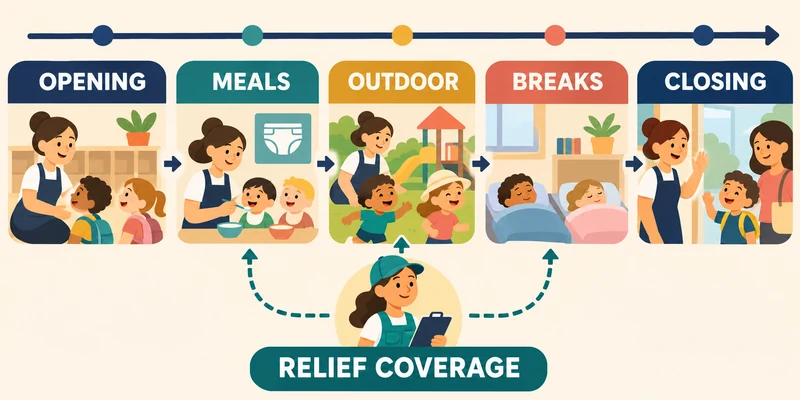
Keep attendance, staff assignment, head-count, and transition records in the format your regulator expects. Those records also make your next childcare licensing inspection easier to prepare for because you can show how the ratio was maintained, not only display a policy.
Calculate The Number Of Staff
For a simple single-age room, divide the number of children by the permitted children per adult and always round up:
Required adults = children present ÷ permitted children per adult, rounded up
If 18 four-year-olds are present and your legal maximum is 1:10, the calculation gives 1.8, so you need at least two countable adults. If your program chooses a quality target of 1:8, the calculation gives 2.25, so you schedule three adults.
That third adult is not automatically your break cover. If your program promises to maintain 1:8 throughout the day, the room still needs three available adults while someone takes lunch. You may need a relief employee or a shared floater whose schedule is written around the actual break times.
For mixed ages, reduced-ratio periods, or rules that calculate across an entire service, do not rely on this simple formula. Use the regulator’s method or calculator and keep a record of the assumptions you used.
Use The Room To Support Supervision
A compliant staff count cannot fix a room full of blind spots. You need to test what each adult can see while doing real work, not only what is visible from the center of an empty floor plan.
Mark these supervision positions on the plan:
- the room entrance;
- the diaper-changing or toileting area;
- feeding and meal tables;
- quiet and rest areas;
- messy-play or handwashing areas;
- the indoor–outdoor threshold.
Then draw the sightline from each position. Tall solid shelving at a corner, cubbies beside the entrance, or a full-height divider across the room can hide children even when the furniture looks orderly. Low open-backed storage can define activity zones while preserving visibility. Clear circulation also lets an adult reach a child quickly without moving chairs or stepping around storage.
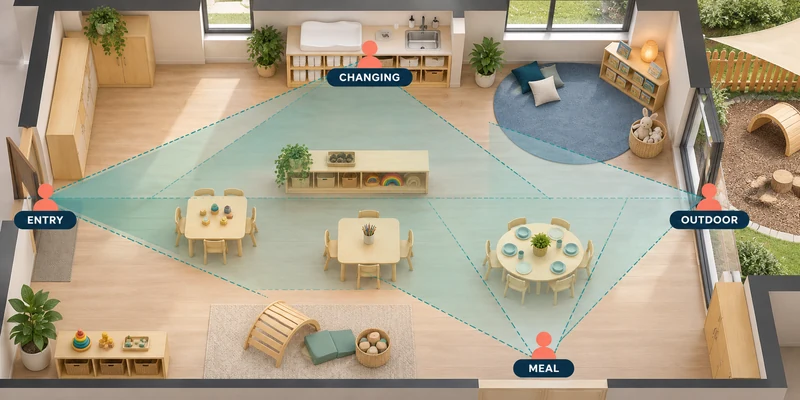
This is why your daycare room setup should follow the staffing and age plan. Furniture should support the way adults supervise, feed, change, settle, and guide children. It should not create a second staffing problem after the room has been licensed.
When West Shore Furniture works from a childcare floor plan, you first confirm the room ages, intended places, usable dimensions, and main staff positions. The layout can then be checked for sightlines and circulation before furniture quantities are fixed. The same process is shown in more detail in the Australian childcare room layout guide, where supervision is tested from the positions educators actually use.
The layout does not approve your ratio or replace a licensing review. It gives you a practical way to find visual barriers and crowding before the furniture is produced or installed.
Choose A Ratio For A New Center
If you are planning a new daycare, use this order:
- Identify The Rule. Find the official ratio, age bands, maximum group size, qualification requirements, and exceptions for your location and type of service.
- Set The Age Groups. Decide which children will use each room. Do not finalize capacity while the age mix is still changing.
- Choose The Operating Target. Decide whether you will staff at the legal maximum or use fewer children per adult for quality, individual needs, or a difficult room.
- Build The Daily Schedule. Add breaks, opening and closing combinations, non-contact time, transitions, and absence cover.
- Test The Floor Plan. Check real supervision positions, circulation, toilets, changing, sleep, meals, and outdoor access.
- Create The Room List. Only after the first five decisions should you fix the number of cribs, chairs, tables, shelves, cubbies, and activity zones.
This order prevents two expensive errors: buying for a capacity your staffing model cannot support, and filling the room so densely that supervision becomes harder. An infant room furniture list is especially sensitive to this sequence because cribs, changing, feeding, and floor play all compete for supervised space.
Questions To Ask When Comparing Programs
If you are choosing care for your child, ask about the ratio in the actual room your child will use. A center-wide average does not tell you what happens during a busy toddler lunch or at the end of the day.
Ask these questions:
- How many children and countable staff are normally in this room?
- What is the maximum group size?
- Does the program staff above the legal minimum?
- How are breaks, absences, opening, and closing covered?
- What happens when age groups combine?
- Which staff qualifications are required in this room?
- How long have the regular teachers worked with this age group?
- Can adults see the children from changing, toileting, meal, and rest areas?
Listen for a specific answer. “We always meet ratio” is less useful than an explanation of the room’s normal group size, who covers breaks, and how the center records transitions.
FAQ
Is A 1:10 Teacher-to-Child Ratio Good?
It can be a reasonable preschool ratio, but it is not suitable for infants and may not meet the rule for younger toddlers. Check the children’s ages, group size, staff qualifications, and local license. For preschoolers, 1:10 appears in current quality guidance, but a smaller group or 1:8 target may work better when needs or room conditions require more attention.
Is A Lower Teacher-to-Child Ratio Always Better?
A lower number of children per adult usually gives staff more capacity for supervision and individual interaction, but ratio alone does not define quality. Teacher skill, continuity, group size, daily practice, and the physical environment also matter. You should meet the strictest applicable rule and then choose the staffing level that fits the children and the room.
Do Sleeping Children Count In The Ratio?
Usually, children remain part of the ratio while sleeping, but some regulations allow defined staffing adjustments during rest periods for certain age groups. Infants often have stricter requirements. Never reduce staff at nap time unless your current local rule clearly permits it and all supervision conditions are met.
Can A Director Or Assistant Count In The Ratio?
Only when the local rule allows that person to count and the person is qualified, available, and working directly with the children as required. A director doing administration in an office should not be treated as automatic classroom coverage.
Which Ratio Applies In A Mixed-Age Classroom?
It depends on your jurisdiction. Some rules use the youngest child’s ratio for the whole group, while others calculate the age bands separately. Record the number of children in each band and use the official mixed-age method. Do not average the ages.
How Often Should You Check The Ratio?
You should monitor it continuously while children are in care and recalculate whenever attendance, staffing, room assignments, or age groups change. Written checks are especially useful at opening, closing, breaks, transitions, and room combinations.
Conclusion
The ideal teacher-to-child ratio is an age-based operating decision, not one universal number. Start around 1:3–1:4 for infants, 1:4–1:6 for toddlers, and 1:8–1:10 for preschoolers, then apply any stricter local requirement. Check maximum group size, qualifications, mixed-age rules, and real coverage before you call the plan complete.
Your final test is practical: can the scheduled adults see, reach, and respond to every child through meals, changing, rest, outdoor transitions, breaks, and absences? If you are planning a new center, send West Shore Furniture the measured floor plan, room ages, intended places, and opening date. The layout can then be developed into an age-appropriate furniture plan while your licensing authority confirms the staffing requirements.