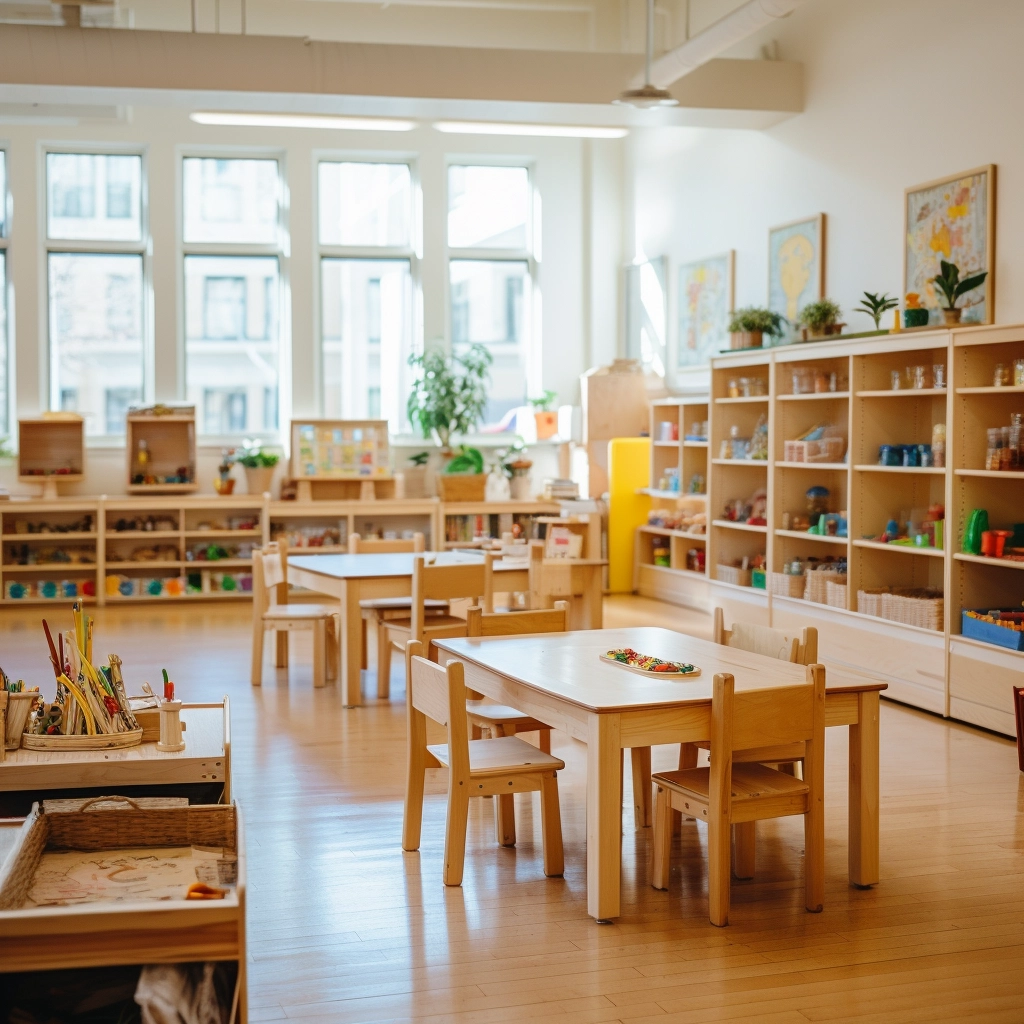
Childcare table and chair height in Australia is a millimetre and a quantity, not a Pinterest set. ACECQA does not publish a legal seat height. Standard 3.1 asks whether fixtures and furniture are fit for the children in that room. Get the height wrong and children climb, fidget, or cannot reach the table. Get the count wrong and you fail the 3.25 m² unencumbered indoor test before the first tour.
Australia planning cluster: How to start a centre · Classroom furniture cost · Furniture checklist · Room layout · Sydney fit-out cost · CCS approved service · Table & chair height (this guide) · Startup cost Hub · Furniture Australia
Operator page — millimetres and quantities, not a home shopping chart
ACECQA does ない publish a legal millimetre for childcare tables and chairs. Quality Area 3 requires furniture that is fit for purpose and sufficient. This page turns that into a purchase order: NQF age rooms, factory sizes, a 150–200 mm gap, a 60-second fit test, and chair counts that do not eat 3.25 m² unencumbered indoor space.
AUD room budgets sit on cost to furnish a classroom. The U.S. inch chart is a different page: kid’s table and chair height guide.
Childcare table and chair height calculator (Australia)
Enter the NQF room and licensed places. You get a planning millimetre, a chair count, and a table count. Fit-test the children who will actually sit there before you freeze the PO.
Planning tool only. It does not replace a fit test, a floor plan, or the regulatory authority’s view of unencumbered space. Educator-to-child ratios do not set millimetres; they only tell you how many adults sit in the room.
Heights look right but the chairs still have to fit the drawing.
Send room ages, licensed places and the dimensioned plan. West Shore returns a furniture concept with millimetres on the schedule.
What ACECQA Actually Requires (and What It Does Not)
ACECQA and the National Regulations set space, supervision and a physical environment that works. They do ない write “preschool chairs must be 300 mm.” Element 3.1.1 is fit for purpose. Element 3.1.2 is upkeep. Element 3.2.2 is that resources are sufficient in number and allow every child to take part.
- Furniture that is clearly too high, too low, unstable, or too numerous can still fail an assessment visit.
- Unencumbered indoor space is 3.25 m² per child. Chairs occupy floor the children cannot use.
- Educator-to-child ratios tell you how many adults sit in the room. They do not set millimetres.
- Do not invent an Australian Standard number for seat height. Spec commercial factory sizes and a fit test instead.
その room layout guide covers how to keep 3.25 m² after the furniture is drawn. This page covers which millimetres go on that drawing.
Childcare Table and Chair Height Chart (Australia, 2026)
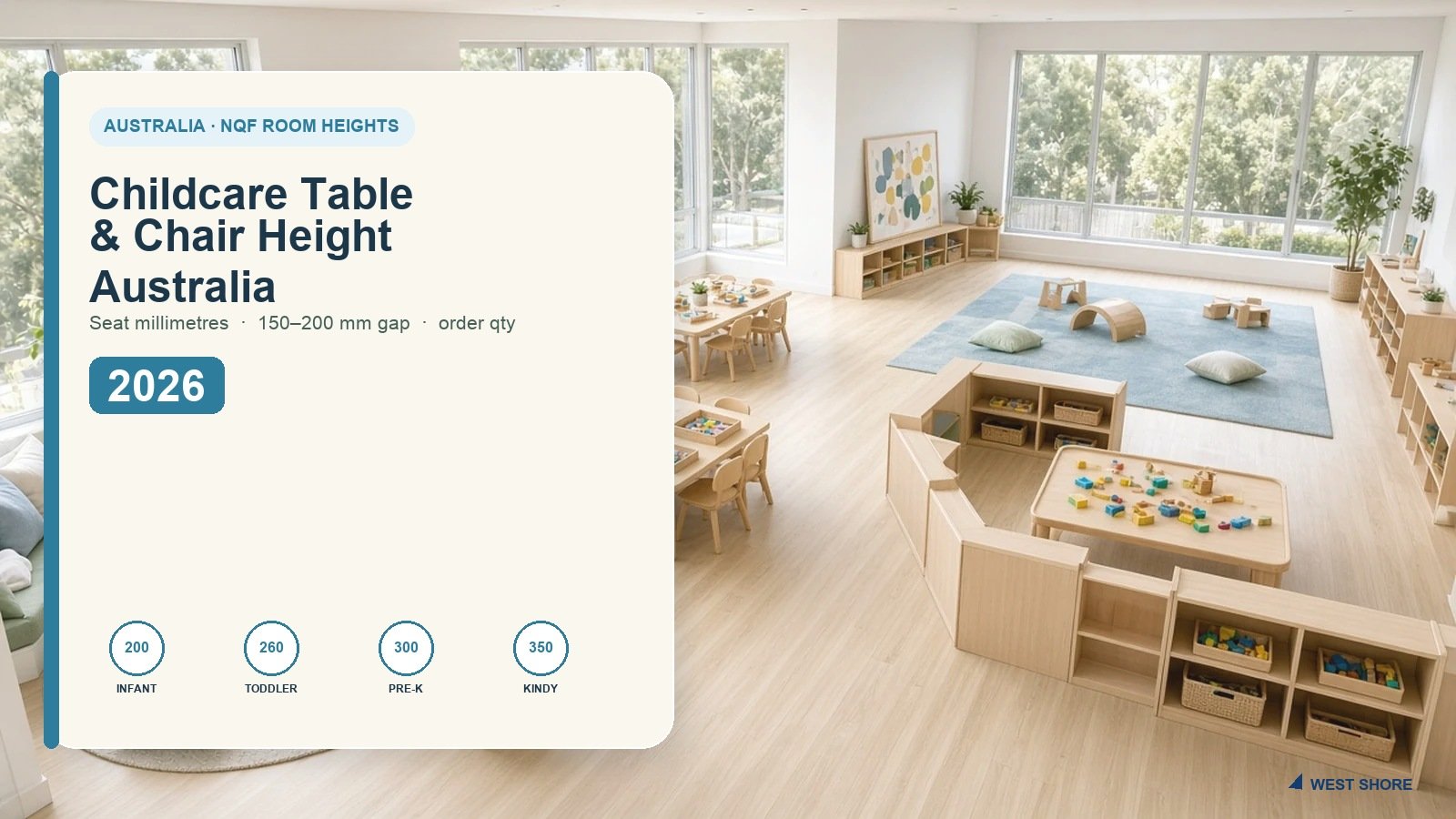
These are commercial planning bands used in Australian long day care, not a law. Australian catalogues commonly sell seats at 200, 260, 300 and 350 mm. West Shore factory seats for the same rooms are typically 200 / 260 / 300 / 340 mm. Spec the gap first (150–200 mm from seat top to tabletop), then pick the size that passes the fit test in that room.
| NQF room | Typical seat height | Typical table height | Seat-to-table gap | Factory size to write on the PO |
|---|---|---|---|---|
| Birth–24 months | 200–260 mm | 370–450 mm | 150–200 mm | 200 mm or 260 mm |
| 24–36 months | 260 mm (300 mm if the cohort is taller) | 400–480 mm | 150–200 mm | 260 mm |
| 36 months to preschool age | 300–350 mm | 460–540 mm | 150–200 mm | 300 mm + a few 350 / 340 mm |
| Over preschool age / OSHC | 350–380 mm | 540–620 mm | 150–200 mm | 350 mm or 380 mm |
If a retailer quotes 450 mm tables for 3–5 year olds and another quotes 560 mm, both can be right for a different chair. The gap is the control. A 300 mm seat under a 560 mm tabletop is a 260 mm gap—shoulders go up. A 350 mm seat under a 460 mm tabletop is a 110 mm gap—knees jam.
Do Not Copy a U.S. Inch Chart onto an Australian PO
Our own U.S. table and chair height guide is built for homes and Pre-K rooms that buy in inches. It puts many preschool seats around 250 mm with ~460 mm tables. That undersizes a typical Australian kindergarten room, where 300–350 mm seats are the commercial default, and it oversizes infant feeding seats that should start at 200 mm.
- Write millimetres on the Australian purchase order. Convert inches only as a check, then throw the inches away.
- One height for the whole centre is a false economy. Educators stack the wrong chairs in the laundry by week three.
- Colour-code chairs by height (for example navy 260, oak 300, white 350) so rooms cannot be mixed after a deep clean.
The 60-Second Fit Test (Do This Before You Freeze Sizes)
Age bands are a starting point. Children in the same NQF room still vary. Ask the nominated supervisor to sit three children—shortest, typical, tallest—on the sample chair at the sample table.
- Feet. The whole sole rests on the floor, or on a footrest that is part of the chair. Toes pointing at the ceiling means the seat is too high.
- Knees. Roughly a right angle, not jammed under the apron of the table, not swinging.
- Hips. The child sits back. If they perch on the front edge to reach the table, the table is too far or too high.
- Forearms. Rest on the tabletop without hiking the shoulders. That is the 150–200 mm gap in practice.
- Get on and off. The child can sit and stand without climbing the rail or rocking the chair. If they climb, the seat is too high for that room.
- Two more children. If two of the three fail, change the millimetre. Do not “make do” with a cushion; cushions walk.
This is an operator check for a purchase order, not a clinical posture assessment and not medical advice. Children with additional needs may need a different chair or an occupational therapist’s specification—order that as a line item, not as a centre-wide average.
Send three photos from the fit test
Photograph the shortest, typical and tallest child seated at the sample set, plus the room’s licensed places. West Shore will mark millimetres on a 2D/3D furniture concept.
Get Free Daycare DesignHow Many Chairs: Licensed Places Are Not the Same as Seats
National centre-based ratios are 1:4 birth to 24 months, 1:5 for 24–36 months (1:4 in Victoria), and 1:11 from 36 months to preschool age (1:10 in NSW, WA and some other settings). Ratios size the staffing roster. They do not mean “buy four chairs for every infant.”
| Room | Licensed places (example) | Child chairs to order | Why |
|---|---|---|---|
| Infant | 12 | 4–6 low feeding / activity seats | Floor play is the program. Twelve dining chairs eat 3.25 m² and sit empty. |
| Toddler | 15 | 15 + 2 stacked spares | Meals and table activities run at licensed capacity. |
| Preschool | 20 | 16 × 300 mm + 4 × 350 mm + 2 spares | One height at each table group. Taller children get their own four-seat table, not a mixed row. |
| Educator | — | 2 adult chairs per room | Adult chairs never share a child-height table. They sit at the documentation bench or against the wall. |
Activity tables are usually 4, 6 or 8 seats. Divide child chairs by seats per table, then round up. A 15-place toddler room on 6-seat tables needs three tables, not two crammed eights that block circulation. Confirm cubby depth and shelf runs on the furniture checklist before you add a fourth table “just in case.”
Worked Example: Four-Room Centre, 67 Licensed Places
This is the same 4-room mix used in the Australia furniture budget spoke. Heights and counts below are what should sit on the schedule beside those AUD figures.
| Room | Places | Seat SKUs | Tables | Child chairs | Adult chairs |
|---|---|---|---|---|---|
| Nursery / infant | 12 | 260 mm (or 200 mm if the cohort is younger) | 2 × low 400 mm, 4–6 seats total | 6 | 2 |
| Toddler | 15 | 260 mm | 3 × 460 mm, 6-seat | 15 + 2 spare | 2 |
| Preschool A | 20 | 16 × 300 mm + 4 × 350 mm | 3 × 520 mm (300 mm chairs) + 1 × 540 mm (350 mm chairs) | 20 + 2 spare | 2 |
| Preschool B | 20 | 16 × 300 mm + 4 × 350 mm | same split | 20 + 2 spare | 2 |
Centre total: 61 child chairs in daily use, 6 stacked spares, 8 adult chairs, 12 activity tables. If you had ordered one chair per licensed place in the nursery, you would have shipped 12 infant dining chairs and given away floor that the layout guide tells you to protect. The AUD for this mix lives on cost to furnish a classroom ($45,000–$85,000 indoor furniture for a typical 4-room program).
Room Notes That Change the Millimetre
Infant rooms
Low open shelves and a small feeding table beat a miniature classroom. High chairs and feeding seats are a different product from stackable classroom chairs—spec them only where meals happen, and keep the count to the children who eat at the same time, not the licensed total. Do not fill the remaining 3.25 m² with extra seats.
Toddler rooms
Lock one seat height at the activity tables. 260 mm is the Australian commercial default. If a few children fail the fit test because they are tall, give them a second table at 300 mm rather than raising the whole room and leaving the shorter children dangling.
Preschool / kindergarten rooms
300 mm is the workhorse. 350 mm (or West Shore 340 mm) is for taller or older children in the same NQF band. Keep those chairs at their own table so the gap stays in the 150–200 mm band. Stackable frames matter here: meal time and floor group time share the same 3.25 m². See Australian rooms in Sydney そして Everwood for how tables sit off the circulation spine.
Mixed-age or OSHC overlay
If kindergarten and after-school care share a room, do not average 300 mm and 380 mm. Stack one height and reset the tables, or run two table groups. Adjustable legs earn their cost only when the age band of the room will change within a year.

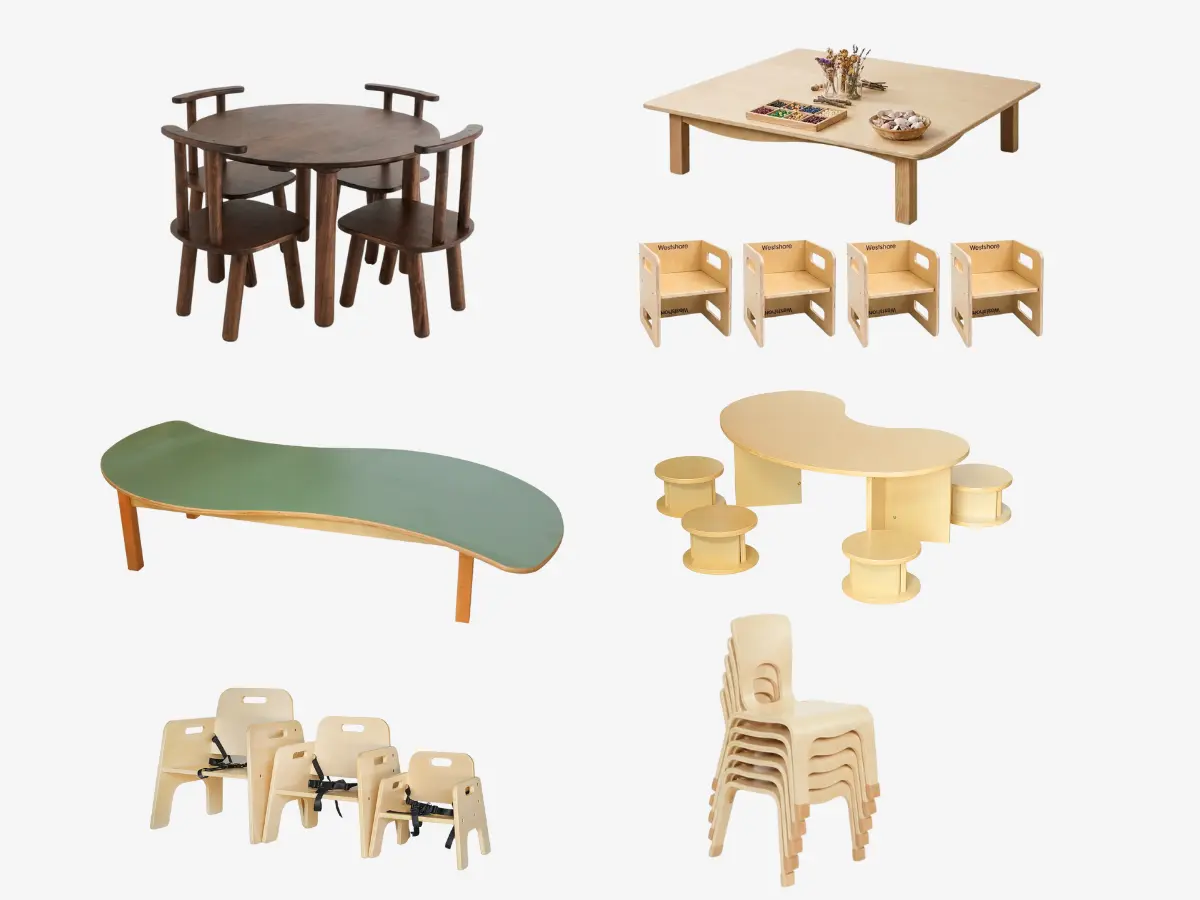
Stackable, Fixed or Adjustable?
| Type | Use it when | Skip it when |
|---|---|---|
| Fixed-height stackable | The room will stay one NQF age band; you need floor back after meals | You hoped one SKU would cover infant through kindy |
| Fixed non-stack | A permanent home-corner or documentation bench | The 3.25 m² is already tight |
| Adjustable-height table | The room will change age band, or furniture will move between toddler and preschool | The layout is not frozen and you are using hardware to delay a decision |
Browse factory options on 幼稚園のテーブルと椅子 and the Australia collection on preschool classroom furniture. Write millimetres in the enquiry, not “preschool size.”
How Height Hits 3.25 m², the Budget and the Import Clock
- Space. A chair that is too big is usually also too many. Draw the footprint on the layout before you add a fourth 8-seater.
- Money. Infant rooms cost more per child because sleep and hygiene furniture does not scale. Tables and chairs are the cheaper line—until you re-order the wrong height. Room AUD ranges stay on cost to furnish.
- Fit-out. Joinery heights (benches, sinks, nappy change) are a builder line. Child tables are FF&E. Keep them off the Sydney builder quote—see fit-out cost Sydney.
- Clock. Freeze millimetres when the layout freezes. Imported classroom packages need about 10–14 weeks (production, ocean transit, a licensed customs broker, GST, inland delivery). Opening in under 10–12 weeks is a local buy, not a factory program.
On a full classroom or multi-room program, operators commonly land 30–50% under comparable local retail once freight, GST/duties and delivery are in the comparison. Use the landed-cost guide and a licensed customs broker—do not self-clear a container of chairs. A six-chair top-up lets freight dominate; that is when you should not import.
Mistakes That Show Up on Assessment Day
- One height for 0–5. Educators then stand toddlers at preschool tables or seat preschoolers on infant chairs for meals.
- Mixing 260 mm and 350 mm at one table. The gap cannot be right for both.
- Adult chairs pulled up to child tables. Educators hunch; children lose places.
- Twelve dining chairs in a 12-place nursery. The floor disappears; the chairs sit in the hallway by week two.
- Cushions as a height fix. They walk, they fail the fit test, they do not survive laundry.
- Ordering from an inch chart after the layout is frozen. The chairs arrive 40 mm too low and there is no 10–14 week window left.
- Ignoring the table apron. A thick under-frame eats the 150–200 mm gap even when the tabletop millimetre looks right.
Send the floor plan, NQF room ages, licensed places and opening date. West Shore returns a 2D/3D concept with seat heights, table heights and quantities that respect 3.25 m².
Related Australia guides
- Childcare startup cost Australia
- How to start a childcare centre in Australia
- Cost to furnish a childcare classroom in Australia
- Childcare furniture checklist Australia
- Childcare centre room layout Australia
- Childcare centre fit-out cost Sydney
- CCS approved childcare service Australia
- Childcare table and chair height Australia
- Childcare furniture Australia
- Preschool playground costs
よくある質問
What table and chair height should an Australian childcare centre order?
Does ACECQA set a legal millimetre for tables and chairs?
How many chairs do I buy per licensed place?
Can I use one chair height for the whole centre?
What is the gap between the chair seat and the tabletop?
Why doesn’t a U.S. inch chart match Australian rooms?
Should I buy adjustable tables for a long day care?
When should I order imported table and chair sizes?
Planning guidance for operators and procurement teams. Confirm current National Regulations, your jurisdiction’s ratio table, and the children who will actually sit in the room. This page is not legal, building, or medical advice.